 aboard-io/tinylittleoffice: A free office suite where your document is inside the link and easy to share. There's no account and nothing saved unless you choose.
https://github.com/aboard-io/tinylittleoffice
A free office suite where your document is inside the link and easy to share. There's no account and nothing saved unless you choose.
 Michael Tsai - Blog - Reddit to Remove RSS
https://mjtsai.com/blog/2026/10/06/reddit-to-remove-rss/
Well, this sucks ass.
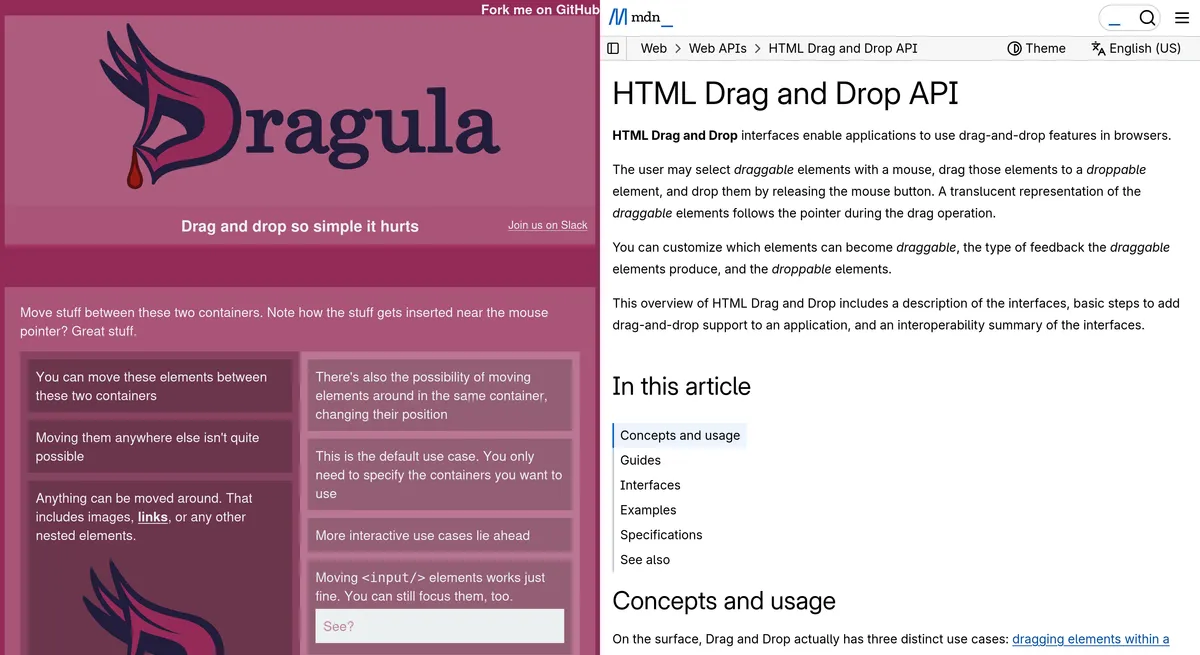
 Why don’t more developers “use the platform”? | Read the Tea Leaves
https://nolanlawson.com/2026/10/03/why-dont-more-developers-use-the-platform/
The argument is simple: why build something yourself, in JavaScript, when the browser can do it for you? Whatever you build, it’s likely to have poorer performance and worse usability than something the browser could just give you out-of-the-box.
 Clicks have killed the Inverted Pyramid
https://gordonmeyer.com/blog/clicks-have-killed-the-inverted-pyramid.html
Writing students once learned that putting the most important information first in an article was the preferred, humane way of reporting on a situation. This allowed readers to quickly decide if a story interested them without having to read further.
 Tiny Emulators
https://floooh.github.io/tiny8bit-preview/index.html

 Memories Can’t Wait—or, How I Learned to Keep Worrying About the Web - Jeffrey Zeldman Presents
https://zeldman.com/2026/07/06/memories-cant-wait-or-how-i-learned-to-keep-worrying-about-the-web/
The web is still the best hope we have for a durable, shared memory. But it requires us to be gardeners, not just tenants. To plant things in soil we control, and to tend them. Because if we don’t, the only record that we were here will be someone else’s ad inventory, and when the ads move on, we’ll move with them—into the quiet, unmarked graveyard of the deleted.
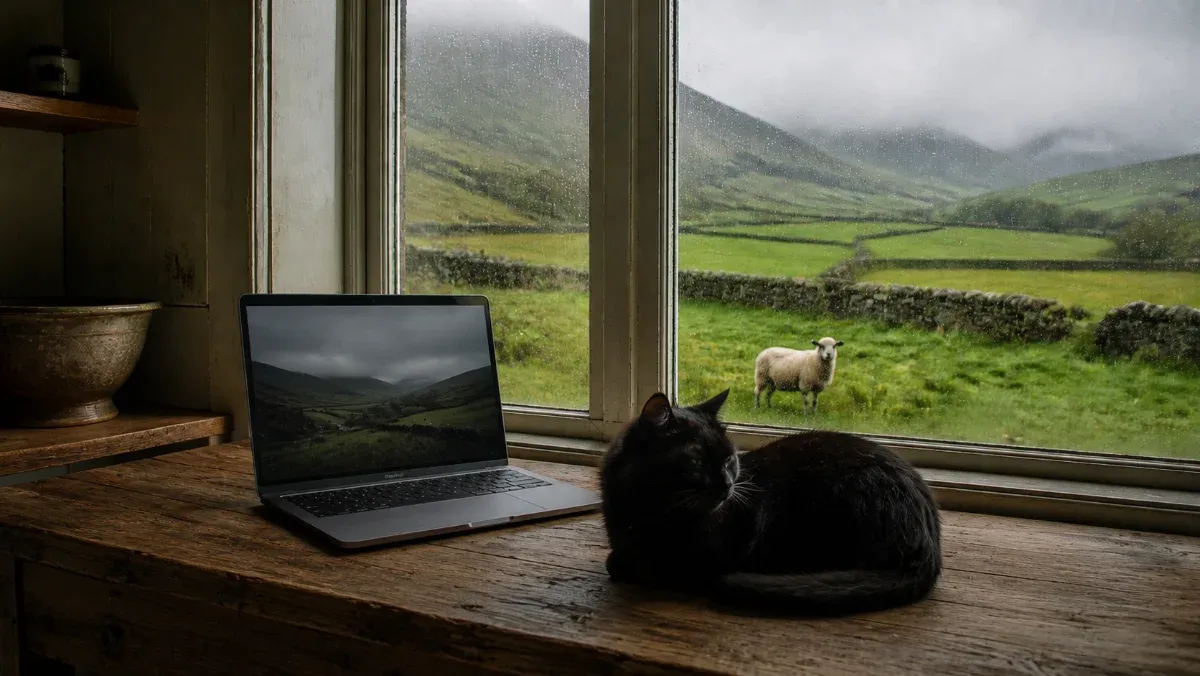
 The Internet Doesn't Want Readers. It Wants Livestock. – The Grumpy Welshman
https://grumpywelshman.com/the-internet-doesnt-want-readers-it-wants-livestock/
"...mind you, no one's ever paid me for my manners either."
 Be a Gardener, not a Tenant - Lireo Designs
https://www.lireo.com/be-a-gardener-not-a-tenant/
Cloud services are not forever.
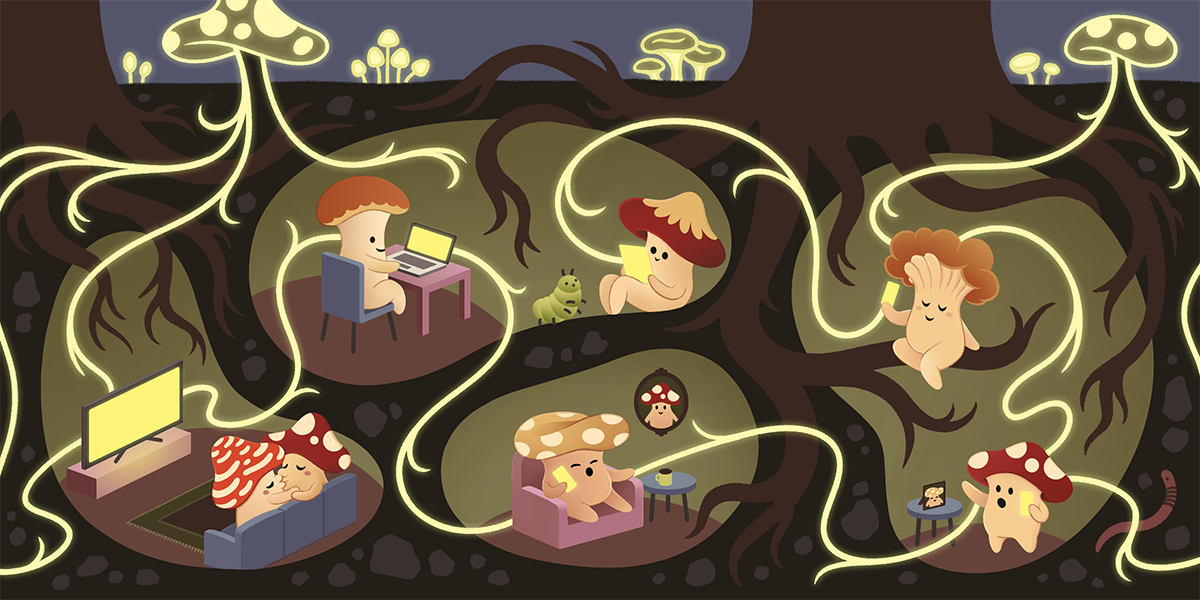
 Hate “The Algorithm?” RSS Is One of the Tools You’ve Been Looking For | Electronic Frontier Foundation
https://www.eff.org/deeplinks/2026/06/hate-algorithm-rss-one-tools-youve-been-looking
RSS is one of the best examples we have of the open web, where we can design and customize how we experience the internet, not the other way around. RSS has come in and out of fashion, been declared dead, and has come back, every time. Open systems are the best way forward to a free, equitable internet, and the resilience and continued reinvention of RSS has shown just how creative the web community can be with open protocols.
readtedium/WIT: A recreation and modest modernization of WIT (W3 Interactive Talk), the original web forum, dating to June of 1994.
https://github.com/readtedium/WIT
A recreation and modest modernization of WIT (W3 Interactive Talk), the original web forum, dating to June of 1994.
 Firefox's AI kill switch exists. Only 1% of users have flipped it.
https://thenextweb.com/news/mozilla-firefox-ai-kill-switch-1-percent-smart-window-vpn
Mozilla built an AI kill switch into Firefox after its users demanded one. Only 1% have used it. Another 3% turned off some AI features selectively. The rest left everything on. CEO Anthony Enzor-DeMeo says the point is not the percentage but the choice.
 The Web We Know Is Going to Disappear - Minid.net
https://www.minid.net/2026/6/15/the-web-is-going-to-dissapear?ref=sidebar
Every generation of computing believes the interface it loves will last forever. It never does. I saw information move from floppy disks to BBSs, from BBSs to the Web, from the Web to Flash, from Flash back to open standards, from websites to mobile apps, and now from search engines to AI chat interfaces. The Web will not vanish overnight, but the Web as we know it, the open place where people search, click, read, browse, publish, and discover, is already being replaced by something more convenient, more centralized, and much harder to escape.

 LES ORCHARD IS IN THE WEIGHTS
https://intheweights.com/p/les-orchard
LES ORCHARD IS IN THE WEIGHTS — Mozilla software developer
 Hershey Noailles
https://hershey-noailles.luuse.io/www/
The Hershey fonts are a collection of vector fonts developed c. 1967 by Dr. Allen Vincent Hershey at the Naval Weapons Laboratory, and originally designed to be rendered using vectors on early cathode ray tube displays. Decomposing curves to connected straight lines allowed Hershey to produce complex typographic designs.
In their original form the font data consists simply in a series of coordinates, meant to be connected by straight lines on the screen. We forked hersheytextjs and made it a program that defines strokes in css, then exports it as a font.
 Ask HN: Is the web for machines (/llm.txt) the one we wished we had as humans? | Hacker News
https://news.ycombinator.com/item?id=48410589
We broke the web so badly for humans that we had to build a clean web for machines, and now humans will have to use machines to experience a clean web again.
 The Boring Internet (text) | Terry Godier
https://www.terrygodier.com/the-boring-internet/ascii
Some things need to become enormous to survive. Other things survive because they never needed to become enormous.
brexhq/CrabTrap: An LLM-as-a-judge HTTP proxy to secure agents in production
https://github.com/brexhq/CrabTrap
An LLM-as-a-judge HTTP proxy to secure agents in production

 Endgame for the Open Web - Anil Dash
https://www.anildash.com/2026/03/27/endgame-open-web/
But ultimately what matters is power. It is precisely because technologies like LLMs have powers that the authoritarians have rushed to try to take them over and wield them as effectively as they can. I don't think that platforms owned and operated by those bad actors can be the tools that disrupt their agenda. I do think it might be possible that the creative communities that built the web in the first place could use their same innovative spirit to build what could be, for lack of a better term, called "good AI". I think, if given the choice, people will pick home-cooked, locally-grown, heart-felt digital meals over factory-farmed fast food technology every time.
 Tooscut - Video Editor
https://tooscut.app/
A powerful NLE editor with GPU compositing, keyframe animation, and real-time preview. No installs required.
 Digg - People. Places. Things.
https://digg.com/
Building on the internet in 2026 is different. We learned that the hard way. Today we're sharing difficult news: we've made the decision to significantly downsize the Digg team. This wasn't a decision made lightly, and it's important to say clearly: this is one of the strongest groups of people we've ever had the privilege of working with. This is not a reflection of their talent, their effort, or their belief in what we were building. It's a reflection of the brutal reality of finding product-market fit in an environment that has fundamentally changed.

theredsix/agent-browser-protocol: Browsers are async. Agents are synchronous. ABP turns continuous browsing into discrete, atomic steps—so LLMs can reason about the web without racing against it.
https://github.com/theredsix/agent-browser-protocol
ABP is a Chromium build with MCP + REST baked directly into the browser engine.
 Pluralistic: The web is bearable with RSS (07 Mar 2026) – Pluralistic: Daily links from Cory Doctorow
https://pluralistic.net/2026/03/07/reader-mode/
It's almost impossible to overstate how superior RSS is to the median web page. Imagine if the newsletters you followed were rendered with black, clear type on a plain white background (rather than the sadistically infinitesimal, greyed-out type that designers favor thanks to the unkillable urban legend that black type on a white screen causes eye-strain). Imagine reading the web without popups, without ads, without nag screens. Imagine reading the web without interruptors or "keep reading" links.
 A fun trick for getting discovered by LLMs and AI tools
https://cassidoo.co/post/ai-llm-discoverability/
I have been getting a lot of newsletter responses, DMs, and emails in general saying that people have discovered my work not via traditional SEO, but via LLMs and AI tools like ChatGPT, Claude, Perplexity, and even GitHub Copilot.

 How to Make a Damn Website
https://lmnt.me/blog/how-to-make-a-damn-website.html
A lot of people want to make a website but don’t know where to start or they get stuck. That’s in part because our perception of what websites should be has changed so dramatically over the last 20 years.
 Resources for the Personal Web: A Follow-Up Guide · brennan.day
https://brennan.day/resources-for-the-personal-web-a-follow-up-guide/
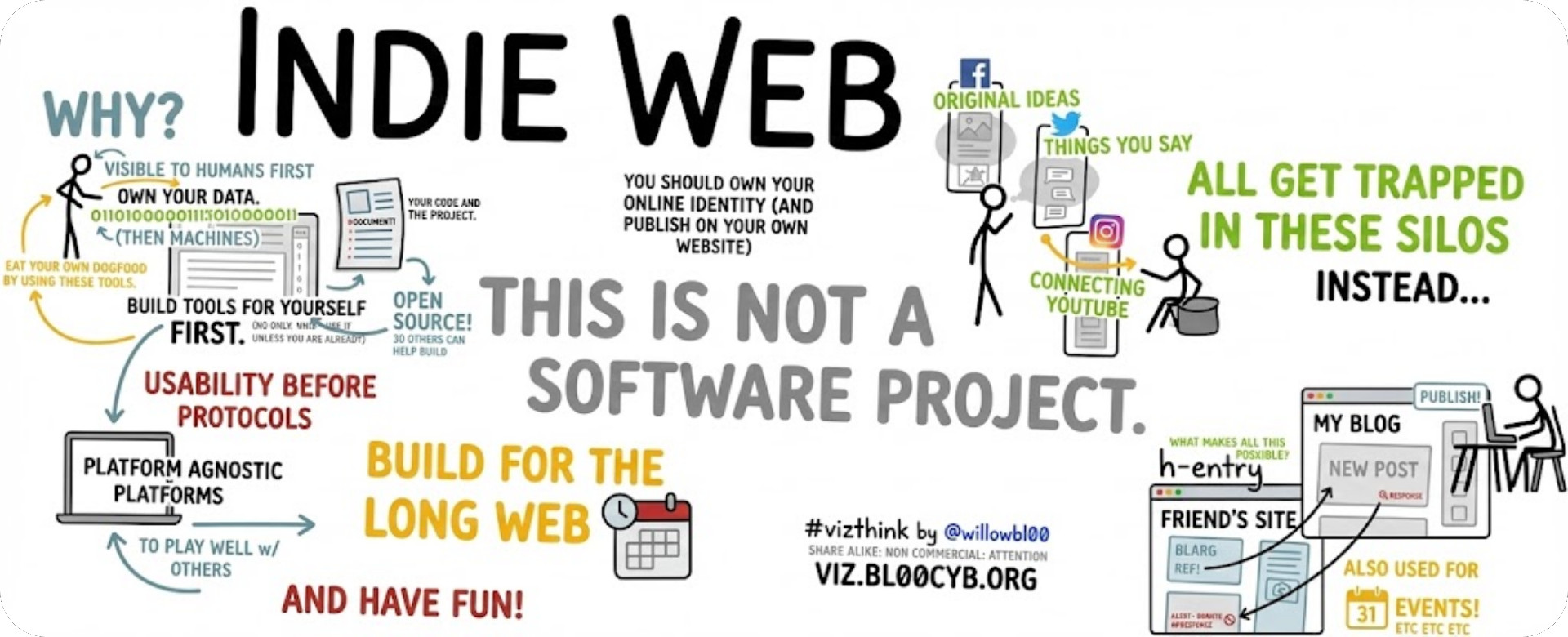
We must find moments of joy in the horror of our present. Joy is not a prize for getting through it all—joy is a tool that enables us to get through the horror. Our joy is an act of resistance.
The independent web is already here, quietly thriving while Big Tech implodes under its own extractive weight. All you have to do is join it.
 ChatGPT as a Digital Wellbeing Tool
https://riggraz.dev/chatgpt-digital-wellbeing.html
In general, ChatGPT with web search can mitigate the problem of the modern web: annoying cookie consents, pages overoptimized for SEO where relevant information is only a fraction of the overall content, pop-ups, advertisements, unnecessarily slow to load websites, and so on. Finally, we can focus on the content instead of employing 99% of our brain resources wrestling against all that mess.
So, I advocate that ChatGPT with web search (or any LLM equipped with web search functionality) can be a new way to interact with the web, a sort of new UI for the web. And it’s a UI that respects users’ sense of agency and time more than most websites do. In this sense, ChatGPT can be seen as a digital wellbeing tool.

 EchoFeed - Cross post your RSS feed to Mastodon, Bluesky, Micro.blog, Discord, and more!
https://echofeed.app/
It supports reading RSS & Atom & JSON feeds and then posting those items to Mastodon & Micro.blog & Bluesky & GitHub & Discord & LinkAce & LinkDing. Or it can send them as Webmentions & Webhooks.
 Keynote: The Death of the Browser - Rachel-Lee Nabors, AgentQL - YouTube
https://www.youtube.com/watch?v=pznpsgZqlGQ
In ten years, Internet Browsers may be a nostalgic memory. As enterprises face mounting API costs and integration headaches, a new paradigm is emerging. The internet's evolution from an open highway into a maze of walled gardens and monetized APIs has created significant challenges for businesses—but it has also set the stage for accessing and organizing the world’s information.
This lightning talk traces our journey from the invention of the browser to the arms race of scraping for data and access to it to the dawn of AI agents, showing how the challenges of today opened the door to tomorrow. See how technologies refined by the web scraping community are combining with large language models to create practical alternatives to costly API integrations.
From the rise of platform monopolies to the emergence of AI agents, this timeline-based exploration will help you understand where we've been, where we are, and where we're heading. Join us for a glimpse of how AI agents are enabling a return to the era of free information with ""the web as the API.
 Origin private file system - Web APIs | MDN
https://developer.mozilla.org/en-US/docs/Web/API/File_System_API/Origin_private_file_system
The origin private file system (OPFS) is a storage endpoint provided as part of the File System API, which is private to the origin of the page and not visible to the user like the regular file system. It provides access to a special kind of file that is highly optimized for performance and offers in-place write access to its content.
 delphitools - Handmade Developer Tools
https://tools.rmv.fyi/
A collection of small, low stakes and low effort tools.
No logins, no registration, no data collection. I can't believe I have to say that. Long live the handmade web.
If you find these tools useful, I'm glad. You don't owe me anything. But if you're an artist, feel free to email me your work. I'd love to see it.
antonmedv/textarea: A minimalist text editor that lives in URL
https://github.com/antonmedv/textarea?tab=readme-ov-file
A minimalist text editor that lives in URL

 I sell onions on the Internet - Deep South Ventures
https://www.deepsouthventures.com/i-sell-onions-on-the-internet/
I’m Peter Askew, and I sell onions on the internet.
 Scripting News: The web as your plan B
http://scripting.com/2025/12/22/220039.html?title=theWebAsYourPlanB
My advice -- think this through, now. And if you can't see a way that you share in the success of the company behind Bluesky, which we know very little about, then I urge you to at least have the web as a backup. Use a standard format to broadcast your writer's work to places outside the AT Proto-verse, so we can pick up your signal, and you'll still be on the air if they yank your chain. This alone might get the Bluesky folk to listen to you more carefully. My experience, no matter how much you want, you can't wish away the economics of this stuff.

 The handleEvent() method is the absolute best way to handle events in Web Components | Go Make Things
https://gomakethings.com/the-handleevent-method-is-the-absolute-best-way-to-handle-events-in-web-components/
A bunch of people shared their own approaches, but the one that absolutely blew my mind was the handleEvent() method, a platform-native method for managing all of the events on your Web Component.

My HTML Web Component boilerplate for 2026 | Go Make Things
https://gomakethings.com/my-html-web-component-boilerplate-for-2026/
I created web component boilerplate years ago. Since then, my approach to writing web component has changed quite a bit.
I just updated the boilerplate, adding everything I’ve learned from working on Kelp UI. Today, I wanted to explain how it works.
 Please Just Fucking Try HTMX
https://pleasejusttryhtmx.com/
Look. I'm not going to call you a fucking moron every other sentence. That's been done. It's a whole genre now. And honestly? HTMX doesn't need me to scream at you to make its point.

 The Web Platform is a Triumph of Object-Oriented Programming | That HTML Blog
https://thathtml.blog/2025/12/the-dom-is-a-triumph-of-object-oriented-programming/
It’s not just that web APIs often take advantage of OOP. They would not exist without OOP! Virtually every web API you have ever used is designed specifically within the OOP paradigm. And every entity in the lifecycle of a web page is based on objects. These objects are instances of classes and in a great many cases these classes are subclasses of other classes. This means that key functionality is spread across a class hierarchy. That isn’t a bug, it’s a feature! And this means that it’s absurd to think that to write a web app you need to reach for a “framework”. The Web Platform is a framework.

 Why RSS matters
https://werd.io/why-rss-matters/
RSS has always worked quietly in the background. In a moment when the web is being reshaped by enclosure, consolidation, and algorithmic mediation, its reliability is exactly what we need. It offers a simple, durable way for publishers to keep control of their distribution and for readers to keep control of their attention, without permission, platform lock-in, or hidden agendas. If we treat RSS not as a relic of an earlier web but as the strategic infrastructure it already is, it can continue to anchor a more open, more resilient, and more humane internet for decades to come.
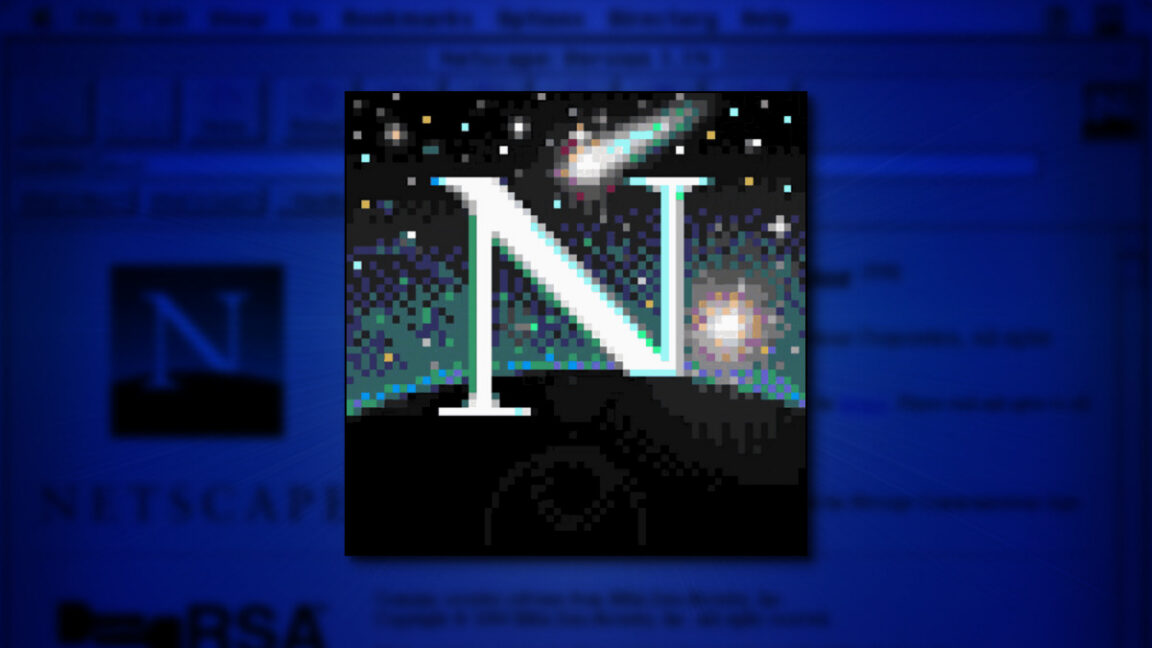
 In 1995, a Netscape employee wrote a hack in 10 days that now runs the Internet - Ars Technica
https://arstechnica.com/gadgets/2025/12/in-1995-a-netscape-employee-wrote-a-hack-in-10-days-that-now-runs-the-internet/
The 10-day creation story has become programming folklore, but even with that kernel of truth we mentioned, it tends to oversimplify the timeline. Eich’s sprint produced a working demo, not a finished language, and over the next year, Netscape continued tweaking the design. The rushed development left JavaScript with quirks and inconsistencies that developers still complain about today. So many changes were coming down the pipeline, in fact, that it began to annoy one of the industry’s most prominent figures at the time.

 Being of the Web – CogDogBlog
https://cogdogblog.com/2011/08/being-of-the-web/
If you are “of” the web, you are doing things that make content available, leaving it there, making it findable. Twitter takes place “on” the web (and elsewhere) but the older rings of growth die off as the search is only able to return just the newest few weeks of stuff. Twitter thus creates debris rings of dead web content.

Of the web
https://werd.io/of-the-web/
most web apps are on the web, but not of it. This seems right to me, and I suspect web instigators like Tim Berners-Lee would agree.
The odd thing is that, for a while, desktop software did exactly this. Word would save a document in a particular format, and another application written by someone else entirely could open that document. When we moved to the cloud, we signed up for a computing environment that was as much about siloing and isolation as much as it was about ease of access and maintenance.

 Nothing Feels Authentic Anymore Because Everything is an Ad
https://hannahglenn.substack.com/p/nothing-feels-authentic-anymore-because
I have an ever increasing feeling that something is off. I find myself feeling skeptical, cynical. Weary of whatever I encounter. Feeling like nothing is authentic or genuine.
Because someone is always trying to sell me something. Around every corner an ad lurks. Waiting to capitalize off my attention. Capitalize off any genuine moment in real life or online. I think I have ad fatigue
Servo 0.0.2 hints at a real Rust alternative to Chromium • The Register
https://www.theregister.com/2025/11/18/servo_002_arrives/
In summary, there are a handful of non-Chromium based alternative browsers out there, but not many and they do have some limitations. In the world of web components to embed into apps, there's really no choice except Chromium. That is why Servo matters. It's FOSS, it's independent, and it's more or less the original Rust project.
Rewiring Mozilla: Doing for AI what we did for the web
https://blog.mozilla.org/en/mozilla/rewiring-mozilla-ai-and-web/
Mozilla has always been focused on making the internet a better place. Which is why pushing AI in a different direction than it’s currently headed is the core focus of our strategy right now. As AI becomes a fundamental component of everything digital — everything people build on the internet — it’s imperative that we step in to shape where it goes.
Scripting News: Wednesday, November 19, 2025
http://scripting.com/2025/11/19.html#a140139
If Bluesky and Mastodon were "on the web" they would already interop because friends that's what the freaking web does. They behave like closed off silos, and until that changes, they can't claim to be on the web. Don't sell out the web so cheap. It really means something to be on the web.#
I know you don’t want them to want AI, but… - Anil Dash
https://www.anildash.com/2025/11/14/wanting-not-to-want-ai/
Another reality that people were a little more quiet in acknowledging, and sometimes reluctant to engage with out loud, is the reality that hundreds of millions of people are using the major AI tools every day. When I would point this out, there was often an initial defensive reaction talking about how people are forced to use these tools at work, or how AI is being shoehorned into every tool and foisted upon users. This is all true! And also? Hundreds of millions of users are choosing to go to these websites, of their own volition, and engage with these tools.
The death of Glitch, the birth of Slack
https://www.johnnyrodgers.is/the-death-of-glitch-the-birth-of-slack/
Glitch was an unusual, clever, heartfelt game. Within the realm of Ur, dreamt by eleven magical Giants, players created playful new identities for themselves. They designed and clothed their avatars to their heart’s content, delighting in new hats and a rainbow of possible skin tones. They crafted working music boxes and decorated their architecturally-unlikely homes.
PESOS - IndieWeb
https://indieweb.org/PESOS
PESOS is an acronym for Publish Elsewhere, Syndicate (to your) Own Site. It's a syndication model where publishing starts by posting to a 3rd party service, then using infrastructure (e.g. feeds, Micropub, webhooks) to create an archive copy on your site.
Editorial Independence Means Technological Independence - Columbia Journalism Review
https://www.cjr.org/tow_center/editorial-independence-means-technological-independence.php
From Google to Microsoft, European newsrooms often rely on tools built in Silicon Valley. Some are trying to break free, turning to open-source alternatives or home-grown solutions.
2002: Last.fm and Audioscrobbler Herald the Social Web | Cybercultural
https://cybercultural.com/p/lastfm-audioscrobbler-2002/
Following in Amazon's footsteps, two student projects independently use 'collaborative filtering' to bring recommendations and social networking to online music; soon they will join forces.
DOCTYPE magazine 🚀⌨️
https://vole.wtf/doctype/
’80s BASIC type-in mags are back, but this time for HTML!
10 wonderful web apps, including games, toys, puzzles and utilities
No coding knowledge needed, you just type
generative engine optimization | mgx
https://mgx.bearblog.dev/generative-engine-optimization/
What really bothers me about GEO is that it doubles down on the industrial content machine that already wrecked the internet. SEO filled the web with keyword-stuffed, regurgitated sludge. GEO will do it with auto-generated LLM sludge. We're now training future models on data that was artificially inflated to sound optimized for machines. So the next generation of models will be trained on synthetic content designed for older models -- and quality will just keep sinking in a recursive spiral. Truth is, most people claiming to optimize for "the future of AI search" are just optimizing for the next invoice.
Rediscovering the Joy of Silly Activities Online
https://nathanwrigley.com/2025/10/29/we-need-more-silliness-on-the-web/
I think that we forgot, or perhaps grew up never knowing, that you can do silly things online too. Magnificent, pointless, silly things. Just because you want to, just because you can. You need no permission. Your silliness will brighten up your day, and perhaps the brightness will spread to other people as well; people who enjoy the same silly things that you do.
 WebFinger
https://webfinger.net/
WebFinger is used to discover information about people or other entities on the Internet that are identified by a URI using standard Hypertext Transfer Protocol (HTTP) methods over a secure transport. A WebFinger resource returns a JavaScript Object Notation (JSON) object describing the entity that is queried. The JSON object is referred to as the JSON Resource Descriptor (JRD).
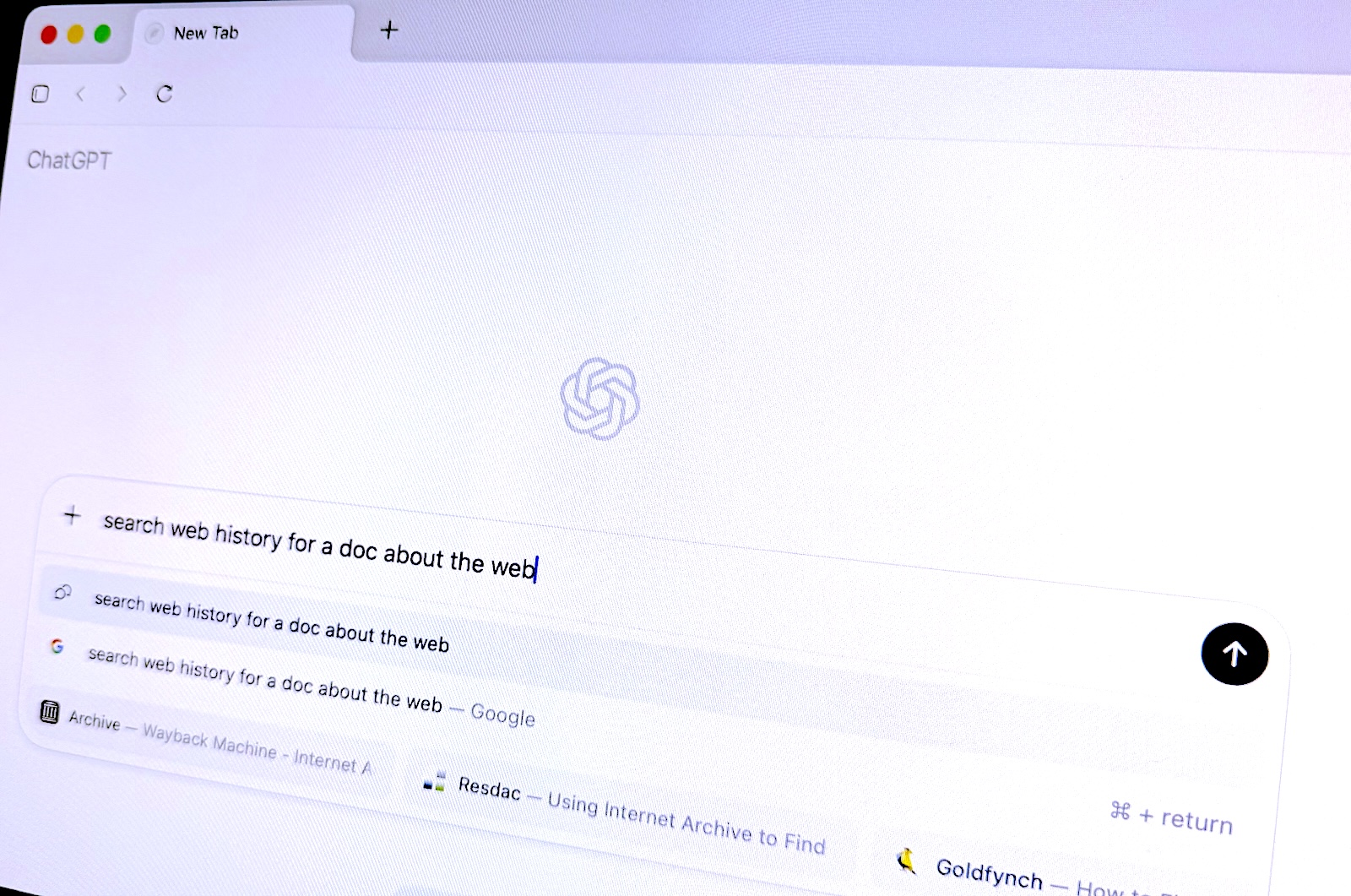
ChatGPT's Atlas: The Browser That's Anti-Web - Anil Dash
https://www.anildash.com/2025/10/22/atlas-anti-web-browser/
OpenAI, the company behind ChatGPT, released their own browser called Atlas, and it actually is something new: the first browser that actively fights against the web. Let's talk about what that means, and what dangers there are from an anti-web browser made by an AI company — one that probably needs a warning label when you install it.
 Democracy and the open internet die in daylight – Hi, I'm Heather Burns
https://heatherburns.tech/2025/10/22/democracy-and-the-open-internet-die-in-daylight/
Leaving aside the idea of access to any form of content being conditional on the use of a proprietary browser, which is a particularly horrid 1990s throwback, I’m going to call this day 0 of an experiment in shifting the funding model of journalism from adtech to agentic AI.
cdzombak/feedfilter: RSS feed filtering tool
https://github.com/cdzombak/feedfilter/tree/main
RSS feed filtering tool
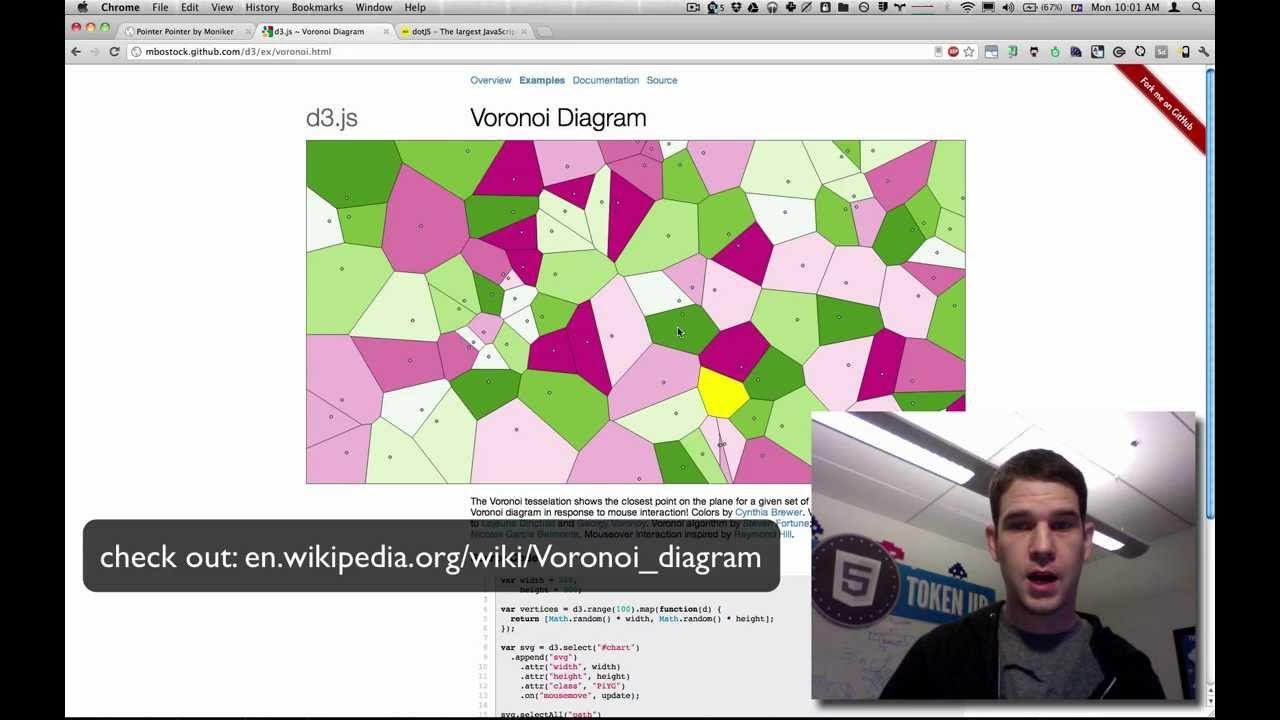
pointerpointer.com's use of voronoi, canvas, and javascript - YouTube
https://www.youtube.com/watch?v=Z2ZXW2HBLPM
I explain a little bit behind how pointerpointer.com was built.
Can't believe I'd never seen this before, back in the day!


 Personal data storage is an idea whose time has come
https://blog.muni.town/personal-data-storage-idea/
Personal Data Storage has long since escaped containment as a concept pertaining to any specific protocol. Some implementations of it will be more mainstream than others, but pragmatic data coops can be protocol-agnostic and storage formats are transmutable.
As long as we have sufficient control of our own data there will always be a way to restart our social graph and digital presence elsewhere in the event of platform collapse. Let’s make the web personal again.
jmsdnns/webbol: A minimal static web server written in COBOL
https://github.com/jmsdnns/webbol
A minimal static web server written in COBOL
 Web Technology News
https://webtechnology.news/
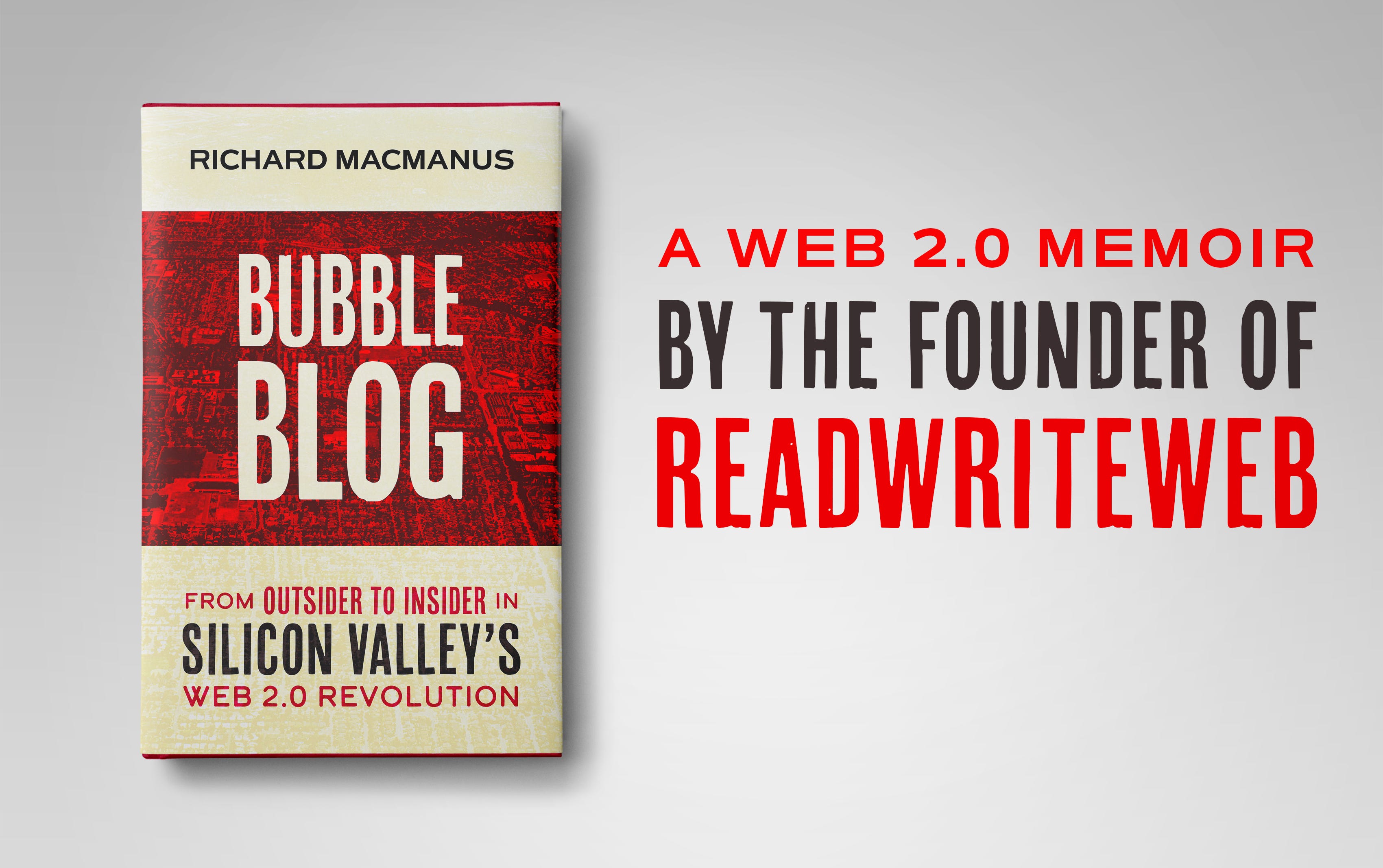
What's next on the Web. A weekly newsletter by tech journalist and ReadWriteWeb founder Richard MacManus.
 Cybercultural: Internet History and Its Impact on Our Culture
https://cybercultural.com/
Cybercultural chronicles internet history and its cultural impact, from the pre-web era to the dot-com boom, Web 2.0, and beyond. Written by pioneering tech blogger Richard MacManus.

 Inside the Behind the Scenes Battle for the Future of the Web - Business Insider
https://www.businessinsider.com/google-microsoft-openai-fight-standards-limit-ai-access-websites-2025-9
In today's new AI era, products such as Google's AI Overviews and AI Mode, OpenAI's ChatGPT, and Perplexity deliver answers directly, often eliminating the need to visit the original source. These systems still rely on content scraped for free, but by cutting off traffic, they threaten the revenue that funds the creation of quality information online.
 Tiny Awards
https://tinyawards.net/
This is the home of the Tiny Awards, which, since 2023, has celebrated the best of the small, poetic, creative, handmade web.
The Tiny Awards exist because we thought it was important to shine a spotlight on the sorts of personal web projects that tend to get overlooked by more traditional, larger or more commercial awards.

 Rebooting The Blogosphere (Part 2: Interaction) – Climb to the Stars
https://climbtothestars.org/archives/2025/09/11/rebooting-the-blogosphere-part-2-interaction/
So, let’s sum up today: interaction is not a monolith. Online conversations occur at varying speeds and are made up of contributions of varying nature. Reclaiming and rebooting the blogosphere and the open web needs to take that into account and embrace it, and figure out how to bring it together in an open way, with frameworks, standards, protocols or the like, not yet another “One Platform to Replace Them All”.
Rebooting The Blogosphere (Part 1: Activities) – Climb to the Stars
https://climbtothestars.org/archives/2025/09/10/rebooting-the-blogosphere-part-1-activities/
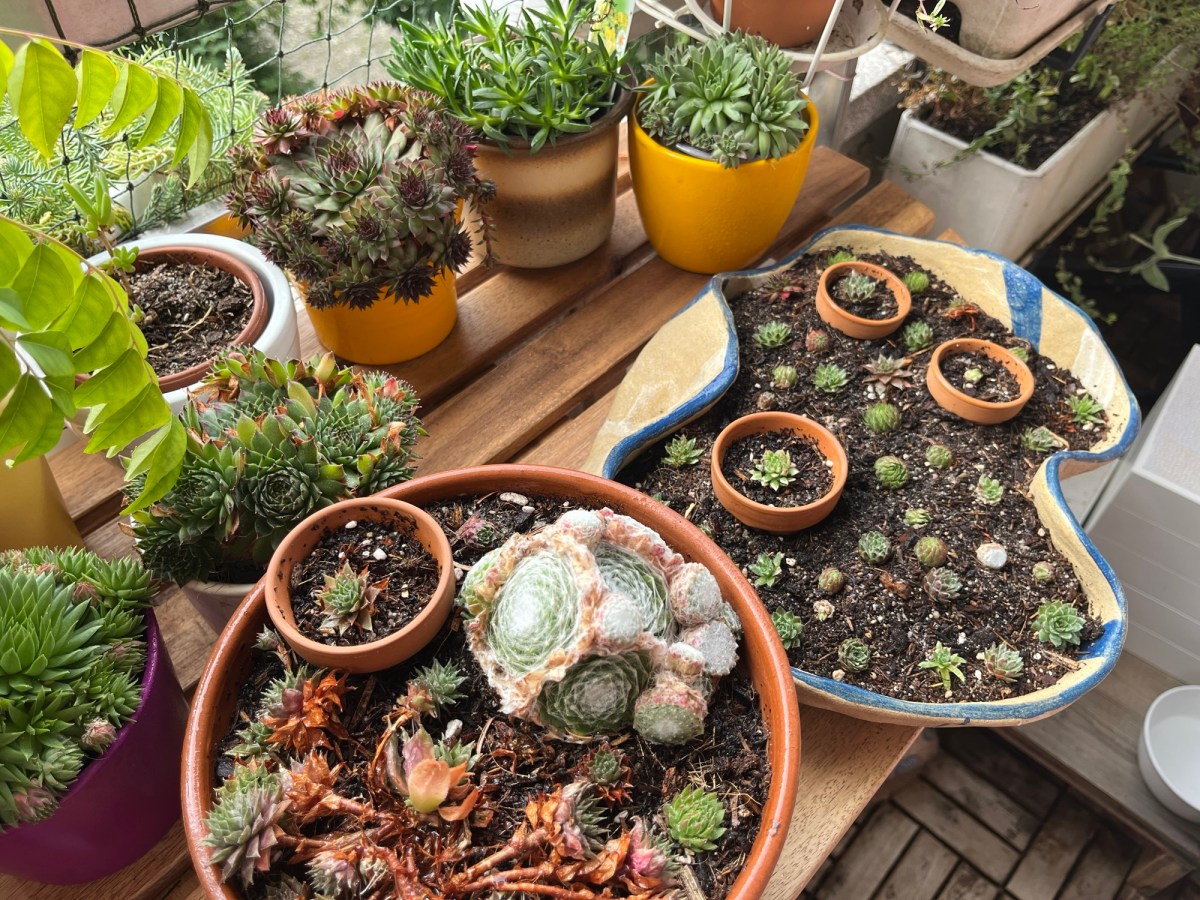
Some thoughts (part 1 of 3) following exchanges on Bluesky with Dave, amongst others. My Facebook exile is clearly bringing to a boil my preoccupation with our reliance on big capitalist platforms for our online presence and social life. Though I never “stopped blogging”, I clearly poured a lot more energy over the last decade into what I now think of as “The Socials” (Twitter, Facebook, Bluesky, Mastodon and the like).

Who Will See My Comment? – Climb to the Stars
https://climbtothestars.org/archives/2025/09/15/who-will-see-my-comment/
Bluesky, Mastodon and Twitter (yeah, and Threads) feel more fragmented. It’s more difficult to follow for lots of people. They are faced with bits and pieces of conversations flying about, and access to the context of those is not frictionless. Part of this, I think, has to do with how publication audience is managed (I’ll definitely have to do a “part 4” about this in my Rebooting the Blogosphere series). And another, of course, is the primacy of non-reciprocal connections on those platforms.

Where Have All The Bloggers Gone? – Climb to the Stars
https://climbtothestars.org/archives/2025/09/15/where-have-all-the-bloggers-gone/
What is happening for me right now is interesting. During my Facebook exile, I reconnected with the social networks that I had been present on in a very passive manner these last years. I also wrote more on my blog (here!), and made an effort to get back into reading other blogs, even though I have never been a really huge blog reader in my past. I installed an RSS reader, and started subscribing, process which is now pretty frictionless. To my surprise, there are lots of blogs! Lots of people still blogging! Lots of people who took up blogging way after the Golden Era of Blogs! I see them show up here and there on Mastodon and Bluesky, and of course, in blog posts.
 cgit - A hyperfast web frontend for git repositories written in C.
https://git.zx2c4.com/cgit/about/
 Cloudflare's Matthew Prince has a plan to get Google and the AI oliigarchs to pay for your content even though many are used to getting it for free. He might have enough leverage to make them.
https://crazystupidtech.com/2025/08/30/cloudflares-ceo-wants-to-save-the-web-from-ais-oligarchs-heres-why-his-plan-isnt-crazy/
 AI is impressive because we’ve failed at semantic web and personal computing | exotext
https://rakhim.exotext.com/ai-is-impressive-because-we-ve-failed-at-semantic-web-and-personal-computing
My point is that if all knowledge were stored in a structured way with rich semantic linking, then very primitive natural language processing algorithms could parse question like the example at the beginning of the article, and could find the answer using orders of magnitude fewer computational resources. And most importantly: the knowledge and the connections would remain accessible and comprehensible, not hidden within impenetrable AI models.
 Why blocking LLMs from your website is dumb | by John Wang | Aug, 2025 | Medium
https://johnjianwang.medium.com/why-blocking-llms-from-your-website-is-dumb-3dc7c3c9097d
LLMs are the next generation’s search layer. They’re already generating massive amounts of pipeline for the companies and websites that have gotten good at getting their content displayed in LLMs. Combine that with the fact that most LLMs have an agentic web-search component that will actively generate links, and you have a massive funnel of potential readers for your content.
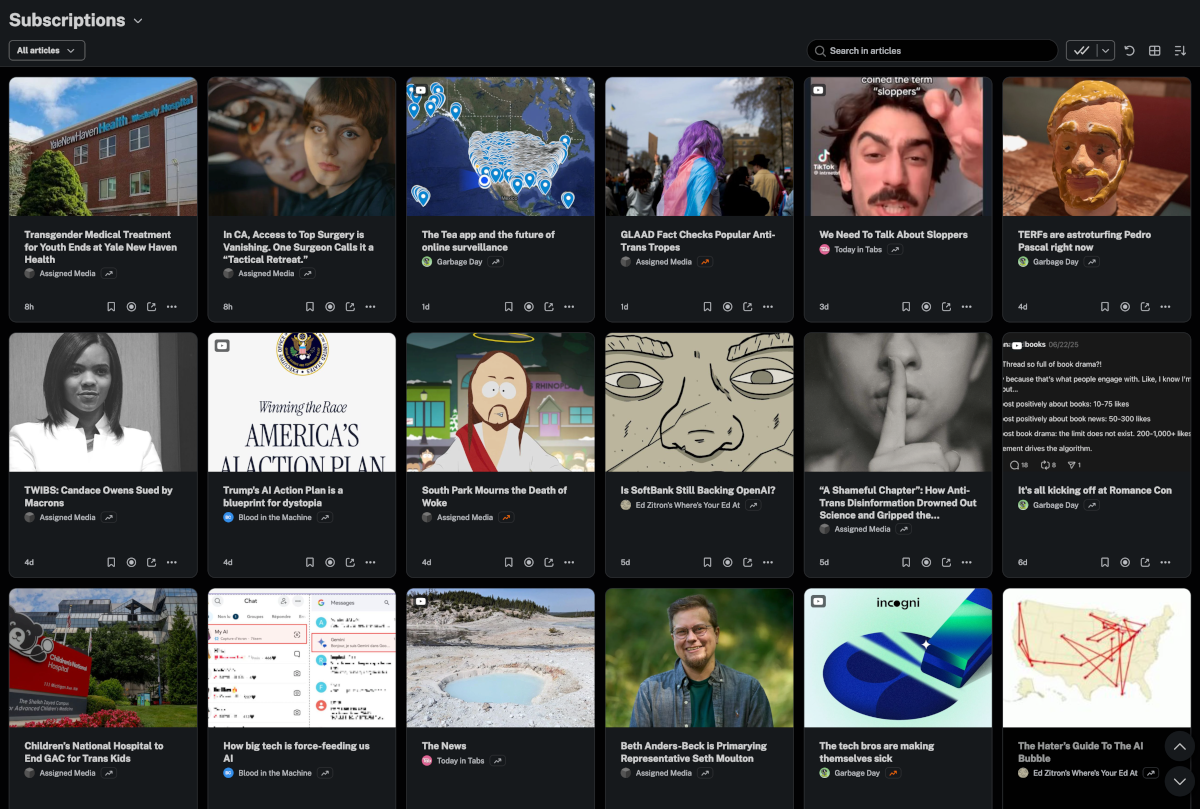
 Curate your own newspaper with RSS
https://www.citationneeded.news/curate-with-rss/
Escape newsletter inbox chaos and algorithmic surveillance by building your own enshittification-proof newspaper from the writers you already read
 SDL DOOM! v1.10
https://www.nytimes.com/2025/05/21/arts/play-doom-ports.html
For decades, tech enthusiasts have made the 1993 video game Doom playable on screens of all sizes, including treadmills, calculators and pregnancy tests. (Even this article.)
SDL DOOM! v1.10
https://www.nytimes.com/2025/05/21/arts/play-doom-ports.html?unlocked_article_code=1.KU8.W3qp.3oxjIeBU4gMc
For decades, tech enthusiasts have made the 1993 video game Doom playable on screens of all sizes, including treadmills, calculators and pregnancy tests. (Even this article.)
 Whimsy by Ct.js
https://ctjs.itch.io/whimsy?utm_source=FuckOff&utm_medium=FuckOff
Whimsy is a small game engine and a fantasy console for making interactive stories where you can navigate the worlds you create and talk with stuff! Whilst simple in nature, the toolset allows making narrative-driven exploratory games with no prior experience in game development.
 Digital Ghost Towns: When Big Companies Acquire, Shut Down, and Sit on Premium Domains
https://www.snagged.com/post/digital-ghost-towns-when-big-companies-acquire-shut-down-and-sit-on-premium-domains
The internet is littered with digital ghost towns—premium domains once associated with thriving businesses, now sitting dormant or parked, waiting for their next life. Some of the biggest companies in the world have made strategic acquisitions, only to shut down the businesses they bought, leaving behind valuable domain names that are either redirected, held indefinitely, or simply left in limbo. Let’s take a look at some high-profile cases where major corporations scooped up valuable domains, shut down the original companies, and left the URLs in the digital graveyard.
 This blog is hosted on a Nintendo Wii
https://blog.infected.systems/posts/2025-04-21-this-blog-is-hosted-on-a-nintendo-wii/
If you are reading this message, the experiment below is still ongoing. This page was served to you by a real Nintendo Wii.
 The IndieWeb Doesn't Need to "Take Off" - Susam's Quick Notes
https://susam.net/indieweb-does-not-need-to-take-off.html
I feel that such claims about the IndieWeb not "taking off" are either stating the obvious or, if that's not the intention, completely missing the point. It's like saying that gardening hasn't taken off because most people buy their vegetables at the supermarket. The IndieWeb doesn't need to "take off" to be valuable to those who participate in it. Maintaining a personal website is about owning your digital presence, embracing creative freedom, and expressing your individuality! It's not about appealing to the masses!
 This page is under construction - localghost
https://localghost.dev/blog/this-page-is-under-construction/
If you take just one thing away from this article, I want it to be this: please build your own website. A little home on the independent web.
 Bookmarklets (and Custom URL Schemes) Are Criminally Underrated | silly business
https://silly.business/blog/bookmarklets-and-custom-url-schemes-are-criminally-underrated/
"Bookmarklets" are an underutilized and frankly little-known feature in Chrome and Firefox (and probably most other browsers too) that allows you to create a bookmark that contains a little bit of JavaScript instead of a link to a web page.
DrSnuggles/chiptune: chiptune3.js - ES6 module with AudioWorklet
https://github.com/DrSnuggles/chiptune?tab=readme-ov-file
This is a javascript library that can play module music files. It is based on the libopenmpt C/C++ library. To translate libopenmpt into Javascript emscripten was used.
Modernized ES6 module version with libopenmpt AudioWorklet backend
 Web page annoyances that I don't inflict on you here
https://rachelbythebay.com/w/2025/01/04/cruft/
Web page annoyances that I don't inflict on you here

 Lens - Check your meta tags, icons, and rss feeds
https://lens.rknight.me/
Check your meta tags, icons, and rss feeds
 Don’t build your castle in other people’s kingdoms – How To Market A Game
https://howtomarketagame.com/2021/11/01/dont-build-your-castle-in-other-peoples-kingdoms/
The kingdom gets absorbed by another neighboring King that has no idea why people where there in the first place and starts changing the laws and everyone leaves. Example: Tumblr
There are countless tales of this happening. EVERY SINGLE EXTERNAL KINGDOM will do this to you. No matter how “cool” or “hip” they are right now. They will let you down.
 Webmentions / ArtLung Lab
https://lab.artlung.com/webmentions/
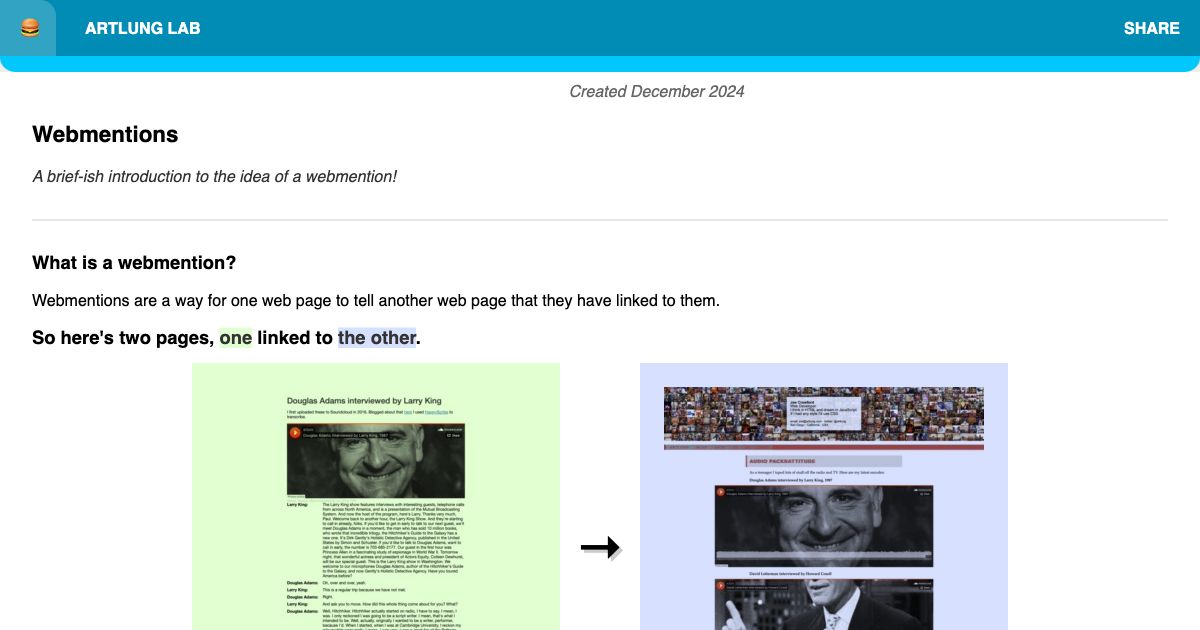
A brief-ish introduction to the idea of a webmention!

 Never Forgive Them
https://www.wheresyoured.at/never-forgive-them/
I will never forgive these people for what they’ve done to the computer, and the more I learn about both their intentions and actions the more certain I am that they are unrepentant and that their greed will never be sated. I have watched them take the things that made me human — social networking, digital communities, apps, and the other connecting fabric of our digital lives — and turned them into devices of torture, profitable mechanisms of abuse, and find it disgusting how many reporters seem to believe it's their responsibility to thank them and explain why it's good this is happening to their readers.
 The enshittification of the web in one image – The Interconnected
https://theinterconnected.net/kirabug/the-enshittification-of-the-web-in-one-image/
But this screenshot right here of the Financial Times site posting a Cory Doctorow article about enshittification is a work of art. Yes, we’ve proven that quality news needs to be paid. Yes, subscriptions are a good way to do that. And yes, cookies do often keep your computer secure. But putting an article on enshittification behind both a paywall and a giant cookie management dialog asking you to accept cookies from FT and their 27 technology partners? Chef’s kiss right there.
svenstaro/miniserve: 🌟 For when you really just want to serve some files over HTTP right now!
https://github.com/svenstaro/miniserve
🌟 For when you really just want to serve some files over HTTP right now!
 The Website Manifesto
https://nora.zone/manifesto.html
I know. You already have a social media account. But you should also have a personal website. Here's why.
 modernity is stupid: a rant not about politics | The Roof is on Phire
https://phirephoenix.com/blog/2024-11-05/modernity
The only reason I even moved to Omnivore is because Mozilla has been systematically neglecting and underfunding Pocket for years and the app is increasingly dominated by things I did not save, the literal one job it had, and I had moved to Pocket after Instapaper first changed ownership in 2013 or whatever and I didn’t like the new owners, and I also can’t go back to Pinboard because while I used to love that dude’s writing he’s turned into a transphobic asshole crank so fuck him, but like, why do I even know that?? Why do I know what Maciej thinks?? Why do I know that DHH is a fucking creep and a weirdo which is why I will never pay for their email service which otherwise seems pretty cool, why do I know that Brave is the homophobic browser in bed with cryptocurrency bros, why do I know that the Kagi dude thinks adding suicide prevention hotlines to search results for “how to kill yourself” is censorship, why do I know about Matt Mullendweeb’s entire existence?? The modern world is unbelievably stupid, and if you don’t pay attention to the stupidity when something bad happens someone shows up in your notifications all like, well what did you expect. I expect you to fuck off!!
icholy/ContainerScript: Firefox Addon for programmatically assigning URLs to containers.
https://github.com/icholy/ContainerScript
Firefox Addon for programmatically assigning URLs to containers.
 Don't Fuck With Scroll
https://dontfuckwithscroll.com/
Momentum scrolling plugins are the web equivalent of turning a functional bike into a unicycle because it "looks cool." It adds unnecessary complexity, degrades usability, and frustrates users. Instead of reinventing scrolling, stick to what works: native, predictable, fast scrolling behavior.
Don't make scrolling a thing. Just let people scroll.
Scripting News: Friday, November 29, 2024
http://scripting.com/2024/11/29.html#a133619
I want to add an important feature to podcasting that can only work with RSS, it can’t work with Spotify, Google, Audible etc. The idea is subscribing to subscription lists, which the influencers are likely to really love because they can create networks of podcasts. And when they want to edit the list, if this is done right, the users will automatically be updated.
 Best of the old web | MetaFilter
https://www.metafilter.com/206483/Best-of-the-old-web
Exhausted from election 2024 and tired of re-litigating the 2016 primary? Perhaps you'd enjoy re-visiting The Race for the Whitehouse 2004 or 2000 in their original web 1.0 glory. Too soon? The 1996 websites for the Dole/Kemp and Clinton/Gore campaigns are still online. Too political? Maybe you want to play Star Ship Titanic (1998) or Space Jam (1996), both preserved in high resolution 1024x768 perfection. Or relax with zombo.com (1999), spork.org (1996) and milk.com (1994). These are all reminders that Cool URI's don't change on the WWW project (1991).
 "Never Build Your House On Someone Else's Land" - ErosBlog
https://www.erosblog.com/2022/02/07/someone-elses-land/
Never build your house on someone else’s land.
Bacchus's First Rule Of The Internet - ErosBlog
https://www.erosblog.com/2013/06/11/bacchus-first-rule-of-the-internet/
Bacchus’s First Rule Of The Internet: Anything worth doing on the internet is worth doing on your own server that you control.
 Webring component - Octothorpes Demo
https://demo.ideastore.dev/webring-component
Since octothorpes get registered with an Octothorpes Ring, that means you’re automatically on a webring if you’re using octothorpes. So each Ring hosts a web component that lets you put a classic webring browser on your page. You can see it working right now in the footer of this site!
 ArtLung: Owning my own bookmarks over 20 years ~ 31 Oct 2024
https://artlung.com/blog/2024/10/31/owning-my-own-bookmarks-over-20-years/
I wrote code (in PHP) to import my old bookmarks. And you didn’t misread that, it’s 28,000 links over the last 20 years. They come from my original links blog, and from Delicious, and from Instapaper, and from Twitter back when I backfilled those shared links into Pinboard, which I then backfilled into my link blog database. It’s a lot of things, but really, it’s straightforward from a programming point of view. It’s a simple POST to the REST API which Linkding provides by default. I have shared most of the code I wrote as a Gist in GitHub. It includes code in PHP to convert exported CSV from Instapaper to a JSON format that my poster code can use. And over the last 2 days and over many hours, every few seconds a link would be posted. And as of now, it’s finished.
 Elon Musk Admits X is Throttling Link Out from the Platform
https://www.mediaite.com/news/elon-musk-admits-x-is-throttling-links-effectively-limiting-people-from-reading-news/
Elon Musk confirmed that posts containing links in their main text are deprioritized on X in a revelation that renews criticism that the platform is restricting the visibility of and access to external sources of information.
 I don't have time to learn React - Keith Cirkel
https://www.keithcirkel.co.uk/i-dont-have-time-to-learn-react/
When I mentor early career developers and they ask me what they should learn, I can't say React, they don't have time. I mean sure, pick up enough React to land you the inevitable job doing it, but it's not going to level up your career. Anyone with $5,000-$10,000 can make their way through a bootcamp and scrape their way through an interview, but it's a competitive market and it's usually quite evident when your interviewing a bootcamp candidate. Stand out by picking up some more fundamentals
 RFC 35140: The Do-Not-Stab flag in the HTTP Header
https://www.5snb.club/posts/2023/do-not-stab/
This document defines the syntax and semantics of the Do-Not-Stab header, a proposed HTTP header that allows users to indicate to a website their preferences about being stabbed. It also provides a standard for how services should comply with such user preferences, if they wish to.
 Introducing Sill | Tyler Fisher
https://www.tylerjfisher.com/blog/post/2024/11/20/introducing-sill
I built Sill because I value the people in my social network, and I believe I can learn the most about the world by reading what they read and hearing what they have to say. Sill listens to them at scale and helps me understand the conversation. In the month or so I’ve been using it myself, Sill has completely changed my relationship to my social network.
MaggieAppleton/digital-gardeners: Resources, links, projects, and ideas for gardeners tending their digital notes on the public interwebs
https://github.com/MaggieAppleton/digital-gardeners
Resources, links, projects, and ideas for gardeners tending their digital notes on the public interwebs
 Highlighting Text in Links with Text Fragments
https://calebhearth.com/text-fragmentsFuckOffFuckOff
I’ve used URL text fragments in a few posts now and often use it outside of this blog to point someone to a particular piece of text on a page. They’re a really useful feature that allows you to create a URL that links not just to a page or an anchor on that page, but specifically to a bit of text that you’d like to call out to your audience.
 About – StarSubculture
https://starsubculture.com/about/
StarSubculture is an online community space where creatives can showcase their websites and art and interact with a like-minded community as well as keep up with their favorite artists and websites!
In this era of the internet, it’s become near-impossible to connect to other creative website owners. Here at StarSubculture, you’re free to cultivate that community that the internet is so desperately needing.
 House of Nettles • A Sociable Web
https://nex-3.com/blog/a-sociable-web/
I want things to be sociable, to be friendly, to be fun. I don't mean to try to avoid conflict entirely, which is neither possible nor truly desirable. But to envision a sociable web is to envision a place where interactions that make your world richer are easy to realize, and those that make your life worse easy to curtail. I want to be able to chat in public without the world overhearing, to meet new people and be able to block creeps, and to have conversations without being drowned in a sea of bad faith.
It feels like 2004 again. - Anil Dash
https://www.anildash.com/2024/10/15/its-2004-again/
I keep having a conversation with people around the tech world about how the industry’s current state of change — especially the potential disruption of incumbents — feels like nothing so much as a cyclical repeat of what we saw in 2004.
 Wasm is the new CGI | Roborooter.com
https://roborooter.com/post/wasm-is-the-new-cgi/
And to be clear I don't mean the Common Gateway Interface as a protocol. I mean what CGI and the cgi-bin application model brought to the web. They allowed people to easily write code that makes websites interactive. This shifted the web from an archive of documents to a vast network of applications. It was the first "web application model". I think Wasm (WebAssembly) is setup to bring the next "web application model" to the industry.
 Forums Are Still Alive, Active, And A Treasure Trove Of Information - Aftermath
https://aftermath.site/best-active-forums-internet-today?giftLink=82ea56e95339e53fd2c0673d4b8018f3
Here are the Internet forums that are still alive and kicking and full of information and interesting people.
 We Haven't Launched But We're Not A Secret Anymore -
https://ideastore.dev/blog/shrodingers-launch/
Octothorpes is currently in a sort of liminal stage between launched and not launched, but it got posted to Lobsters and Hackernews today! Which was quite a surprise to both of us. So, if you’re reading this because you found out about us on one of those sites, here’s a little context for the project.
Molly White, Citation Needed / Web3 Is Going Just Great - XOXO Festival (2024) - YouTube
https://www.youtube.com/watch?v=MTaeVVAvk-c&list=PLCbA9r6ecYWU6SVyvb32a0YHIzpr9jxnW&index=3
Best known for puncturing blockchain/crypto hype with her Web3 Is Going Just Great project, writer/researcher Molly White believes a better web is possible. Launched two years ago, her Citation Needed newsletter covers “tech world without all the boosterism,” while her latest project tracks the crypto industry’s attempts to influence the 2024 elections.
 Weird Web October
https://weirdweboctober.website/
Weird Web October is a challenge to try and make a website every day of October, based on the theme for each day, inspired by Inktober. It’s open to you and everyone!
 linkhut: A social bookmarking site
https://sr.ht/~mlb/linkhut/
linkhut is an open source social bookmarking website.
 linkhut
https://ln.ht/

 Raw dog the open web!
https://www.fromjason.xyz/p/notebook/raw-dog-the-open-web/
Highlight:In our current digital landscape, where a corporate algorithm tells us what to read, watch, drink, eat, wear, smell like, and sound like, human curation of the web is an act of revolution. A simple list of hyperlinks published under a personal domain name is subversive. Curation is punk.
Lets break away from the protective layer that is our For You Pages.

 What RSS Needs
https://www.mnot.net/blog/2024/08/25/feeds
Highlight:It’s just that feeds could be so much more with some love and directed care – something that could jump from a niche use case to a widespread ‘normal’ part of the Web for many.
Web feeds could be so much more if we put some effort into them. This post explores some ideas of how to start.
 Local-First Web Development
https://localfirstweb.dev/
So, you want to build an app that has its data co-located with its UI? That works offline? That synchronizes between clients? And that lets its users own their data?
Local-First Web Development
https://localfirstweb.dev
So, you want to build an app that has its data co-located with its UI? That works offline? That synchronizes between clients? And that lets its users own their data?
 What does it look like for the web to lose? - Chris Coyier
https://chriscoyier.net/2023/01/04/what-does-it-look-like-for-the-web-to-lose/
Better yet, let’s ditch the idea of native apps. All web! All web! All web!
What does it look like for the web to lose? - Chris Coyier
https://chriscoyier.net/2023/01/04/what-does-it-look-like-for-the-web-to-lose
Better yet, let’s ditch the idea of native apps. All web! All web! All web!
 shaktool / beepbox — Bitbucket
https://bitbucket.org/shaktool/beepbox
This is the source code for BeepBox, an online tool for sketching and sharing chiptune melodies. All of the source code here is available under the MIT license.
 Tangle: a JavaScript library for reactive documents
http://worrydream.com/Tangle/
Tangle is a JavaScript library for creating reactive documents. Your readers can interactively explore possibilities, play with parameters, and see the document update immediately. Tangle is super-simple and easy to learn.