 tobi/qmd: mini cli search engine for your docs, knowledge bases, meeting notes, whatever. Tracking current sota approaches while being all local
https://github.com/tobi/qmd
mini cli search engine for your docs, knowledge bases, meeting notes, whatever. Tracking current sota approaches while being all local

 DuckDuckGo !Bangs
https://duckduckgo.com/bangs
Bangs are shortcuts that quickly take you to search results on other sites. For example, when you know you want to search on another site like Wikipedia or Amazon, our bangs get you there fastest. A search for !w filter bubble will take you directly to Wikipedia.
 A fun trick for getting discovered by LLMs and AI tools
https://cassidoo.co/post/ai-llm-discoverability/
I have been getting a lot of newsletter responses, DMs, and emails in general saying that people have discovered my work not via traditional SEO, but via LLMs and AI tools like ChatGPT, Claude, Perplexity, and even GitHub Copilot.
 Is the LLM response wrong, or have you just failed to iterate it?
https://mikecaulfield.substack.com/p/is-the-llm-response-wrong-or-have
 A Secret Web
https://blog.clew.se/posts/secret-web/
 GPT-5 Thinking in ChatGPT (aka Research Goblin) is shockingly good at search
https://simonwillison.net/2025/Sep/6/research-goblin/#atom-everything
 Why blocking LLMs from your website is dumb | by John Wang | Aug, 2025 | Medium
https://johnjianwang.medium.com/why-blocking-llms-from-your-website-is-dumb-3dc7c3c9097d
LLMs are the next generation’s search layer. They’re already generating massive amounts of pipeline for the companies and websites that have gotten good at getting their content displayed in LLMs. Combine that with the fact that most LLMs have an agentic web-search component that will actively generate links, and you have a massive funnel of potential readers for your content.

 Death by AI - Dave Barry’s Substack
https://davebarry.substack.com/p/death-by-ai
I found out about my death the way everybody finds out everything: from Google.
 Embeddings are underrated
https://technicalwriting.dev/ml/embeddings/overview.html
Embeddings aren't exactly new, but they have become much more widely accessible in the last couple years. What embeddings offer to technical writers is the ability to discover connections between texts at previously impossible scales.
 VectorVFS: Your Filesystem as a Vector Database
https://vectorvfs.readthedocs.io/en/latest/
VectorVFS is a lightweight Python package that transforms your Linux filesystem into a vector database by leveraging the native VFS (Virtual File System) extended attributes. Rather than maintaining a separate index or external database, VectorVFS stores vector embeddings directly alongside each file—turning your existing directory structure into an efficient and semantically searchable embedding store.
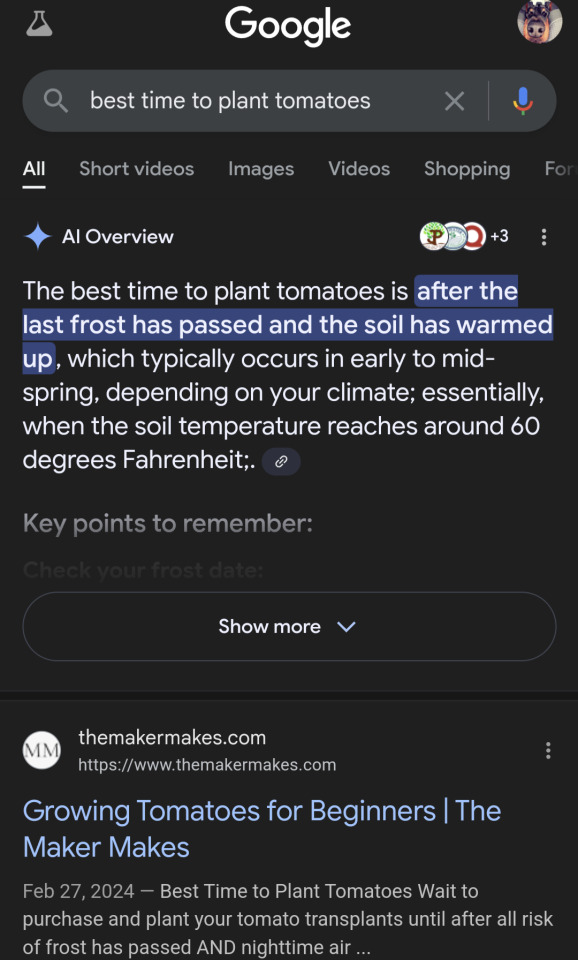
 every time I do a web search, right at the top I have AI info dumping on me just give me the top result please – @andthentheresanne on Tumblr
https://www.tumblr.com/andthentheresanne/774090613079621632?source=share
Swear in your search request. I know it sounds ridiculous, but the most effective way I've found of it not doing the AI summary is just to add "fucking" go my search.
 Implementing Filtered Semantic Search Using Pgvector and JavaScript
https://www.timescale.com/blog/implementing-filtered-semantic-search-using-pgvector-and-javascript-2/
Conventional search methods rely on keyword matching, where the system locates exact words or phrases from the query within documents. This technique can be enhanced to better capture the context and intent behind the user's query, leading to more relevant and precise search results. Semantic search focuses on understanding the meaning and intent behind the query. Combining semantic search with filters—or additional parameters to narrow the results based on specific attributes—further improves accuracy.
In this article, we explore semantic search with filters and demonstrate how you can implement it using pgvector and JavaScript.
 ArtLung: Owning my own bookmarks over 20 years ~ 31 Oct 2024
https://artlung.com/blog/2024/10/31/owning-my-own-bookmarks-over-20-years/
I wrote code (in PHP) to import my old bookmarks. And you didn’t misread that, it’s 28,000 links over the last 20 years. They come from my original links blog, and from Delicious, and from Instapaper, and from Twitter back when I backfilled those shared links into Pinboard, which I then backfilled into my link blog database. It’s a lot of things, but really, it’s straightforward from a programming point of view. It’s a simple POST to the REST API which Linkding provides by default. I have shared most of the code I wrote as a Gist in GitHub. It includes code in PHP to convert exported CSV from Instapaper to a JSON format that my poster code can use. And over the last 2 days and over many hours, every few seconds a link would be posted. And as of now, it’s finished.
TylerFisher/sill: Find the most popular links from your Mastodon/Bluesky networks
https://github.com/TylerFisher/sill/
Find the most popular links from your Mastodon/Bluesky networks
 Introducing sqlite-lembed: A SQLite extension for generating text embeddings locally | Alex Garcia's Blog
https://alexgarcia.xyz/blog/2024/sqlite-lembed-init/index.html
sqlite-lembed is a SQLite extension for generating text embeddings, meant to work alongside sqlite-vec. With a single embeddings model file provided in the .gguf format, you can generate embeddings using regular SQL functions, and store them directly inside your SQLite database. No extra server, process, or configuration needed!
KNN queries | sqlite-vec
https://alexgarcia.xyz/sqlite-vec/features/knn.html
The most common use-case for vectors in databases is for K-nearest-neighbors (KNN) queries. You'll have a table of vectors, and you'll want to find the K closest
Hybrid full-text search and vector search with SQLite | Alex Garcia's Blog
https://alexgarcia.xyz/blog/2024/sqlite-vec-hybrid-search/index.html
You can use SQLite's builtin full-text search (FTS5) extension and semantic search with sqlite-vec to create "hybrid search" in your applications. You can combine results using different methods like keyword-first, re-ranking by "semantics", and reciprocal rank fusion. Best of all, since it's all in SQLite, experiments and prototypes are cheap and easy, no 3rd party services required!
 APIsearch
http://apis.io/
Welcome to APIs.io - an experimental API Search service to help discover APIs on the web. The service uses the APIs.json proposed discovery format. To find APIs type your request in the search box.
APIsearch
http://apis.io
Welcome to APIs.io - an experimental API Search service to help discover APIs on the web. The service uses the APIs.json proposed discovery format. To find APIs type your request in the search box.
 Yahoo Struggles to Find Way Out of Microsoft Web-Search Deal - WSJ.com
http://online.wsj.com/article_email/SB10001424127887323372504578469401316209428-lMyQjAxMTAzMDAwNzEwNDcyWj.html
Yahoo Inc. has been quietly trying to find a way out of its struggling Web-search partnership with Microsoft Corp., a person familiar the situation said, but has so far failed in that effort.
 lunr.js - A bit like Solr, but much smaller and not as bright
http://lunrjs.com/
Simple full-text search in your browser
lunr.js - A bit like Solr, but much smaller and not as bright
http://lunrjs.com
Simple full-text search in your browser
 inessential.com: Decentralized search engine
http://inessential.com/2011/12/01/decentralized_search_engine
Decentralization, in tech as in politics, is how we prevent one entity from having too much power. Power corrupts.
 Google keyword: Pepsi | MetaFilter
http://www.metafilter.com/109207/Google-keyword-Pepsi
Two weeks ago, Google disabled the + operator for searches, requiring quotation marks to force inclusion of a word.
Today, Google Plus rolled out a new feature - Pages for companies and brands, so you can "build relationships with all the things you care about". Included is Direct Connect - go straight to Pepsi's Google+ page by searching for +Pepsi.
 A9.com - Innovations in Search Technologies - OpenSearch
http://opensearch.a9.com/-/company/opensearch.jsp
A9.com invented the OpenSearch technology for search aggregation in 2004.
OpenSearch is a set of simple formats for the sharing of search results. Any website that has a search feature can make their results available in OpenSearch format. Other tools can then read those search results.
 Lucandra: A Cassandra-based Lucene backend « Sematext Blog
http://blog.sematext.com/2010/02/09/lucandra-a-cassandra-based-lucene-backend
"In this guest post Jake Luciani (@tjake) introduces Lucandra, a Cassandra-based backend for Lucene."
 Facebook Wants to Be Your One True Login
http://www.readwriteweb.com/archives/facebook_wants_to_be_your_one_true_loginpage3.php#comments
"@David, it's real. We've determined by looking at our traffic stats that people are doing Google searches for "facebook login" and coming upon RWW. They see the FB Connect button and assume that RWW is the "new Facebook."
Sigh.
The Internet Is Hard."
 Introduction to Information Retrieval
http://nlp.stanford.edu/IR-book/information-retrieval-book.html
"The book aims to provide a modern approach to information retrieval from a computer science perspective. It is based on a course we have been teaching in various forms at Stanford University and at the University of Stuttgart. "
 Douglas Rushkoff » Calacanis and Rushkoff Agree
http://rushkoff.com/2009/07/29/calacanis-and-rushkoff-agree
 Yahoo committed seppuku today « The Jason Calacanis Weblog
http://calacanis.com/2009/07/29/yahoo-committed-seppuku-today
 pre dev wiki: Global Search Addons
http://predev.wikidot.com/global-search-addons
Now, if only it supported OpenSearch
 qs_score - Quicksilver Score
http://rails-oceania.googlecode.com/svn/lachiecox/qs_score/trunk/qs_score.js
"A port of the Quicksilver string ranking algorithm"
 Searching across websites with OpenSearch | StressFree
http://www.stress-free.co.nz/searching_across_websites_with_opensearch
"Providing search services that span a number of disparate websites is a challenging problem that in the past has been left to the big-boys such as Google. However Amazon's OpenSearch RSS format is changing this reality and providing a means for effective multiple website search to be deployed at low cost by small development teams. "
 Do Tags Work?
http://www.tekka.net/10/tags.html
If you can get past the rambling paragraphs of awkward fun-poking at tags interspersed with library science / web 2.0 / cultural references—as well as a discovery of what, you know, Flickr is all about—there's a well-embellished and obsessively-assembled statistical analysis of tags vs title vs notes in finding photos featuring tourist heel-spinning on the testicles of a bull mosaic in Milan. My impression is that she's missed the point of tags, but I'm having trouble reducing the impression to a critique.
 fuzzyfinder.vim - Fuzzy/Partial pattern explorer for buffer/file/MRU/command/favorite/tag/etc. : vim online
http://www.vim.org/scripts/script.php?script_id=1984
 Browser Wars: Why does Firefox use Google for search? Follow the money
http://valleywag.com/5015054/why-does-firefox-use-google-for-search-follow-the-money
"Let's not pretend that calling for open search is anything but a tactic for generating false controversy."
 IT Discovery — Intelligent, Strategic Email Discovery
http://it-discovery.com
"By a happy coincidence, the two primary difficulties inherent in searching emails — its sheer volume and its "noisy" nature — are susceptible of recent developments in machine learning technologies that make this task manageable. This is what IT Disc
 Lijit | Home
http://www.lijit.com
"Install the Lijit Search Wijit on your blog to give readers the most relevant results from a source they trust. YOU."
 Design details of Audiogalaxy.com’s high performance MySQL search engine | Spiteful.com
http://www.spiteful.com/2008/02/29/design-details-of-audiogalaxycoms-high-performance-mysql-search-engine
"At peak times, the search engine needed to handle 1500-2000 searches every second against a MySQL database with about 200 million rows."
 A VC: delicious search
http://avc.blogs.com/a_vc/2008/02/delicious-searc.html#comment-124223
"Here is to hoping Yahoo! figures out how to better leverage Delicious without killing it in the process. They have done an admirable job in not killing Flickr, and lets see if they can do the same for Delicious. In the meantime, kudos to Joshua and the D
 Delicious Integrated Into Yahoo Search Results
http://www.techcrunch.com/2008/01/19/delicious-integrated-into-yahoo-search-results
"I just got word that Yahoo is testing the integration of Delicious user generated bookmarks into Yahoo search results pages"
 ASCII by Jason Scott: My Delicious Slaves
http://ascii.textfiles.com/archives/000559.html
"Just a little detective work, and the next thing you know your smart agent (made of convenient meat and self-sustaining) is on your side."
 XML.com: Introducing OpenSearch
http://www.xml.com/pub/a/2007/07/20/introducing-opensearch.html?ATT=Introducing+OpenSearch&CMP=OTC-TY3388567169
"You go to your favorite Web 2.0 search engine and set up a query like http://web20.example.com/search=john+doe&ouptut=atom and search for "john doe," but rather than getting back results as the usual HTML web page, you get it back in Atom format."
 SuperHappyDevHouse 18 - review :: semicomplete.com - Jordan Sissel
http://www.semicomplete.com/blog/geekery/shdh18-review.html?source=rss20
"The projector was displaying the decoded contents of search queries. My first work that day was on hacking the projected screen."
 Bloglines | Feed Access Control RSS and ATOM
http://www.bloglines.com/about/specs/fac-1.0
"Used to indicate the re-distribution restrictions for a feed. The 'relationship' attribute is used to indicate whether a feed will 'allow' or 'deny' access."
 MonitorThis
http://alp-uckan.net/free/monitorthis
"With MonitorThis you can subscribe to 22 different search engine feeds at the same time. Enter a search term and click the 'make monitor.opml' button to get a list of rss feeds in OPML format."
 Search With Kevin
http://searchwithkevin.prodege.com
Uhh, what? Who's the genius who thought this would work? "Every time you search the web you stand a chance of winning a prize from Kevin Federline."
 Don Norman's jnd.org / UI Breakthrough-Command Line Interfaces
http://www.jnd.org/dn.mss/ui_breakthroughcomma.html
"So now command line interfaces are back again, hiding under the name of search. ... And they will get better and better with time: mark my words, that is my prediction for the future of interfaces."
 3 Reasons Why Snap Preview is Ruining Your Blog, and Hurting Your Readership | Performancing.com
http://performancing.com/node/5721
"All joking aside, SPA is not helpful, it's not cool, and it's not winning you readers -- It's bling, a silly little shiney thing designed specifically to increase awareness of Snap.com"
 Catalog Search Cloud | Ann Arbor District Library
http://www.aadl.org/searchcloud
"This cloud represents the popularity of searches against the AADL catalog."
 Quoderat ? Beginning of the end for open web data APIs?
http://www.megginson.com/blogs/quoderat/archives/2006/12/18/beginning-of-the-end-for-open-web-data-apis
"Another victory for REST over WS-*? Nope — Google doesn’t have a REST API to replace it."
 Nelson's Weblog: tech / googleSearchAPI
http://www.somebits.com/weblog/tech/googleSearchAPI.html
"I just learned that two weeks ago Google officially put the SOAP search API on end of life status."


 Netflix: Search Results
http://www.netflix.com/Search?search_submit.x=0&search_submit.y=0&v1=%s
Search for movies, actors, etc on Netflix
 Amazon Web Services Developer Connection: Will I have to pay for ...
http://developer.amazonwebservices.com/connect/thread.jspa?messageID=38305&tstart=0#38305
"if I have a bunch of publicly accessible objects in my S3 buckets, then won't I have to pay bandwidth costs when Google/yahoo/a9 and all the other search engines go and spider my buckets?"
 What is OPML? (GnomeREPORT)
http://channels.lockergnome.com/windows/archives/20060317_what_is_opml.phtml
"That's just an OPML document which displays all the categories and feeds we pre-populate with your keyword on Gada.be. Go ahead, change the word "keyword" to something else - watch what happens."
 Splunk Welcome
http://www.splunk.com
It's a search engine for your log files. "It’s search software that indexes all your fast moving IT data as it happens."
 A Journey to the Center of Yahoo - New York Times
http://www.nytimes.com/2005/11/06/business/yourmoney/06techno.html?ei=5088&emc=rss&en=11aa3a8e097005a7&ex=1288933200&pagewanted=print&partner=rssnyt
"What is different is Yahoo's systematic plan to build "community intelligence" into nearly all aspects of its operation"
 Google Search: "my new * * technique is unstoppable"
http://www.google.com/search?q=%22my+new+*+*+technique+is+unstoppable%22