
 Antiquated HTML Snippets and Artefacts | Vale.Rocks
https://vale.rocks/posts/html-relics
This article doesn’t cover once-specced but now obsolete bits of HTML but instead looks at all the snippets that have wormed their way into websites as result of, or in combat against, third-party integrations, browser competition, vendor extensions, and platform-specific hacks. The bits of HTML that were included for reasons, and which have been forgotten for present irrelevance. The snippets that live on only in the markup of sites from bygone eras and in the minds of those who fought during the browser wars.
HTMLcat — Compact notes on HTML, CSS, and JavaScript
https://htmlcat.net/
small, native web tricks worth remembering

 How building an HTML-first site doubled our users overnight
https://mohkohn.co.uk/writing/html-first/
It is not acceptable to bounce users on old browsers, users with bad network connections, users using assistive technologies. Certainly not from a monopoly public service. A lot of hype and noise is pressing us to extend the cowboy, wild-west phase of the software industry’s expansion. We should set that aside, and take ourselves seriously as a mature industry. Build a web application that works on a playstation portable on a 3G connection - if you do, it will work for all your users, and it will still work 30 years from now.
 Progressive Web Components | Ariel Salminen
https://arielsalminen.com/2026/progressive-web-components/
A Progressive Web Component is a native Custom Element designed in two layers: a base layer of HTML and CSS that renders immediately, without JavaScript, and an enhancement layer of JavaScript that adds reactivity, event handling, and more advanced templating.

 letientai299/md2cb: Convert Markdown to rich HTML clipboard content
https://github.com/letientai299/md2cb
Convert Markdown to rich HTML clipboard content

 How to Make a Damn Website
https://lmnt.me/blog/how-to-make-a-damn-website.html
A lot of people want to make a website but don’t know where to start or they get stuck. That’s in part because our perception of what websites should be has changed so dramatically over the last 20 years.
 You can make up HTML tags: (Maurycy's blog)
https://maurycyz.com/misc/make-up-tags/
Browsers handle unrecognized tags by treating them as a generic element, with no effect beyond what’s specified in the CSS. This isn’t just a weird quirk, but is standardized behavior. If you include hyphens in the name, you can guarantee that your tag won’t appear in any future versions of HTML.
 Please Just Fucking Try HTMX
https://pleasejusttryhtmx.com/
Look. I'm not going to call you a fucking moron every other sentence. That's been done. It's a whole genre now. And honestly? HTMX doesn't need me to scream at you to make its point.

 The Web Platform is a Triumph of Object-Oriented Programming | That HTML Blog
https://thathtml.blog/2025/12/the-dom-is-a-triumph-of-object-oriented-programming/
It’s not just that web APIs often take advantage of OOP. They would not exist without OOP! Virtually every web API you have ever used is designed specifically within the OOP paradigm. And every entity in the lifecycle of a web page is based on objects. These objects are instances of classes and in a great many cases these classes are subclasses of other classes. This means that key functionality is spread across a class hierarchy. That isn’t a bug, it’s a feature! And this means that it’s absurd to think that to write a web app you need to reach for a “framework”. The Web Platform is a framework.
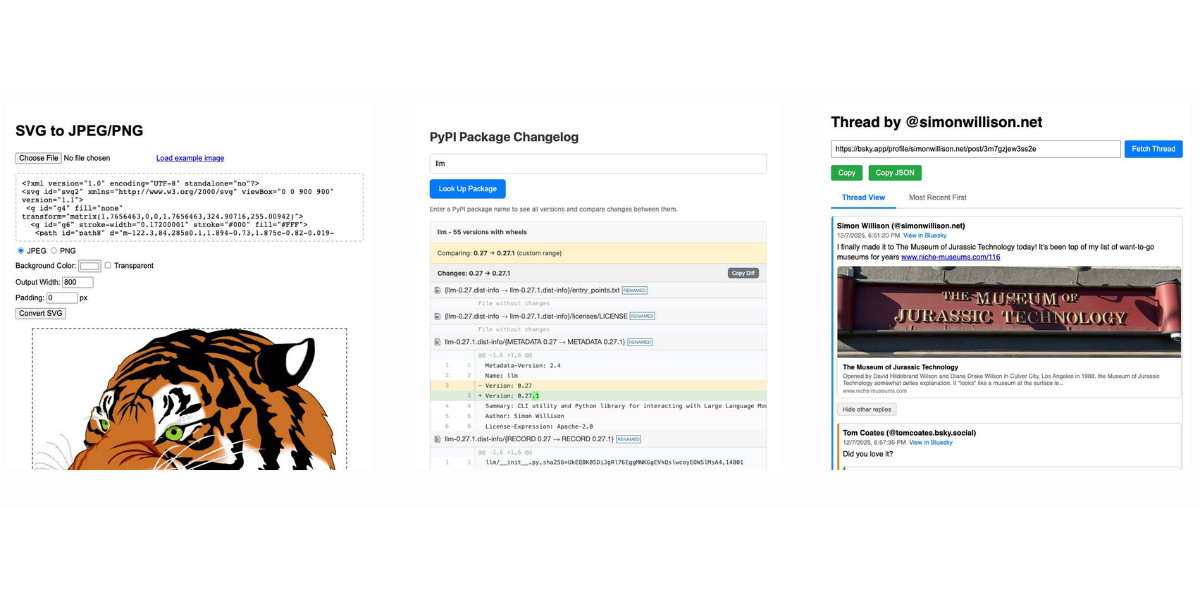
 Useful patterns for building HTML tools
https://simonwillison.net/2025/Dec/10/html-tools/
I’ve started using the term HTML tools to refer to HTML applications that I’ve been building which combine HTML, JavaScript, and CSS in a single file and use them to provide useful functionality. I have built over 150 of these in the past year, almost all of them written by LLMs. This article presents a collection of useful patterns I’ve discovered along the way.
DOCTYPE magazine 🚀⌨️
https://vole.wtf/doctype/
’80s BASIC type-in mags are back, but this time for HTML!
10 wonderful web apps, including games, toys, puzzles and utilities
No coding knowledge needed, you just type
Syntax Highlighting in Web Component Templates
https://remysharp.com/2025/11/12/syntax-highlighting-in-web-component-templates
The extremely quick read is, add /* HTML */ to the front of the template. Case sensitive and space sensitive (though hopefully one day it won't be so strict). Now highlighting and prettier (with save and fix) works.
Note that you need the es6-string-html VS Code extension for this to highlight correct (something I had forgotten I had installed).
HTML is for lovers | Go Make Things
https://gomakethings.com/html-is-for-lovers/
I’ve had the opportunity to use Kelp on a big client project for the last few weeks, and it’s been so awesome to work with!
 Abandonware of the web: do you know that there is an HTML tables API? | Christian Heilmann
https://christianheilmann.com/2025/10/08/abandonware-of-the-web-do-you-know-that-there-is-an-html-tables-api/
When people turn data into HTML tables using JavaScript, they either use the DOM methods (createElement() and the likes), but most of the time just append a huge string and use innerHTML, which always is a security concern. However, did you know that HTML tables also have an old, forgotten API ? Using this one, you can loop over tables, create bodies, rows, cells, heads, footers, captions an summaries (yes, HTML tables have all of those) and access the table cells. Without having to re-render the whole table on each change.

JohannesKaufmann/html-to-markdown: ⚙️ Convert HTML to Markdown. Even works with entire websites and can be extended through rules.
https://github.com/JohannesKaufmann/html-to-markdown
Convert HTML to Markdown. Even works with entire websites and can be extended through rules.
 Tailwind is the Worst of All Worlds
https://colton.dev/blog/tailwind-is-the-worst-of-all-worlds/
Tailwind is the worst of all worlds. It is a regrettable step backwards that takes everything bad about CSS and modern web development and brings it all together in one library.

 Single HTML Element Star Rating Component - DEV Community
https://dev.to/alvaromontoro/single-html-element-star-rating-component-205l?
In this article, we'll explore how to build a star rating system using a single HTML and just one JavaScript command.

 Durable websites | Go Make Things
https://gomakethings.com/durable-websites/
Serve mostly static HTML. Use flat JSON storage. Go buildless! Use service workers. Go HTML-first.

 Lens - Check your meta tags, icons, and rss feeds
https://lens.rknight.me/
Check your meta tags, icons, and rss feeds
 Retro futuristic radio buttons with GSAP
https://codepen.io/jdillon/pen/qEWOGxm
 How to fix Storybook screenshot testing | Tiger Oakes
https://tigeroakes.com/posts/storybook-test-runner-screenshots/
As an alternative to Chromatic, I’ve been using Storybook’s Test Runner to power screenshot tests for Microsoft Loop. We configure the test runner to run in CI and take a screenshot of every story. However, the initial implementation based on the official Storybook docs was very flaky due to inconsistent screenshots of the same story. Here are some tips to reduce flakiness in your Storybook screenshot tests.
Domo Dance Party! (2024 remake)
https://codepen.io/lonekorean/pen/KKOLdzK
 More options for styling <details> | Chrome for Developers
https://developer.chrome.com/blog/styling-details
From Chrome 131 you have more options to style the structure of <details> and <summary> elements. You can now use these elements when building disclosure or accordion widgets.
 Speculation Rules API - Web APIs | MDN
https://developer.mozilla.org/en-US/docs/Web/API/Speculation_Rules_API
The Speculation Rules API is designed to improve performance for future navigations. It targets document URLs rather than specific resource files, and so makes sense for multi-page applications (MPAs) rather than single-page applications (SPAs).
 </> htmx ~ You Can't Build Interactive Web Apps Except as Single Page Applications... And Other Myths
https://htmx.org/essays/you-cant/
The browser has come a long way. Give it a chance!
 The Different (and Modern) Ways To Toggle Content | CSS-Tricks
https://css-tricks.com/the-different-and-modern-ways-to-toggle-content/
let’s spend some time looking at disclosures (<details> and <summary>), the Dialog API, the Popover API, and more. We’ll look at the right time to use each one depending on your needs. Modal or non-modal? JavaScript or pure HTML/CSS? Not sure? Don’t worry, we’ll go into all that.
 HTML Form Validation is heavily underused
https://expressionstatement.com/html-form-validation-is-heavily-underused
HTML Forms have powerful validation mechanisms, but they are heavily underused. In fact, not many people even know much about them. Is this because of some flaw in their design? Let’s explore.
 Highlighting Text in Links with Text Fragments
https://calebhearth.com/text-fragmentsFuckOffFuckOff
I’ve used URL text fragments in a few posts now and often use it outside of this blog to point someone to a particular piece of text on a page. They’re a really useful feature that allows you to create a URL that links not just to a page or an anchor on that page, but specifically to a bit of text that you’d like to call out to your audience.
Tab panel using <details> with vertical tabs and web components
https://codepen.io/lmorchard/pen/eYqWmvV
Tab panel using <details> with selectable tab orientation (no JS)
https://codepen.io/lmorchard/pen/mdNmyvP
 Example of Tabs with Automatic Activation | APG | WAI | W3C
https://www.w3.org/WAI/ARIA/apg/patterns/tabs/examples/tabs-automatic/
This example section demonstrates a tabs widget that implements the Tabs Pattern. In this example, a tab is automatically activated and its associated panel is displayed when the tab receives focus. It is recommended that authors consider implementing automatic activation of tabs only in circumstances where panels can be displayed instantly, i.e., all panel content is present in the DOM.
Pure CSS Tabs
https://codepen.io/markcaron/pen/MvGRYV
A version of a tab panel in HTML & CSS with no javascript, using a radio selector
Cycling gradient glow - no text duplication
https://codepen.io/thebabydino/pen/rNPOpJK
jacktuck/unfurl: Metadata scraper with support for oEmbed, Twitter Cards and Open Graph Protocol for Node.js :zap:
https://github.com/jacktuck/unfurl?tab=readme-ov-file
Highlight:Unfurl (spread out from a furled state) will take a url and some options, fetch the url, extract the metadata we care about and format the result in a sane way. It supports all major metadata providers and expanding it to work for any others should be trivial.
Metadata scraper with support for oEmbed, Twitter Cards and Open Graph Protocol for Node.js :zap: - jacktuck/unfurl
microlinkhq/metascraper: Get unified metadata from websites using Open Graph, Microdata, RDFa, Twitter Cards, JSON-LD, HTML, and more.
https://github.com/microlinkhq/metascraper
Highlight:The metascraper library allows you to easily scrape metadata from an article on the web using Open Graph metadata, regular HTML metadata, and series of fallbacks.
Get unified metadata from websites using Open Graph, Microdata, RDFa, Twitter Cards, JSON-LD, HTML, and more. - microlinkhq/metascraper
 Server-side rendering (SSR) – Lit
https://lit.dev/docs/ssr/overview/
Lit supports server-side rendering through the Lit SSR package. Lit SSR renders Lit components and templates to static HTML markup in non-browser JavaScript environments like Node. It works without fully emulating the browser's DOM, and takes advantage of Lit's declarative template format to enable fast performance, achieve low time-to-first-byte, and support streaming.
Server-side rendering (SSR) – Lit
https://lit.dev/docs/ssr/overview
Lit supports server-side rendering through the Lit SSR package. Lit SSR renders Lit components and templates to static HTML markup in non-browser JavaScript environments like Node. It works without fully emulating the browser's DOM, and takes advantage of Lit's declarative template format to enable fast performance, achieve low time-to-first-byte, and support streaming.
 Learn HTML
https://web.dev/learn/html/
This HTML course for web developers provides a solid overview for developers, from novice to expert level HTML.
Learn HTML
https://web.dev/learn/html
This HTML course for web developers provides a solid overview for developers, from novice to expert level HTML.
 Tree views in CSS
https://iamkate.com/code/tree-views/
A tree view (collapsible list) can be created using only HTML and CSS, without the need for JavaScript. Accessibility software will see the tree view as lists nested inside disclosure widgets, and the standard keyboard interaction is supported automatically.
Tree views in CSS
https://iamkate.com/code/tree-views
A tree view (collapsible list) can be created using only HTML and CSS, without the need for JavaScript. Accessibility software will see the tree view as lists nested inside disclosure widgets, and the standard keyboard interaction is supported automatically.
 Fill Murray
http://www.fillmurray.com/
The internet was missing the ability to provide custom-sized placeholder images of Bill Murray. Now it can.
Fill Murray
http://www.fillmurray.com
The internet was missing the ability to provide custom-sized placeholder images of Bill Murray. Now it can.
 HTML5 Drag and Drop Avatar Changer with Resizing and Cropping | CSS-Tricks
http://css-tricks.com/html5-drag-and-drop-avatar-changer-with-resizing-and-cropping/
Let's create a page where a user can update their avatar with as little friction as possible: they just drop an image anywhere on the page and it's done.
HTML5 Drag and Drop Avatar Changer with Resizing and Cropping | CSS-Tricks
http://css-tricks.com/html5-drag-and-drop-avatar-changer-with-resizing-and-cropping
Let's create a page where a user can update their avatar with as little friction as possible: they just drop an image anywhere on the page and it's done.
 Case Study: Auto-Resizing HTML5 Games - HTML5 Rocks
http://www.html5rocks.com/en/tutorials/casestudies/gopherwoord-studios-resizing-html5-games/
In the summer of 2010, we created Sand Trap, a game that we entered in a competition on HTML5 games for mobile phones. But most mobile phones either displayed only part of the game or made the game too small—making it completely unplayable. So we took it upon ourselves to make the game fluidly adjust to match any resolution. After a bit of re-programming and using ideas outlined in this article, we had a game that scaled across any modern browser, whether it ran in a desktop or a mobile device.
Case Study: Auto-Resizing HTML5 Games - HTML5 Rocks
http://www.html5rocks.com/en/tutorials/casestudies/gopherwoord-studios-resizing-html5-games
In the summer of 2010, we created Sand Trap, a game that we entered in a competition on HTML5 games for mobile phones. But most mobile phones either displayed only part of the game or made the game too small—making it completely unplayable. So we took it upon ourselves to make the game fluidly adjust to match any resolution. After a bit of re-programming and using ideas outlined in this article, we had a game that scaled across any modern browser, whether it ran in a desktop or a mobile device.

 You can’t create a button | NCZOnline
http://www.nczonline.net/blog/2013/01/29/you-cant-create-a-button/
Unfortunately, sometimes web developers try to get a bit too clever in creating their interfaces. What if I want something to look like a link but act like a button?
You can’t create a button | NCZOnline
http://www.nczonline.net/blog/2013/01/29/you-cant-create-a-button
Unfortunately, sometimes web developers try to get a bit too clever in creating their interfaces. What if I want something to look like a link but act like a button?
 hColumns
http://hax4.in/plugins/hColumns/
hColumns is a jQuery plugin that looks like Mac OS X Finder's column view for the hierarchical data.
hColumns
http://hax4.in/plugins/hColumns
hColumns is a jQuery plugin that looks like Mac OS X Finder's column view for the hierarchical data.
 Infinite Scrolling that Works - Evil Trout's Blog
http://eviltrout.com/2013/02/16/infinite-scrolling-that-works.html
The URL is the serialized state of your web application
<hgroup> - HTML | MDN
https://developer.mozilla.org/en-US/docs/HTML/Element/hgroup
<aside> - HTML | MDN
https://developer.mozilla.org/en-US/docs/HTML/Element/aside
<footer> - HTML | MDN
https://developer.mozilla.org/en-US/docs/HTML/Element/footer
<header> - HTML | MDN
https://developer.mozilla.org/en-US/docs/HTML/Element/header
<nav> - HTML | MDN
https://developer.mozilla.org/en-US/docs/HTML/Element/nav
<article> - HTML | MDN
https://developer.mozilla.org/en-US/docs/HTML/Element/article
<section> - HTML | MDN
https://developer.mozilla.org/en-US/docs/HTML/Element/section
 Combining HTML Hypermedia APIs and Adaptive Web Design – Jayway
http://www.jayway.com/2012/08/01/combining-html-hypermedia-apis-and-adaptive-web-design/
HTML is the lowest common denominator in a world where the number of devices are steadily growing. In such a world, our API should be hypermedia driven and we should consider choosing HTML as the media type for our APIs. If we choose this, we can enhance the API with CSS and JavaScript, making the API human-friendly as well. Further, we can use Adaptive Web Design to make the best possible experience for all types of browsers and devices. This kind of solution has some risks and technical issues related to it though. And it is not a silver bullet.
 JonLax.com - The unOfficial homepage of Jon Lax
http://jonlax.com/
JonLax.com - The unOfficial homepage of Jon Lax
http://jonlax.com
 List.js - Add search, sort and flexibility to plain HTML lists with cross-browser native JavaScript by @javve
http://listjs.com
Do you want a 7 KB cross-browser native JavaScript that makes your plain HTML lists super flexible, searchable, sortable and filterable? Yeah!
Do you also want the possibility to add, edit and remove items by dead simple templating? Hell yeah!
 Shining - Awesome presentations in HTML!
http://shining.heroku.com
A toolkit for building presentations in HTML
 Using SimpleXML with HTML | drewish.com
http://drewish.com/content/2007/08/using_simplexml_with_html
"PHP 5's SimpleXML module is one of the the biggest reasons to upgrade to 5. If you're parsing RSS feeds or the results of webservice requests it works beautifully and saves a ton of time. The only problem with it is that it'll only load valid XML. I banged my head against it for way to long before coming up with the following:"
 Some Notes On iTunes LP · Jay Robinson
http://jayrobinson.org/2009/09/11/some-notes-on-itunes-lp
"The iTunes LP experience is accomplished with HTML 4.01, CSS and JS. The interface feels very Flash-like, but there is no trace of it. The CSS animations are elaborate and smooth. ... As a music fan, and as a web developer, I couldn’t be more pleased with the new iTunes LP offering. If your audience is significantly Apple-oriented (e.g. a site about Mac rumors or a popular iPhone app) this proves that you can provide an incredible experience using only JavaScript and some proposed CSS3 properties."
 Version Control for HTML
http://www.neverfriday.com/html-version-control/web-vc.html
"This webpage is a demonstration of the built-in version control capabilities for HTML. The INS and DEL tags are used along with the cite and datetime attributes to indicate why and when something changed."
 Weekend coding: Add a character counter as the background of a textarea with JavaScript | CodeUtopia
http://codeutopia.net/blog/2009/08/01/weekend-coding-add-a-character-counter-as-the-background-of-a-textarea-with-javascript
"Have you ever filled a textarea on a page, which had a limit to how many characters you could type into it? ... How to effectively communicate how many characters you can type into a box, and have it look good. ... Add the number counter as the background of the textarea!"
 camen design · Video for Everybody!
http://camendesign.com/code/video_for_everybody
"Video For Everybody is very simply a chunk of HTML code that embeds a video into a website using the HTML5 element which offers native playback in Firefox 3.5 and Safari 3 & 4 ... In other browsers that do not support , it falls back to Adobe Flash ... If Flash is not installed, QuickTime is used (which allows playback on the iPhone) ... If QuickTime is not installed then Windows Media Player is used in Internet Explorer for Windows Vista and above. ... Finally, if all else fails, a warning is issued that provides links to download the video, and links to software relevant to getting the video to play within the browser itself. ... This is all done without JavaScript and requires only two video encodes, one OGG file for Firefox 3.5, and one MP4 file for everything else (Flash / Safari / iPhone)."
 URL Shortening Hinting - Laughing Meme
http://laughingmeme.org/2009/04/03/url-shortening-hinting/comment-page-1#comment-750497
 V2 suggestion on WeGottaEat
http://wegottaeat.com/forums/postsm/v2-suggestion_211
 HTML-Ipsum
http://html-ipsum.com
 Deliverance — Deliverance v0.3 documentation
http://deliverance.openplans.org
"Deliverance is a tool to theme HTML, applying a consistent style to applications and static files regardless of how they are implemented, and separating site-wide styling from application-level templating."
 Eric's Archived Thoughts: JavaScript Will Save Us All
http://meyerweb.com/eric/thoughts/2008/10/22/javascript-will-save-us-all
"we’re all vendors now, baby!"
 paulhammond.org: Conditional classnames
http://www.paulhammond.org/2008/10/conditional
 PURE Unobtrusive Rendering Engine for HTML
http://beebole.com/pure
 woork: FORM elements design using CSS and list (ul and dl)
http://woork.blogspot.com/2008/06/form-elements-design-using-css-and-list.html
"if you want to use pure CSS code instead of HTML table to design your FORM I think this is a good way to do it."
 Creating accessible charts using canvas and jQuery | Filament Group, Inc., Boston, MA
http://www.filamentgroup.com/lab/creating_accessible_charts_using_canvas_and_jquery
"Data visualization in HTML has long been tricky to achieve. Past solutions have involved non-standard plugins, proprietary behavior, and static images. But this has changed with the recent growth in support for the new HTML Canvas element, which provides a native drawing API that can be addressed with simple Javascript. This article is a proof of concept for visualizing HTML table data with the canvas element."
 Text + Image + CSS3 = Crazy Delicious
http://metaatem.net/highlite?colors=128&image=http://images.slashdot.org/topics/topiced.gif&text=start+coming+up+with+overregularizations+like+%22goed%22+instead+of+%22went%22+or+%22playses%22+in+place+of+%22plays,%22+that+kind+of+attempt+at+applying+regular+morphological+rules+to+irregular+items,+is+when+you+might+say+they+are+acquiring+language+via+data+mining.+I.e.,+they+hear+a+form+used+often+enough+that+it+becomes+part+of+their+knowledge+about+words,+to+the+extent+that+that+form+is+unconsciously+applied+even+to+make+words+they+have+certainly+never+heard+in+adult+speech+before.+&width=120
"Hide an image in html"
 poshformats - Microformats
http://microformats.org/wiki/poshformats
 Welcome to Tablecloth
http://cssglobe.com/lab/tablecloth
"By simply adding 2 lines of code to your html page you will have styled and active tables that your visitors will love"
 Brad Neuberg: Coding In Paradise: Purple Include Update
http://codinginparadise.org/weblog/2007/08/purple-include-update.html
"Purple Include works on the iPhone!"
 HTML Purifier - Filter your HTML the standards-compliant way!
http://htmlpurifier.org
"HTML Purifier will not only remove all malicious code (better known as XSS) with a thoroughly audited, secure yet permissive whitelist, it will also make sure your documents are standards compliant, something only achievable with a comprehensive knowledg
 Scrollovers - A New Way of Linking
http://www.scrollovers.com
"Scrollovers are a way to quickly and easily add flare to your web pages, giving your users an experience they weren't expecting." Lens flare, then rounded corners, now this.
 elzr: HyperScript - A 16-line hack to make the JS DOM API a tad more humane.
http://elzr.com/posts/hyperscript
"HyperScript is a bizarre and quixotic attempt to write French in English; that is, HTML in Javascript."
 purple-include
http://blueoxen.net/c/purple/purple-include
"purple-include is a client-side JavaScript library that allows you to do client-side transclusions."
 Table of Malcontents - Wired Blogs - Anime Character 'Drawn' In HTML Tests Limits of Sanity
http://blog.wired.com/tableofmalcontents/2007/05/anime_character.html
"A voluptuous anime bunny woman, created in time-lapse using thousands of lines of HTML code to individually create and color table cells as pixels. Perhaps more astonishing than the asinine level of detail necessary to code something like this in Notepad
 YouTube - Ordinary person drawing Udonge with text
http://www.youtube.com/watch?eurl=http://blog.wired.com/tableofmalcontents/2007/05/anime_character.html&v=ELZAU0Ohfdk
"This is simply way too awesome XD I have nothing but respect for this person. Ordinary my ass, this person is about as ordinary as Marisa is."
 Particletree » Rediscovering the Button Element
http://particletree.com/features/rediscovering-the-button-element
"Creating a consistent interface for your users is a constant struggle for every application designer. Building consistency on the web is especially tough because the visual rendering differences across browsers and operating systems are wildly different
 E-Scribe News : Color names in JSON format
http://e-scribe.com/news/361
"because it’s a lot more fun for students to type in “lemonchiffon” and see the result than it is for them to learn hexadecimal"
 Spotlight-Like Search As You Type With CSS, AJAX & JS » Dustin Bachrach Blog
http://dbachrach.com/blog/2007/04/15/spotlight-like-search-as-you-type-with-css-ajax-js
Categorized, Spotlight-like autocompletion search
 Corner.js
http://www.netzgesta.de/corner
Can we have LensFlare.js next please? "Corner.js 1.0 allows you to add corners to images on your webpages. It uses unobtrusive javascript to keep your code clean."
 dtm: Most HTML templating languages are written incorrectly
http://dtm.livejournal.com/33960.html
"the problem with virtually every HTML templating language out there is that they make it easier for the person writing HTML templates to add an XSS hole than to avoid it."
 Digital Web Magazine - HTML5, XHTML2, and the Future of the Web
http://www.digital-web.com/articles/html5_xhtml2_and_the_future_of_the_web
"HTML5 will be the future of the web, so my advice would be to pay close attention to it."
 PragDave: The RADAR Architecture: RESTful Application, Dumb-Ass Recipient
http://pragdave.pragprog.com/pragdave/2007/03/the_radar_archi.html
"Put the main application logic into a RESTful server. This is where all the CRUD-style access to resources takes place. Then, write a second proxy ... When browser-based users need to interact with your resources, they actually connect to this proxy."
 "There is no public standard that applies to this" site:msdn2.microsoft.com - Google Search
http://www.google.com/search?filter=0&num=100&q=%22There+is+no+public+standard+that+applies+to+this%22+site:msdn2.microsoft.com
 SitePoint Blogs » Microsoft Breaks HTML Email Rendering in Outlook 2007
http://www.sitepoint.com/blogs/2007/01/10/microsoft-breaks-html-email-rendering-in-outlook
"Instead of taking advantage of Internet Explorer 7, Outlook 2007 uses the very limited support for HTML and CSS that is built into Word 2007 to display HTML email messages."
 DocDescriptionRemoteApplications - xmpp4moz - Trac
http://dev.hyperstruct.net/xmpp4moz/wiki/DocDescriptionRemoteApplications
"Example: notetaking application"
 Cite Bite - Link directly to specific quotes in web pages
http://citebite.com
 The Frosty Mug Revolution: A Semantic Solution for Presenting NSFW Content
http://pj.doland.org/archives/041577.php
"there are several problematic issues that might make us question our decision to use the REL attribute as a means of indicating that content is “not suitable for work”"
The Frosty Mug Revolution: Genius Grant Please, or The NSFW HTML Attribute
http://pj.doland.org/archives/041571.php
'I am now proposing a new attribute: rel=”nsfw”'
 a valid, semantic, and imageless tree from britta to you
http://jeweledplatypus.org/xmas.html
"happy post-xmas tree"
 You cannot rely on JavaScript being available. Period. | 456 Berea Street
http://www.456bereastreet.com/archive/200612/you_cannot_rely_on_javascript_being_available_period
"Have you forgotten about, never heard of, or never cared about the terms progressive enhancement, graceful degradation, and Hijax?"
 err.the_blog.find_by_title('Me and uFormats')
http://errtheblog.com/post/37
"Remember when everyone realized that HTTP was really good at what it did and since we already knew it, we should just use it and stop going crazy with proprietary / complex / lesser known protocols?"
 Facebook | Share Partners
http://www.facebook.com/share_partners.php
 Brain on Fire - Dublin Core plugin for Wordpress
http://www.brainonfire.net/resources/files/dublin-core-for-wordpress
"This plugin implements some Dublin Core metadata elements for Wordpress."
 Hixie's Natural Log: Tag Soup: appendChild() of a script that calls document.write()
http://ln.hixie.ch/?count=1&start=1155195074
"What will happen? What should I put in the spec?"
 Green Dragon Software.com
http://www.greendragonsoftware.com/software/palm/dragonedit
"DragonEdit is two applications in one: a full-featured text editor, and a powerful HTML editor."
 Awesome Form: The Simple, Semantic CSS Form
http://paularmstrongdesigns.com/examples/css/awesome-form.html
"Using simple and semantic HTML, this method uses comprehensive CSS to create visually pleasing and extremely accessible web page forms for all purposes."
 SimpleBits | Pairing Wine and Microformats
http://www.simplebits.com/notebook/2006/06/10/wineformats.html
"don't let microformat markup (or semantically rich markup in general) scare you off from turning that structure into something visually attractive."
 Notes on suggesting link styles
http://dbaron.org/css/1999/09/links
"Below I explain a way that both avoids problems in existing browsers and is forward-compatible."
 Suckerfish HoverLightbox | Monday By Noon
http://www.mondaybynoon.com/2006/03/27/suckerfish-hoverlightbox
"Putting these techniques written by these great developers together resulted in quite an expandable image gallery."
 Epeus' epigone - Kevin Marks weblog - AjaxWrite - a huge missed opportunity
http://epeus.blogspot.com/2006_03_01_epeus_archive.html#114324430693800469
 Default style sheet for HTML 4.0
http://www.w3.org/TR/CSS21/sample.html
"This style sheet describes the typical formatting of all HTML 4.0 ([HTML40]) elements based on extensive research into current UA practice. Developers are encouraged to use it as a default style sheet in their implementations."
 Raw » Prediction - 7 reasons 2006 will be a big year for HTML
http://dannyayers.com/archives/2005/12/03/prediction
"(with apologies to Alex Barnett)"
[uf-discuss] XOXO eye for an XML guy
http://microformats.org/discuss/mail/microformats-discuss/2005-November/001954.html
"Because it is not clear that Attention.xml qualifies as a microformat."
 Expressing Dublin Core in HTML/XHTML meta and link elements
http://dublincore.org/documents/dcq-html
"This document describes how a Dublin Core [DCMI] metadata record can be embedded into an HTML/XHTML Web page using HTML/XHTML elements."
 Bitflux Editor - Home
http://bxe.oscom.org
"Bitflux Editor is a browser based Wysiwyg XML Editor – and that changes everything! You can edit now your content semantically and at the same time display it to your users and editors in its final form."
 OSCOM Kupu - Kupu WYSIWYG XHTML Editor
http://kupu.oscom.org
"Kupu is a 'document-centric' open source client-side editor for Mozilla, Netscape and Internet Explorer. Inspired by Maik Jablonski's Epoz editor"
 miscoranda: Link in a Soupstack
http://miscoranda.com/151
"The problem with getting links from HTML is that the HTML you find lying about on the web is often quite broken..."