jeffhajewski/latticedb: Embedded single-file knowledge graph database with vector search and full-text search for AI/RAG apps
https://github.com/jeffhajewski/latticedb
Embedded single-file knowledge graph database with vector search and full-text search for AI/RAG apps
pressly/goose: A database migration tool. Supports SQL migrations and Go functions.
https://github.com/pressly/goose
A database migration tool. Supports SQL migrations and Go functions.
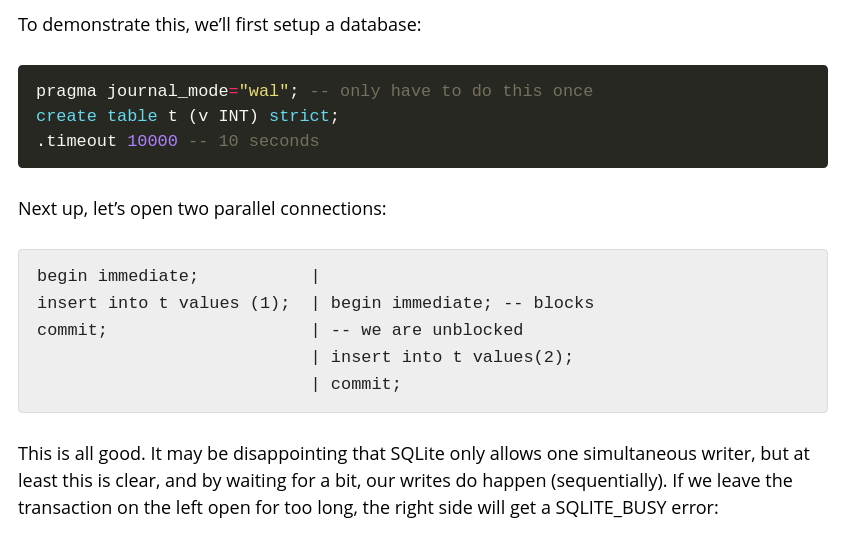
 What to do about SQLITE_BUSY errors despite setting a timeout - Bert Hubert's writings
https://berthub.eu/articles/posts/a-brief-post-on-sqlite3-database-locked-despite-timeout/
The tl;dr on this, to prevent SQLITE_BUSY errors even when setting a timeout, don’t ever upgrade transactions to read-write. If you know you are going to write in a transaction, use ‘BEGIN IMMEDIATE’, or start off with the write. But do read on for why this is so, and how other databases struggle with this problem as well.
 Turning Your Root URL Into a DuckDB Remote Database | Drew Breunig
https://www.dbreunig.com/2024/12/01/turning-your-root-url-into-a-duckdb-remote-database.html
On the Overture Slack, Jake Wasserman shared a cool trick where you can connect to a remote DuckDB database using the ATTACH statement, using an HTTP or S3 URL. Jake’s demo was especially cool because he created a DB containing only views referencing an Overture parquet on S3, so the hosted database file was only a couple hundred kilobytes.
 Writing Composable SQL using Knex and Pipelines
https://lackofimagination.org/2024/11/writing-composable-sql-using-knex-and-pipelines/
We have used a query builder to programmatically build SQL queries, and by using higher-order functions (functions that take other functions as arguments) and pipelines, we have:
Eliminated the need to pass the query object explicitly.
Made it easier to add, remove, or rearrange query modifiers without disrupting the overall structure.
Improved maintainability and simplified testing since each query modifier function is a self-contained unit that can be reused across various queries and scenarios.
 wesql/wesql: WeSQL is an innovative MySQL distribution that adopts a compute-storage separation architecture, with storage backed by S3 (and S3-compatible systems). It can run on any cloud, ensuring no vendor lock-in.
https://github.com/wesql/wesql
WeSQL is an innovative MySQL distribution that adopts a compute-storage separation architecture, with storage backed by S3 (and S3-compatible systems). It can run on any cloud, ensuring no vendor lock-in.

 DB Browser for SQLite
https://sqlitebrowser.org/
DB Browser for SQLite (DB4S) is a high quality, visual, open source tool designed for people who want to create, search, and edit SQLite or SQLCipher database files. DB4S gives a familiar spreadsheet-like interface on the database in addition to providing a full SQL query facility. It works with Windows, macOS, and most versions of Linux and Unix. Documentation for the program is on the wiki.
frectonz/pglite-fusion: Embed an SQLite database in your PostgreSQL table. AKA multitenancy has been solved.
https://github.com/frectonz/pglite-fusion
Embed an SQLite database in your PostgreSQL table. AKA multitenancy has been solved.
 SQLite Index Visualization: Structure
https://mrsuh.com/articles/2024/sqlite-index-visualization-structure/
After learning about indexes, I understood their basic structure, but I wanted to dig deeper — to explore the data structure, understand the algorithm, and learn how the index data is stored on disk.
The theory and actual implementation can differ, so I decided to explore this topic further.
dbcli/litecli: CLI for SQLite Databases with auto-completion and syntax highlighting
https://github.com/dbcli/litecli
CLI for SQLite Databases with auto-completion and syntax highlighting
 Vector Databases Are the Wrong Abstraction
https://www.timescale.com/blog/vector-databases-are-the-wrong-abstraction/
A more effective abstraction is conceptualizing vector embeddings not as independent tables or data types but as a specialized index on the embedded data. This is not to say that vector embeddings are literally indexes in the traditional sense, like those in PostgreSQL or MySQL, which retrieve entire data rows from indexed tables. Instead, vector embeddings function as an indexing mechanism that retrieves the most relevant parts of the data based on its embeddings.
 Announcing Toasty, an async ORM for Rust | Tokio - An asynchronous Rust runtime
https://tokio.rs/blog/2024-10-23-announcing-toasty
Toasty is an asynchronous ORM for the Rust programming language that prioritizes ease of use. Toasty supports SQL and NoSQL databases, including DynamoDB and Cassandra (soon).
 Database Remote-Copy Tool For SQLite
https://sqlite.org/rsync.html
The following command causes REPLICA to become a copy of ORIGIN:
$ sqlite3_rsync ORIGIN REPLICA ?OPTIONS?
 Cron-based backup - Litestream
https://litestream.io/alternatives/cron/
Sometimes Litestream can be overkill for projects with a small database that do not have high durability requirements. In these cases, it may be more appropriate to simply back up your database daily or hourly. This approach can also be used in conjunction with Litestream as a fallback. You can never have too many backups!
 Zero
https://zerosync.dev/
We’re building a general-purpose sync engine for the web. You put Zero in front of your existing database or web service, and we distribute your backend all the way to main thread of the UI.
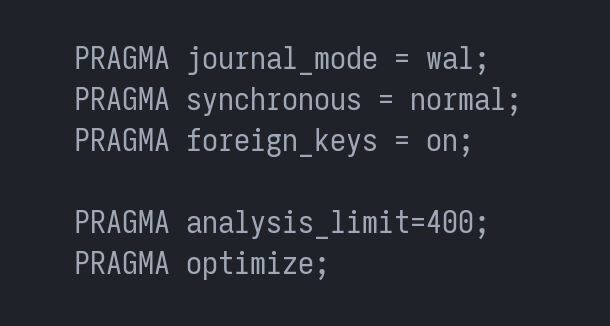
 SQLite Pragma Cheatsheet for Performance and Consistency | Clément Joly – Open-Source, Rust & SQLite
https://cj.rs/blog/sqlite-pragma-cheatsheet-for-performance-and-consistency/
SQLite Pragma Cheatsheet for Performance and Consistency | Clément Joly – Open-Source, Rust & SQLite
https://cj.rs/blog/sqlite-pragma-cheatsheet-for-performance-and-consistency
 SQLite performance tuning - Scaling SQLite databases to many concurrent readers and multiple gigabytes while maintaining 100k SELECTs per second - phiresky's blog
https://phiresky.github.io/blog/2020/sqlite-performance-tuning/
Scaling SQLite databases to many concurrent readers and multiple gigabytes while maintaining 100k SELECTs per second
SQLite performance tuning - Scaling SQLite databases to many concurrent readers and multiple gigabytes while maintaining 100k SELECTs per second - phiresky's blog
https://phiresky.github.io/blog/2020/sqlite-performance-tuning
Scaling SQLite databases to many concurrent readers and multiple gigabytes while maintaining 100k SELECTs per second
 Sqlg Documentation
https://sqlg.org/docs/3.0.0/
Sqlg mark github is a implementation of Apache TinkerPop on a RDBMS. Currently Postgresql, HSQLDB, H2, MariaDB, MySQL are supported.
Sqlg Documentation
https://sqlg.org/docs/3.0.0
Sqlg mark github is a implementation of Apache TinkerPop on a RDBMS. Currently Postgresql, HSQLDB, H2, MariaDB, MySQL are supported.
 Postgres.app | the easiest way to run PostgreSQL on the Mac
http://postgresapp.com/
the easiest way to run PostgreSQL on the Mac
Postgres.app | the easiest way to run PostgreSQL on the Mac
http://postgresapp.com
the easiest way to run PostgreSQL on the Mac
 NoSQL vs. RDBMS: Let the flames begin! – stu.mp
http://stu.mp/2010/03/nosql-vs-rdbms-let-the-flames-begin.html
"I guess what I’m saying is that my decision to use NoSQL, and I’m guessing others’ decisions to do so, has less to do with the fact that we can’t squeeze a few thousand writes a second out of MySQL and more to do with management and cost overhead. NoSQL solutions allow us to serve absurd amounts of data for a really, really low price. I’m happy to put my $/write, $/read, and $/GB numbers for my NoSQL setup against anyone’s RDBMS numbers.
We’re not nearly as dumb as everyone thinks we are; I promise."
 cloudkick | blog: 4 Months with Cassandra, a love story
https://www.cloudkick.com/blog/2010/mar/02/4_months_with_cassandra
"At Cloudkick we track a ton of metrics about our customer's servers and it's quite a challenge to store such massive amounts of data. Early on, we made the decision to avoid using tools like RRDTool, so we could provide a more holistic look at infrastructure. We had two firm requirements: we wanted to show trends on a macro-level and to have very low latency so our users would never wait for graphs to build. We initially used PostgreSQL, but as we added billions of rows, the performance quickly degraded. We used cron jobs that would roll up the data on intervals to trade storage for throughput and lower latency. With clever partitioning, we were able to stretch the system to a certain point, but beyond that we faced issues of needing a much bigger machine and faster rotational disks to accommodate our business requirements; that's when started looking at other solutions."
 Some use cases of Cassadra | a db thinker's home
http://www.dbthink.com/?p=183
 Damn Cool Algorithms: Spatial indexing with Quadtrees and Hilbert Curves - Nick's Blog
http://blog.notdot.net/2009/11/Damn-Cool-Algorithms-Spatial-indexing-with-Quadtrees-and-Hilbert-Curves
"Spatial indexing is increasingly important as more and more data and applications are geospatially-enabled. Efficiently querying geospatial data, however, is a considerable challenge: because the data is two-dimensional (or sometimes, more), you can't use standard indexing techniques to query on position. Spatial indexes solve this through a variety of techniques. In this post, we'll cover several - quadtrees, geohashes (not to be confused with geohashing), and space-filling curves - and reveal how they're all interrelated."
 Enabling Vertical (\G) Output in the MySQL Client | Slaptijack
http://slaptijack.com/software/enabling-vertical-g-output-in-the-mysql-client
"One problem with the MySQL command line client is that queries with lots of columns tend to wrap crazily based on your terminal size. To overcome this, you can get a vertical output by terminating your queries with \G instead of ;. I find this format extremely helpful in cases where I know only one row will be returned. "
 Web Database - W3C HTML5
http://dev.w3.org/html5/webdatabase
"This specification defines an API for storing data in databases that can be queried using a variant of SQL."
 Self-healing databases: managing schema updates in the field
http://www.slideshare.net/jonoxer/selfhealing-databases-managing-schema-updates-in-the-field
"Update database schemas for web applications on live production servers without your users noticing anything"
 Database design and CakePHP (Articles) | The Bakery, Everything CakePHP
http://bakery.cakephp.org/articles/view/database-design-and-cakephp
"First of all you need to forget you are designing a database!" That, straight off, gives me the shakes.

 the ryan king » Introducing Conveyor
http://theryanking.com/entries/2008/02/26/introducing-conveyor
"The future for large websites’ data storage is likely a collection of special purpose data stores: GFS/MapReduce for batch jobs, inverted indexes for search and fast retrieval of small result sets and relational databases for smaller datasets which nee
 TagSchema - MySQLForge Wiki
http://forge.mysql.com/wiki/TagSchema
Noticing one thing missing from most tagging schemes: Preservation of the order of tags as entered with the item. Seems minor, but it's actually important for capturing intent.
 Liminal Existence: SELECT * FROM everything, or why databases are awesome.
http://romeda.org/blog/2007/06/select-from-everything-or-why-databases.html
"Arg stabby stab stab stabbity fuck stab"
 Twitter, Rails, Hammers, and 11,000 Nails per Second — Thought Palace
http://mooseyard.com/Jens/2007/04/twitter-rails-hammers-and-11000-nails-per-second
"And of course you could keep going with this novel “distributed” idea, and make this into an actually-distributed system, where individual users (or groups of them) can run their own Twitter servers that queue their incoming messages and relay their
 Amazon Web Services Blog: MySQL Interface to Amazon S3
http://aws.typepad.com/aws/2007/04/mysql_interface.html
"Independent developer Mark Atwood has been working on a MySQL interface to Amazon S3."
 ITworld.com - A rush of codd to the hand
http://www.itworld.com/AppDev/nlsebizdcodd061128
"Some of the best managed content I have ever seen sits on a Unix file system and some of the worst managed content I have ever seen sits in a big honking, breathtakingly expensive, relational database."
 PostgreSQL and XML updated
http://www.throwingbeans.org/postgresql_and_xml_updated.html
"The XML functions for PostgreSQL (introduced here) have been updated and, as of version 8, ship with the standard distribution of PostgreSQL." XSLT and XPath in the database.
 jclark.org : HOWTO: Build DB XML 2.0 with Python Bindings on OS X
http://jclark.org/weblog/Apple/OSX/dbxml2-py-osx.html
"Here's what I did to build and install DB XML 2.0 along with python bindings on OS X 10.3.7." Wow, this has gotten a *lot* easier.
 Rethinking the relational database | Perspectives | CNET News.com
http://news.com.com/Rethinking+the+relational+database/2010-1015_3-5715457.html?part=rss&subj=news&tag=5715457
"Ironically, a technology previously destined for the history books may well fit current and future requirements perfectly: the flat file." Er... since when were flat files going away?