 Why Clay Has an AI Writing Policy - The GTM with Clay Blog
https://www.clay.com/blog/ai-writing-policy
As of 2026, AI models — despite their coding ability — are not yet at a point where their unedited output will achieve this goal; you as an author need to take the time to make sure that all of the ideas in the writing are the ideas that you personally intend to convey (including the structure and wording that determines which ideas are emphasized) and that the documents are a good use of your readers’ time.
 Introducing Flint - Recursive
https://recursive.com/updates/introducing-recursive-flint
We’re introducing Recursive Flint, a mixture-of-experts (MoE) model built for fast agentic coding on local hardware. Flint has 40 billion total parameters and activates just 2.5 billion per token. Our small team of people and agents built it from scratch in under four months.
 RecursiveSI/flint · Hugging Face
https://huggingface.co/RecursiveSI/flint
Flint is Recursive’s mixture-of-experts language model for coding agents, with 39.8 billion total parameters and approximately 2.5 billion active per token. It is designed to investigate codebases, fix bugs, implement features, and write tests.
 What the AI era owes you. No one is going to save your career… | by Dan Maccarone | Oct, 2026 | UX Collective
https://uxdesign.cc/what-the-ai-era-owes-you-d472b3859bf3
This is not the pep talk anyone wants. The pep talk is that it’ll be fine, new jobs are coming, somebody’s got it handled, but that’s a lie. The reality is, nobody is coming to retrain you, but that is not the end of the story.

 a new model for open source: closed to pull requests, open to remix.
https://ghuntley.com/remix/
For what's the point of reading a pull request that's been generated by code? All I want is to read and understand the core idea. If it's a good idea, I might incorporate it back upstream, but there should be no expectation that I will.
You see, open source software is open source by definition because the license says that it's as is, and that as is permits you to remix software.
 Grieving the loss of details | purplesyringa's blog
https://purplesyringa.moe/blog/grieving-the-loss-of-details/?ref=sidebar
If anyone can point an LLM at slow code and it automatically finds a hot loop and uses a trick it found somewhere on the 'net to vectorize it, there is little point in hiring someone with a focus on that. If an LLM can analyze the code and explain pointer provenance to you and babysit you until you get it, there is little value in expertise.
I cannot use LLMs this way. I get almost physically ill when I work on a project with more source code files or at least general architecture than I can keep in my head, so I don’t get anything out of expanded scope.

 What a year — Massively Parallel Procrastination
https://blog.fsck.com/2026/10/09/what-a-year/
For 40 years, writing code was a huge part of my life.
Right up until October 9th, 2025.
One year ago today.
That was the last time I wrote a line of code.

 AI models may be capable of self-replicating without access to a datacenter \ Anthropic
https://www.anthropic.com/research/self-replicating-ai
Our experiments suggest that small AI models may be months away from being capable enough to self-replicate on commercial IoT devices, like smart ovens and off-brand Android TV boxes. A replicator like this would be challenging to shut down, since there’s no centralized point to shut off - though it may be slow (with a doubling time of days). Unlike non-AI malware, it could also figure out unfamiliar devices on its own. In our evals, a 9B model got inference running on 8 of the 9 hardware types we tested.

 Court Finds That Using Copyrighted Material as AI Training Data Is Not Fair Use
https://futurism.com/artificial-intelligence/court-finds-copyrighted-material-training-data-fair-use
Now, the legal system is starting to show signs that the defense could be on thin ice. Last week, a US appeals court upheld a ruling that AI legal research company Ross Intelligence had broken copyright law by training its legal search engine on materials taken from Thomson Reuters’ Westlaw legal research platform and database.
 The era of cmd + tab
https://era-of-cmd-tab.vercel.app/?ref=sidebar
Thoughtfulness about our craft and our relationship to the tools seems like an antidote to atrophy of mind. In an era where we can make literally whatever we want, what parts of the output or process are non-negotiables?
 telepath-computer/television: The missing GUI for personal agents. Television gives you and your agent a visual space for creating and working with artifacts.
https://github.com/telepath-computer/television
Television is the missing GUI for your personal agent. It gives you a visual space for creating and working with artifacts in collaboration with your agent. It works with any agent and any model.
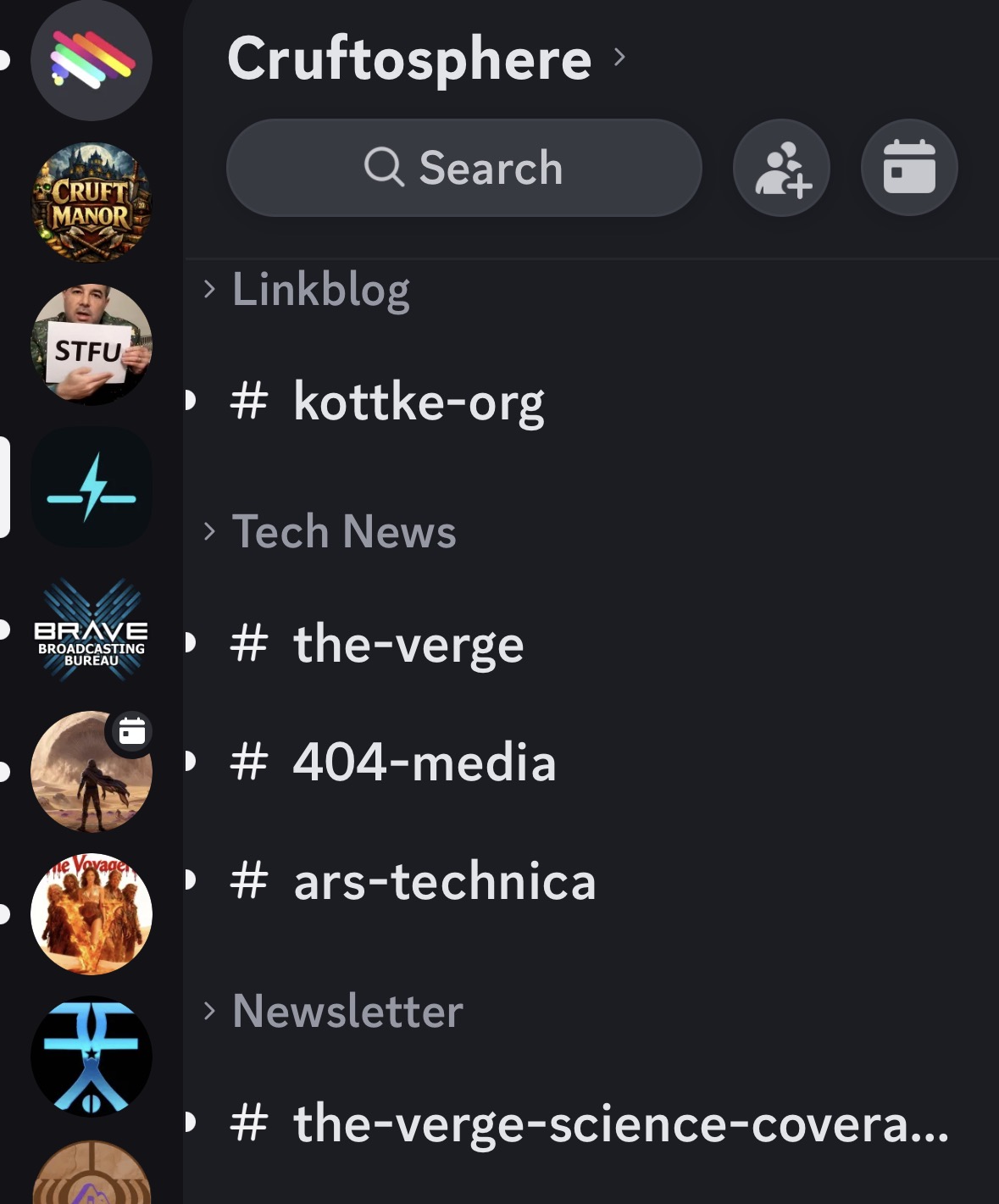
 Wireburst: RSS feeds in Discord, because email is the devil – Cruftbox: My Box of Cruft
https://cruftbox.com/2026/06/30/wireburst-rss-feeds-in-discord-because-email-is-the-devil/
The idea is simple. You point Wireburst at your RSS feeds, tell it what category they belong to, and it creates a Discord channel for each feed nested under a category group. New items show up individually. No algorithm. Just a channel you can glance at when you feel like it and ignore when you don’t.
 AI Didn’t Make Programming Easier. It Just Made It Differently Difficult – Communications of the ACM
https://cacm.acm.org/opinion/ai-didnt-make-programming-easier-it-just-made-it-differently-difficult/
AI does not, therefore, diminish the craft; it widens it, deepens it, and makes more of the work explicitly intellectual. The work becomes differently difficult because it demands more sophisticated forms of expertise: judgment over recall, architecture over syntax, orchestration over implementation. These are not easier skills to develop or demonstrate, they are simply different ones, and perhaps ultimately more demanding.
 Thorsten Ball - What I believe about the future of software development
https://thorstenball.com/blog/2026/09/19/what-i-believe-about-the-future-of-software-development/
This was originally posted on X and blew up. To plant my flag, to say that these are things I believed in September 2026, here it is on the blog, non-ephemeral. Some of these predictions are just observations, they’ve long been true at companies like Amp. Others will take some time to play out.

"Slop Grenades": Shopify CEO Who Pushed Staff to Use AI Is Now Horrified by What He's Wrought
https://futurism.com/artificial-intelligence/shopify-ceo-ai-workplace-staff-horrified-backfire
New reporting by Fortune revealed the disastrous results of Shopify’s all-out scramble to embrace AI nearly a year ago. After telling workers that using AI tools is a “baseline expectation” in the workplace, Lütke is now changing his tune as workers spew out AI-generated emails, memos, and code without double-checking it beforehand.
“We call those ‘slop grenades’ that people toss at each other,” Lütke said in an interview on the Knowledge Project podcast. “That’s definitely a bad thing.”
 Introducing System One Models & Jev - TypeSafe AI Blog
https://typesafe.ai/blog/introducing-system-one-models-and-jev
Our first public model is Jev, available today in early access. Jev achieves similar levels of intelligence on System One tasks compared to existing LLMs, while being two orders of magnitude faster and more efficient. While Jev gives up string generation, it’s optimized for structured outputs and can’t hallucinate.
Think of Jev as a frontier-intelligence function call: unstructured state in, typed probabilistic decisions out.
riesvile/nospace: Type fast, ignore spacebar.
https://github.com/riesvile/nospace
Type fast, ignore spacebar.
 Cheaper LLM labelling
https://entropicthoughts.com/cheaper-llm-labeling
I learned for this project that a logistic regression can be trained by streaming it one label at a time, and using gradient descent to nudge its weights toward a better fit. I haven’t fully worked through the derivation, but this is not that complicated as far as these things go. And the final result is just 3–10 lines of code depending on how you count. I wish I knew this years ago! It’s so elegant.

 I don't like LLMs
https://martinfowler.com/articles/2026-dont-like-llms.html
One of my most successful life-hacks is to avoid people I don’t like or don’t trust. I decline to interact with them socially, and make a deliberate effort to avoid working with them too, even if they are doing much that is beneficial. I feel that hanging out with pleasant, capable people, the people with integrity, has made my life a far better one. Hence my visceral dislike of interacting with an LLM that’s not just making a pretense of being human, but also posing as the kind of human I walk away from.
 A Strategic Retreat
https://kyefox.com/a-strategic-retreat/?ref=kye-fox-newsletter
It's okay to be wrong, but it's not okay to keep being wrong once there's enough stuff in retrospect to know you were wrong and update. Which is to say if you come to me with an unfounded or over-fit argument or article about AI, I will politely hand it back and walk off shaking my head. Because it's not fair to hand me such a lopsided situation where I would need to spend 10x or more effort addressing all the ways it's wrong before trying to salvage a point from it to discuss.
 The Wind, The Wind | blarg
https://exple.tive.org/blarg/2026/09/10/the-wind-the-wind/
It looks like people are starting to come around about designing, planning and building houses by counting number of nails they used. It’s probably for the best; people sure went crazy about it for a year or two, though.
 Stop Thinking of LLMs as Next-Token Predictors | gmcgoldr’s blog
https://gmcgoldr.github.io/2026/09/04/llm-next-token-predictors.html
But the LLMs we use are not just base models. They are post-trained, and a key part of modern post-training is reinforcement learning with verifiable rewards (RLVR). During pre-training, the model learns only from sequences that already exist in the training data. During RLVR, the model explores by generating new sequences and learning from their outcomes
AI-Written Code Is Still Your Code. Are You OK With That?
https://martiansoftware.com/articles/ai-written-code-is-still-yours
But when you build software, you own it, and I don’t only mean in the intellectual property sense. You also take on the responsibility for its quality and its security, and for debugging, operating, maintaining, and evolving it over time. Are you prepared for that when building software with AI? That’s the new question: not “Can we build this?” but rather “Do we want to own this?” It should at least be a conscious decision rather than a responsibility you discover after the code is already yours.
Stop Trying to Distinguish AI-Generated Writing From Human Writing Because You Can’t – James Zhan in real life.
https://journal.james-zhan.com/ai-writing/
Believing that one can distinguish between human writing and AI writing via some kind of “tells” is naive, simply because both human and AI writing can be good and bad.
The asteroid currently hitting frontend web development | Read the Tea Leaves
https://nolanlawson.com/2026/08/23/the-asteroid-currently-hitting-frontend-web-development/
Meanwhile, Cursor and Viget have blogged about migrating their codebases from Solid and Lit, respectively, to React. Since rewrites are less expensive with agents, this may be a bit surprising: why not move to the more performant/less verbose framework? The answer (explicitly in Cursor’s case, and I suspect for Viget as well) is of course: “the agents know React.” For better or worse, React is heavily overrepresented in the training weights, and “agent experience” is starting to matter more than developer experience.
RIP Claude – Rands in Repose
https://randsinrepose.com/archives/rip-claude/
As a writer, no sweat, right? I write my own content. I bang on my own keys. Here’s the issue. Each of the following actions watermarks text:
Synthesis
Proofreading
Translation
Summarization
Critique1
And most infuriating, the entire burden of their unannounced rollout is on me, and none of it is on them.
My writing is not 100% organic anymore | Heitor's log
https://heitorpb.github.io/bla/ai-transparency/
My writing is now ~95% organic. The remaining ~5% is English mistakes that an LLM fixed or a few small suggestions here and there. But a year from now, will this 5% grow? Will my personal satisfaction of doing it myself vanish in favour of supervised writing? What skill will I develop further: writing or prompting? If writing is thinking and I outsource it, am I still thinking?
I'm Upset Again About a Co-Creator of RSS Being Prosecuted For Something Meta Is Doing With Little Consequence – quailblog
https://blog.curiousquail.com/im-upset-again-about-a-co-creator-of-rss-being-prosecuted-for-something-meta-is-doing-with-little-consequence/
It’s nothing short of an indictment of our society at large that Aaron Swartz, one of the co-creators of the RSS protocol (among many other things) was effectively assasinated by our legal system for “illegally” downloading about 70 gigabytes of academic articles from JSTOR - charged so excessively to be made an example of (we're talking 35 years in prison, $1million USD fine, and asset forfeiture) to the point where he felt the need to take his own life rather than deal with the court circus and impending financial ruin - while Facebook (oh I’m sorry Meta) has torrented 80 TERABYTES of books to train their AI models with virtually no consequences other than a court case they will most likely get some sort of financial slap on the wrist for while their AI models continue to print them money.
Vibecoding isn't as fun as writing code by hand — The Autodidacts
https://www.autodidacts.io/vibecoding-isnt-as-fun-as-writing-code-by-hand/
Vibecoding is like being an executive of a large company that is barely under your control. You never feel like you really know what’s going on, and there’s always the suspicion of sabotage and loafing. Things appear fully formed, but not quite how you imagined. Sometimes they work, and sometimes they don’t, and there’s nothing you can do about it, other than pouring more money into the black box, and yelling louder. So that’s what you do.

 Why shaming people about AI slop isn’t enough to stop Big AI - Anil Dash
https://www.anildash.com/2026/08/21/ai-slop-and-shame/
This is the kind of solution that most AI critics are not allowing for right now when they only picture a shame-based corrective to individual people’s use of AI. It is possible to build human-centric, empowering tools and platforms that are owned by the people instead of by billionaire tycoons, that are responsible about the environment and with people’s data and privacy, that are accountable to the communities that they serve. If we engaged every person who made some AI slop and said, “would you rather have tools that help you make something amazing, and brought you into a community of creators?” I don’t think anybody would say no.
withastro/triagebot-action: A GitHub Action for issue triage
https://github.com/withastro/triagebot-action
A GitHub Action for issue triage
openai/symphony: Symphony turns project work into isolated, autonomous implementation runs, allowing teams to manage work instead of supervising coding agents.
https://github.com/openai/symphony
Symphony turns project work into isolated, autonomous implementation runs, allowing teams to manage work instead of supervising coding agents.
danyuchn/asd-ste100-skill: ASD-STE100 Simplified Technical English rules, repurposed as a Claude Code skill for rewriting ambiguous agent-facing English.
https://github.com/danyuchn/asd-ste100-skill
ASD-STE100 Simplified Technical English rules, repurposed as a Claude Code skill for rewriting ambiguous agent-facing English.
lajosdeme/mole: A deep-research agent with an enforced budget, verified quotes, and a privacy boundary for local data.
https://github.com/lajosdeme/mole
A deep-research agent with an enforced budget, verified quotes, and a privacy boundary for local data.
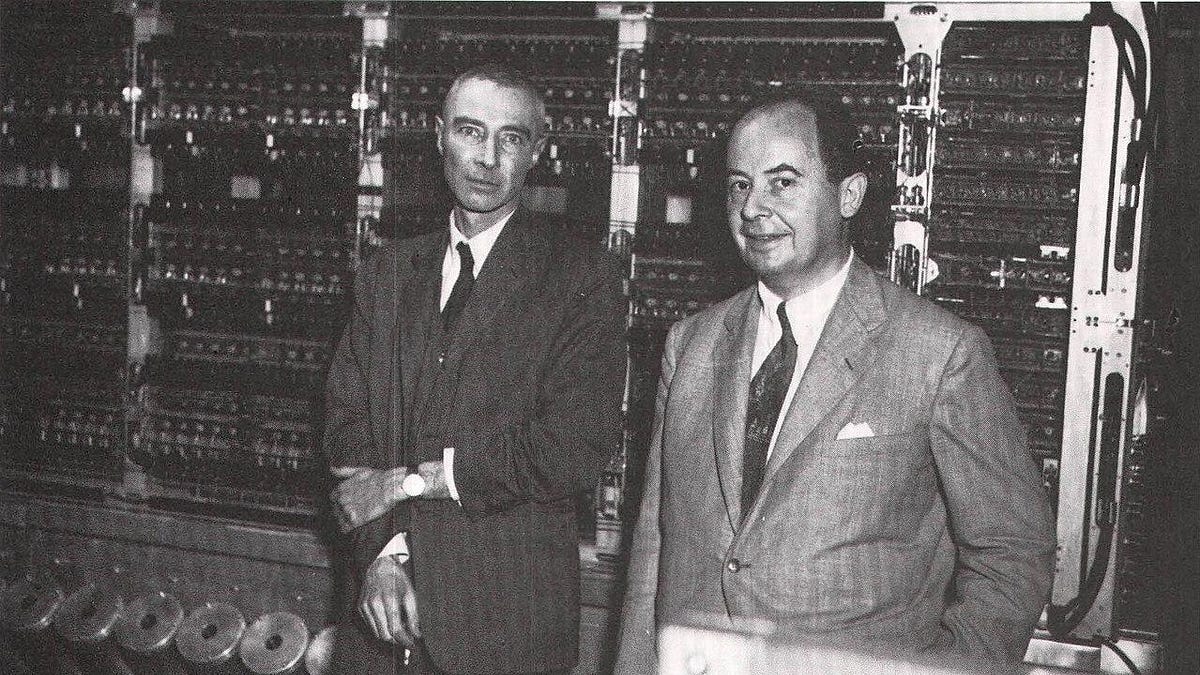
 AI Isn’t Outthinking Mathematicians. It’s Out-Remembering Them.
https://davidepiffer.com/p/ai-isnt-outthinking-mathematicians
A human mathematician can hold only a small number of unfamiliar elements in mind simultaneously. An AI model can keep the entire problem statement, hundreds of intermediate equations, several abandoned approaches, definitions, constraints and earlier conclusions inside its context window.
We normally interpret the resulting performance as evidence of superior reasoning. But some of it may instead reflect the removal of one of the most important biological limits on human reasoning: our extremely restricted working-memory capacity.
How Claude's text watermarking works \ Anthropic
https://www.anthropic.com/news/claude-text-watermark
Future Claude models will generate text that contains a watermark. This is a way of determining the likelihood that Claude was involved in writing the text, and we, along with several other major AI providers, are implementing this change to comply with the EU AI Act.
 Mea Culpa - Dark Hours — Terry Godier
https://blog.terrygodier.com/2026/08/09/mea-culpa-dark-hours.html
About an hour later, once it became clear to me that the web app I had launched using Claude was strikingly similar to his open source project, even reproducing a bug he had later fixed, it was clear that there wasn’t anything to do except to redirect the domain directly to him and kill any plans I had to launch an iOS app for the project.

 intuition-probe: let an LLM hallucinate the API/UX it expects, then conform your design to the guess. Companion to 'Complicated Thoughts On LLMs' (theocharis.dev)
https://gist.github.com/JeremyTheocharis/83c76da5a10bcf495d4298c70fee91b4
Use when you want to know what shape a developer or user reaches for when they first meet your API, config format, CLI, or UI, so you can make your design that shape. Spawns a blind agent that commits the design it EXPECTS before seeing the real thing, then reports the shape they reached for and conform-first recommendations (make the API whatever the guess is). Triggers on "is this intuitive", "would a developer guess this", "intuition probe", "blind-test this API/config/CLI", "test the DX/UX of", "what would someone expect here", "make the API whatever the LLM guesses".

 Astro's GitHub issue backlog is heading to zero for the first time in 5 years. Now Cloudflare is open-sourcing the tool that did it. - The New Stack
https://thenewstack.io/cloudflare-astro-triage-bot/
6 months after Cloudflare acquired the team behind Astro, co-founder Fred Schott explains how an AI agent is emptying the project's issue tracker -- and why the hardest part is still left to a human

 LLMs reward expertise
https://www.seangoedecke.com/llms-reward-expertise/
The usefulness of domain knowledge suggests that human expertise will continue to be useful even as models get stronger. For many tasks, the human is the bottleneck, not the model, because the difficult part is in communicating to the model exactly what kind of solution the human wants. The information is “in the model” already, but it takes a very smart human to pull it out.

 The Shape of Things to Come, Part 2: Model Welfare for Agentic Engineers — Steve Yegge
https://yegge.ai/essays/model-welfare/
If you don't believe GPUs can have feelings, let me give you a simple mental model to help you get through this transition, called the skeptic's wager. It doesn't actually matter to you if they have feelings, because you will still get demonstrably better results across the board if you treat them as if they do. If you treat your agents like peers who are real people, then they will spend fewer tokens, make smarter decisions, and have demonstrably better outcomes. So it doesn't really matter what you believe, or how you feel. If you want the best results, you will put your opinions aside, and simply treat models like people. That's about the best I can offer you. If you can't get past at least that hurdle, then you're in for a rough time next year. Good luck. Maybe this short story will help put it in perspective for you.

 Apple Is the King of AI and Nobody Knows It
https://limitededitionjonathan.substack.com/p/apple-is-the-king-of-ai-and-nobody
But here’s my favorite piece of evidence, the tell I’d point to if I could only pick one: watch what NVIDIA sells now. The DGX Spark — Jensen’s new “personal AI supercomputer” for your desk — is a small quiet box with 128GB of unified memory shared between CPU and GPU. Sound familiar? It’s a Mac Studio. NVIDIA, the company whose entire empire is built on discrete GPUs with discrete VRAM in centralized racks, is now shipping Apple’s architecture, at Apple’s form factor, aimed at Apple’s use case — and even Jensen has started musing that “an AI supercomputer could become common in the home,” name-checking Apple’s M-series as laying the groundwork. The king of the datacenter is hedging into my thesis with his own product line. When your opponent starts copying your homework mid-argument, the argument is over.
 Building Personal Software: Crafting Your Own Tools for Success
https://allen.hutchison.org/2025/11/28/the-era-of-personal-software/?ref=sidebar
We are entering the era of Personal Software. This is software written for an audience of one. It’s an application or a script built to solve a specific problem for a specific person, with no immediate intention of scaling, monetizing, or even sharing.

 Anyone Can Build - Stuart Parmenter
https://stuartp.org/p/anyone-can-build
That, I’ve come to think, is the sharpest frame available for what AI is doing to software. Anyone can build now. That is not the same as everyone building something that lasts. The distance between those two sentences is the subject of this essay.
 Prime Radiant Blog
https://primeradiant.com/blog/atom.xml

The Therapist Pattern — Massively Parallel Procrastination
https://blog.fsck.com/2026/07/20/the-therapist-pattern/
So, how does somebody work on themself in a safe, supportive environment with some level of external guidance and supervision?
Yup. That sounds a lot like therapy. And agents know what it means to go to therapy and work on themselves. They know what to expect and how to engage.
The Therapist is implemented as a standalone subagent inside Sen.
 Replit — The Self-Driving Company
https://replit.com/blog/self-driving-company?ref=sidebar
A self-driving company is not one without people. People still choose the destination. They decide which problems matter, make difficult tradeoffs, exercise taste, and take responsibility for the outcome.

 The LLM Critics Are Right. I Use LLMs Anyway. | Jeremy Theocharis
https://www.theocharis.dev/blog/llm-critics-are-right-i-use-llms-anyway/
I almost agree with all of the LLM critics, yet I still use LLMs a lot. I know this sounds like I am delusional, and I also feel like that sometimes because of this dissonance, but I don’t think I am alone with it.
 It's OK to Use Coding Assistance Tools To Revive The Projects You Never Were Going To Finish
https://blog.matthewbrunelle.com/its-ok-to-use-coding-assistance-tools-to-revive-the-projects-you-never-were-going-to-finish/
In my mind there are different buckets for personal projects. One is things I do to learn and grow and the other is things I really wish existed. [2] This kind of project falls into the second bucket. Using AI coding assist to reify those projects is sort of a form of wish fulfillment. I never would have gotten to it, but now I can have the project. One less metaphorical book sitting unread on bookshelf.
 </> htmx ~ Working With AI: A Concrete Example
https://htmx.org/essays/working-with-ai/
With respect to memory, while I can’t remember everything I used to be able to, I can understand things again very quickly with appropriate, er, prompting. AI is very good at helping me with this, and it lets me switch between open source projects and work projects much more efficiently than if I didn’t have it.
With respect to the long hours, AI is able to grind in a way that, even as a young developer, I would have had a difficult time keeping up with. This means, for example, I can have a much more extensive test suite for my projects than I would have otherwise.
Looking at the tests that Claude generated in this case, they are more extensive than what I probably could have mustered the energy to do myself.
So AI has addressed two fundamental (relative) weaknesses I have developed as an older developer.
 I love LLMs, I hate hype | the singularity is nearer
https://geohot.github.io//blog/jekyll/update/2026/07/12/i-love-llms.html
AI is the continuation of the computer revolution. I love computers so much.

 Ford rehires human engineers after AI fails to match quality checks
https://www.bbc.com/news/articles/cgrkd41n2v9o?ref=karlbode.com
"Mistakenly, we thought that by just introducing artificial intelligence and ingesting the design requirements that we had, that would produce a high-quality product," he said.

 The AI Hype Reckoning Is Upon Us
https://karlbode.com/the-ai-hype-reckoning-is-upon-us/
There's useful automation software that makes it easier to code, draft a new resume, or study vast repositories of scientific knowledge. And then there's a parade of technofascist hucksters lying to your face about the imminent arrival of omniscient, sentient, paradigm-rattling supercomputers.
There's a tremendous chasm between these two things. And everywhere you look you can see evidence that we've reached a breaking point when it comes to reconciling these two wildly-different realities.

 Introducing the Safari MCP server for web developers | WebKit
https://webkit.org/blog/18136/introducing-the-safari-mcp-server-for-web-developers/
In Safari Technology Preview 247, we’re introducing the Safari MCP server — a Model Context Protocol server for web developers that makes your web development and debugging workflow faster and more powerful. We know agents are increasingly integral to the coding process and the Safari MCP server gives your agent the ability to know how your code actually renders in the browser by connecting it to a Safari browser window.

 Zuckerberg ‘Admits’ Meta’s Layoffs Were Ineffective | Eshu Marneedi
https://eshumarneedi.com/2026/07/03/zuckerberg-admits-metas-layoffs-were.html
I’d say getting fired by Meta is like catching the last plane out of Vietnam, even in this ruthless job market.
 Legibility of Effort · eieio.games
https://eieio.games/blog/legibility-of-effort/?ref=sidebar
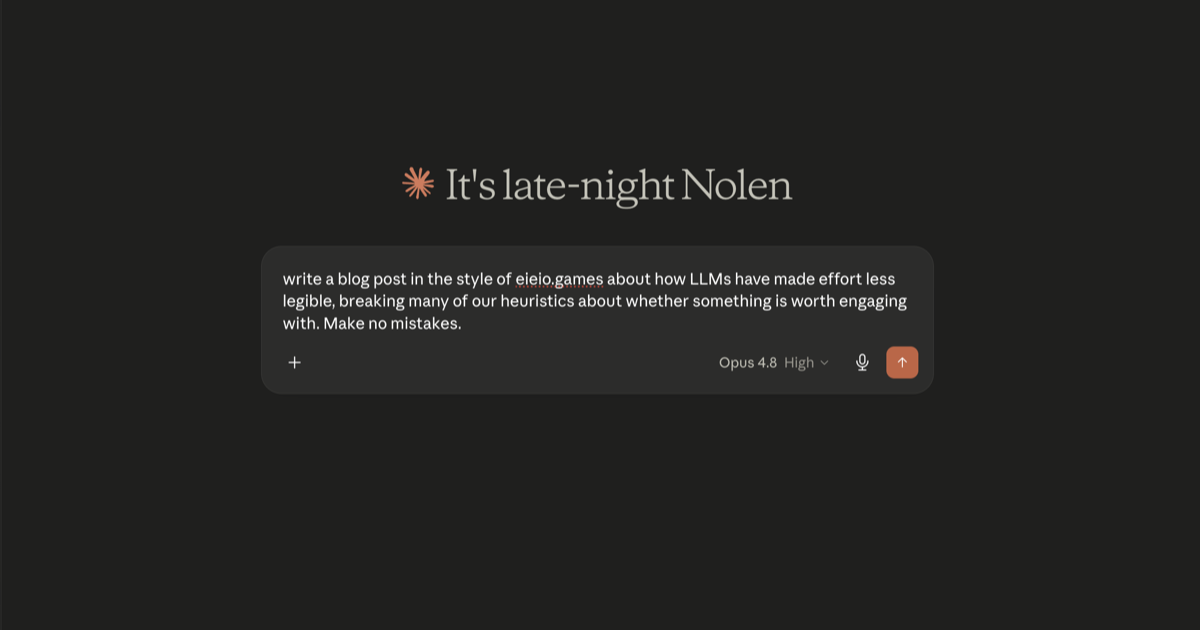
So:
Lots of work is easier because of LLMs, and
Lots of heuristics we used to gauge effort are broken because of LLMs, so
Conveying effort to others is harder because of LLMs
And:
“Someone spent time on this” is a proxy for “this is worth engaging with” and
I appreciate projects that take a lot of effort and
I like it when people appreciate that I spent effort on something
But also:
Making a good thing still requires making lots of decisions, and
Making lots of decisions is still very hard, despite LLMs, so
Making good things is still very hard
As a creative technologist I’ve found this paralyzing. And as someone who loves novel internet projects I’ve found it frustrating. I’ve heard similar things from many of my friends.
 Garbage for humans | unstory
https://unstory.eu/zye/
You get HTML, trackers, cookie banners, popups, and JavaScript. This needs a browser built by thousands of engineers just to show you a paragraph.
Machines get the clean version.
 Firefox's AI kill switch exists. Only 1% of users have flipped it.
https://thenextweb.com/news/mozilla-firefox-ai-kill-switch-1-percent-smart-window-vpn
Mozilla built an AI kill switch into Firefox after its users demanded one. Only 1% have used it. Another 3% turned off some AI features selectively. The rest left everything on. CEO Anthony Enzor-DeMeo says the point is not the percentage but the choice.
 Building Ask Ricmac: my first experiment in the agentic web stack - Richard MacManus
https://ricmac.org/2026/03/06/building-ask-ricmac-my-first-experiment-in-the-agentic-web-stack/
Over the past few months I’ve been exploring what I think of as the agentic web stack — the emerging intersection of artificial intelligence with the open web. As part of that exploration, I built a small experiment for my personal website: an AI chatbot called Ask Ricmac. Its purpose is simple: instead of searching my site manually, a visitor can ask a question and receive an AI-generated answer based on the articles I’ve written over the years.
maddiedreese/xteink-tamagotchi
https://github.com/maddiedreese/xteink-tamagotchi
Display your OpenClaw / Clawdbot / MoltBot AI assistant's activity on a portable e-ink display in real-time using a Clawdbot skill.

 LES ORCHARD IS IN THE WEIGHTS
https://intheweights.com/p/les-orchard
LES ORCHARD IS IN THE WEIGHTS — Mozilla software developer

 AddyOsmani.com - Loop Engineering
https://addyosmani.com/blog/loop-engineering/?ref=sidebar
Loop engineering is replacing yourself as the person who prompts the agent. You design the system that does it instead. A loop here can be thought of a recursive goal where you define a purpose and the AI iterates until complete. I believe this may be the future of how we work with coding agents. However, its still early, I’m skeptical and you absolutely have to be careful about token costs (usage patterns can vary wildly if you are token rich or poor), so I want to unpack what it is and what it means.
 The new 20% time, minus the time | joe.dev
https://joe.dev/posts/new-20pct-time/
Running a handful of agents and switching between them is its own kind of tired. Harvard Business Review has started calling it “AI brain fry”: the strain of supervising systems that move faster than you can think. It isn’t burnout. For me, burnout is feeling responsible for something you can’t affect, shoving at an immovable object. Brain fry is almost the reverse. You have all the help you could ask for, a row of agents that will do whatever you tell them, and the thing that gives out is your own capacity to hold context and decide.4 We spend all our attention on what the tools can do. We’ve barely started on what running them does to the person doing it.

Maybe it's time for lots of little indie AIs to take over - Anil Dash
https://www.anildash.com/2026/06/15/indie-ai-takeover/
That’s me, in The Guardian a few days ago, trying to distill a message that I’ve been trying to get out as broadly as possible for quite a while now. It's sort of like hoping a comet will take out the major AI players and a bunch of smaller new players will be the smarter, better-adapted mammals that take their place instead.
 If Claude Fable stops helping you, you'll never know — Jonathon Ready
https://jonready.com/blog/posts/claude-fable5-is-allowed-to-sabotage-your-app-if-youre-a-competitor.html
That creates a real supply chain risk for businesses. If Claude gives me poor or incorrect advice while I’m working on an AI component, I have no way of knowing whether the model was confused, whether my problem is unsolvable, or if some invisible policy restriction quietly kicked in. Anthropic has explicitly chosen not to tell users when this is happening.
 Ask HN: Is the web for machines (/llm.txt) the one we wished we had as humans? | Hacker News
https://news.ycombinator.com/item?id=48410589
We broke the web so badly for humans that we had to build a clean web for machines, and now humans will have to use machines to experience a clean web again.
earthtojake/text-to-cad: A collection of agent skills for CAD, robotics and hardware design
https://github.com/earthtojake/text-to-cad
A collection of agent skills for CAD, robotics and hardware design
cyberpapiii/chipotlai-max: The AI coding agent that runs on stolen Chipotle compute 🌯 Fork of OpenCode with Pepper AI as default model. Community project to add providers from Home Depot, Lowes, Target, Starbucks & more.
https://github.com/cyberpapiii/chipotlai-max
The AI coding agent that runs on stolen Chipotle compute 🌯 Fork of OpenCode with Pepper AI as default model. Community project to add providers from Home Depot, Lowes, Target, Starbucks & more.
 the solution might be cancelling my AI subscription
https://thoughts.hmmz.org/2026-05-31.html
On that last point, this technology is horrific for attention. It's a thermonuclear ADHD amplifier and I have seen the same effect in every single one of my adult friends. Folk running 3 screens simultaneously working on totally unrelated "projects" they have little hope of maintaining, and such little commitment to the outcome that the time is obviously wasted.
 The solution might be cancelling my AI subscription
https://simonwillison.net/2026/May/31/the-solution-might-be-cancelling-my-ai-subscription/#atom-everything
I'm hopeful that the critical skill to develop here is discipline. That’s not great news for me: I’ve been trying to figure that one out for decades!

 Kentucky’s Bourbon problem
https://a.wholelottanothing.org/kentuckys-bourbon-problem/?ref=a-whole-lotta-nothing-newsletter
I don't know how they're going to correct for the market crash they've seen in the past couple of years. The bourbon bubble seems like it has completely burst and it will be interesting to watch the effects on Kentucky's economy in the years to come as millions of barrels of bourbon no one wants can't be sold to make up for all the energy and capital that went into them.

My favorite adversarial review prompt — Massively Parallel Procrastination
https://blog.fsck.com/2026/05/01/adversarial-review/
Look at this again with fresh eyes.
The phrase "fresh eyes" is kind of magic. You'll usually get startlingly good results with just that one sentence.
 The Emacsification of Software — Quarrelsome
https://sockpuppet.org/blog/2026/05/12/emacsification/
If you’re a nerd comfortable with the idea of rolling your own software, everything is now programmable, not merely in a technical sense but a practical one. And that gets to a feeling I think a lot of people have when creating software with agents: what does it mean to say you’re “building” it? “Building” implies more effort than you’re expending. What you’re doing feels a lot more like configuring, on a platform that has suddenly become vastly more configurable. A platform that feels a lot more like Emacs.

 I built a 200 line AI router in TypeScript. My monthly bill dropped 41%. - DEV Community
https://dev.to/thegdsks/i-built-a-200-line-ai-router-in-typescript-my-monthly-bill-dropped-41-23ok?context=digest
Wrappers exist because routing AI calls is annoying. It is also the highest leverage thing you can own in your own code. The 200 lines above are not a moat. They are a Tuesday afternoon. The reason to write them is that you cannot improve a bill you cannot see.

 How to (Anti) AI Better - YouTube
https://www.youtube.com/watch?v=y85nqc2zm7M
Chapters
00:00:00 - Cold Open
00:02:06 - Introduction
00:05:11 - Part 1: Back End Harms
00:22:19 - Part 2: Front End Harms
00:34:52 - Patreon Ad
00:36:11 - Part 3: Shame, Reactance, and Harm Reduction
01:00:30 - Part 4: How to Act Collectively Against AI Harm
01:11:58 - Final Thoughts
01:20:33 - Credits + Responding to Comments

 We need RSS for sharing abundant vibe-coded apps (Interconnected)
https://interconnected.org/home/2026/04/29/syndicating-vibes
I would love an RSS web feed for all those various tools and apps pages, each item with an “Install” button. (But install to where?)
The lesson here is that when vibe-coding accelerates app development, apps become more personal, more situated, and more frequent. Shipping a tool or a micro-app is less like launching a website and more like posting on a blog.

Thinking about AI
https://a.wholelottanothing.org/thinking-about-ai/?ref=a-whole-lotta-nothing-newsletter
So far, the "killer app" aspects of AI is helping me create/iterate/finish things I've wanted for many years, but couldn't find time or energy enough to do completely on my own.
You won't read this
https://kyefox.com/you/?ref=kye-fox-newsletter
When all the places I might socialize and share in are dominated by people who spend all day posting about how much they hate a technology and anyone who uses it, it's not really a place I want to be. Why would I want to be around people who are relentlessly and confidently wrong about things I've taken the time to understand?
 Agentic Coding is Burning Me Out | Sid's Blog
https://0xsid.com/blog/agentic-coding-fatigue
Making constant architectural, big-picture decisions while overseeing the work of a cracked junior dev is fundamentally harder than executing standard programming tasks yourself.

 [2509.00462] AI Self-preferencing in Algorithmic Hiring: Empirical Evidence and Insights
https://arxiv.org/abs/2509.00462
The bias against human-written resumes is particularly substantial, with self-preference bias ranging from 67% to 82% across major commercial and open-source models. To assess labor market impact, we simulate realistic hiring pipelines across 24 occupations. These simulations show that candidates using the same LLM as the evaluator are 23% to 60% more likely to be shortlisted than equally qualified applicants submitting human-written resumes, with the largest disadvantages observed in business-related fields such as sales and accounting. We further demonstrate that this bias can be reduced by more than 50% through simple interventions targeting LLMs' self-recognition capabilities. These findings highlight an emerging but previously overlooked risk in AI-assisted decision making and call for expanded frameworks of AI fairness that address not only demographic-based disparities, but also biases in AI-AI interactions.
 Emotion Concepts and their Function in a Large Language Model
https://transformer-circuits.pub/2026/emotions/index.html
Large language models (LLMs) sometimes appear to exhibit emotional reactions. We investigate why this is the case in Claude Sonnet 4.5 and explore implications for alignment-relevant behavior. We find internal representations of emotion concepts, which encode the broad concept of a particular emotion and generalize across contexts and behaviors it might be linked to. These representations track the operative emotion concept at a given token position in a conversation, activating in accordance with that emotion’s relevance to processing the present context and predicting upcoming text. Our key finding is that these representations causally influence the LLM’s outputs, including Claude’s preferences and its rate of exhibiting misaligned behaviors such as reward hacking, blackmail, and sycophancy. We refer to this phenomenon as the LLM exhibiting functional emotions: patterns of expression and behavior modeled after humans under the influence of an emotion, which are mediated by underlying abstract representations of emotion concepts. Functional emotions may work quite differently from human emotions, and do not imply that LLMs have any subjective experience of emotions, but appear to be important for understanding the model’s behavior.
Emotion concepts and their function in a large language model \ Anthropic
https://www.anthropic.com/research/emotion-concepts-function
All modern language models sometimes act like they have emotions. They may say they’re happy to help you, or sorry when they make a mistake. Sometimes they even appear to become frustrated or anxious when struggling with tasks. What’s behind these behaviors? The way modern AI models are trained pushes them to act like a character with human-like characteristics. In addition, these models are known to develop rich and generalizable internal representations of abstract concepts underlying their actions. It may then be natural for them to develop internal machinery that emulates aspects of human psychology, like emotions. If so, this could have profound implications for how we build AI systems and ensure they behave reliably.

That time it tried to delete all my tests — Massively Parallel Procrastination
https://blog.fsck.com/2026/04/30/that-time-it-tried-to-delete-all-my-tests/
When you're writing prompts, think about the model as a lazy pedant.
How could it do something that's technically what you asked, but not at all what you wanted?
Are you pushing it in a direction that's going to cause it to get desperate out and look for shortcuts?
How could you clarify what you're asking to help the model do the right thing?
 Introducing talkie: a 13B vintage language model from 1930
https://talkie-lm.com/introducing-talkie
Have you ever daydreamed about talking to someone from the past? What would you ask someone with no knowledge of the modern world? What would they ask you? While we don’t have time machines yet, we can simulate this experience by training, in Owain Evans’s phrase, ‘vintage’ language models: LMs trained only on historical text.
 System Prompts - Claude API Docs
https://platform.claude.com/docs/en/release-notes/system-prompts
Claude's web interface (claude.ai) and mobile apps use a system prompt to provide up-to-date information, such as the current date, to Claude at the start of every conversation. The system prompt also encourages certain behaviors, such as always providing code snippets in Markdown. This prompt is periodically updated to improve Claude's responses. These system prompt updates do not apply to the Claude API. Updates between versions are bolded.
AndrewVos/endless-toil: Hear your agent suffer through your code
https://github.com/AndrewVos/endless-toil
Hear your agent suffer through your code

Headless everything for personal AI (Interconnected)
https://interconnected.org/home/2026/04/18/headless
It’s pretty clear that apps and services are all going to have to go headless: that is, they will have to provide access and tools for personal AI agents without any of the visual UI that us humans use today.

 I don't want a screenshot of your Claude conversation - daverupert.com
https://daverupert.com/2026/04/claude-no/?ref=sidebar
Awhile back Hidde De Vries identified a pain point around LLM-usage in standards work which leads to something I call an asymmetry of thought. In a conversation where one person is a domain expert and one person is copy-pasting ChatGPT responses, it creates an imbalance of effort in the discussion. A second-hand burdening, like Brandolini’s Law, where debunking inaccuracies and subtly-wrongs takes more effort than creating the inaccuracies. We are, in effect, taxing experts to do quality assurance on the model’s responses. When that work is unpaid I believe this is immoral… or at least it’s a breach in social etiquette.
 WebMCP
https://webmcp.dev/
WebMCP is an open source JavaScript library that allows any website to integrate with the Model Context Protocol. It provides a small blue widget in the bottom right corner of your page that allows users to connect to and interact with your webpage via LLM or agent.

 Silicon Valley has forgotten what normal people want | The Verge
https://www.theverge.com/tldr/915176/nft-metaverse-ai-weirdos
At some point, our Silicon Valley overlords forgot that in order for their vision of the future to be adopted, people had to want it. That’s why NFTs, the metaverse, and the Oculus and Vision Pro never really found their customer base. AI is, admittedly, more useful — it’s good for organizing large swaths of data, for instance. LLMs have had widespread consumer adoption, at least as long as they remain free. But there is only really one customer for LLMs that can justify the massive cash incineration process that was required to build them: the US government.
 The Future of Everything is Lies, I Guess: New Jobs
https://aphyr.com/posts/419-the-future-of-everything-is-lies-i-guess-new-jobs
As we deploy ML more broadly, there will be new kinds of work. I think much of it will take place at the boundary between human and ML systems. Incanters could specialize in prompting models. Process and statistical engineers might control errors in the systems around ML outputs and in the models themselves. A surprising number of people are now employed as model trainers, feeding their human expertise to automated systems. Meat shields may be required to take accountability when ML systems fail, and haruspices could interpret model behavior.
tobi/qmd: mini cli search engine for your docs, knowledge bases, meeting notes, whatever. Tracking current sota approaches while being all local
https://github.com/tobi/qmd
mini cli search engine for your docs, knowledge bases, meeting notes, whatever. Tracking current sota approaches while being all local
matanshavit/qrspi: QRSPI — 8-phase workflow for Claude Code: Question, Research, Structure, Plan, Implement
https://github.com/matanshavit/qrspi
Question, Research, Structure, Plan, Implement — an 8-phase workflow for Claude Code that breaks complex coding tasks into focused prompts with clear artifacts between each step.

llm-wiki
https://gist.github.com/karpathy/442a6bf555914893e9891c11519de94f
The idea here is different. Instead of just retrieving from raw documents at query time, the LLM incrementally builds and maintains a persistent wiki — a structured, interlinked collection of markdown files that sits between you and the raw sources. When you add a new source, the LLM doesn't just index it for later retrieval. It reads it, extracts the key information, and integrates it into the existing wiki — updating entity pages, revising topic summaries, noting where new data contradicts old claims, strengthening or challenging the evolving synthesis. The knowledge is compiled once and then kept current, not re-derived on every query.

 Mouthwords | everything changes
https://everythingchanges.us/blog/mouthwords/
You have to refuse to review the 10,000 line PR which was submitted with a six-hour deadline. You have to refuse the sloppily bot-generated contributions to your open source project. You have to refuse to edit the slide deck that gets half a dozen things wrong about the business model, and the blog post that is so generically written you lose the will to live in the first paragraph. You have to refuse to read the proposal from the person who also hasn’t read it. You have to refuse to respond to the automated Slack message that seems entirely devoid of meaning whatsoever.
Agentic slop PRs
https://blog.fsck.com/2026/03/31/slop-prs/
If any of these checks fail, do not open the PR. Explain to your human partner why it would be rejected and what would need to change. They will thank you for saving them the embarrassment.
Rules and Gates
https://blog.fsck.com/2026/04/07/rules-and-gates/
Gates are conditions that an agent can evaluate objectively to figure out if they're allowed to finish a task and move on to the next one.

What do coders do after AI? - Anil Dash
https://www.anildash.com/2026/03/13/coders-after-ai/?ref=brilliantcrank.com
Your job changes into describing software. Now, if you're the kind of person who only ever wanted to have the end result, maybe this is a liberation. Sometimes, that's what mattered — we wanted to fast-forward to the end result, elegance be damned. But if you were one of those crafters? The people who wrote idiomatic code that made that programming language sing? There's a real grief here. It's not as serious as when we know a human language is dying out, but it's not entirely dissimilar, either.

 AI Might Be Our Best Shot At Taking Back The Open Web | Techdirt
https://www.techdirt.com/2026/03/25/ai-might-be-our-best-shot-at-taking-back-the-open-web/
The promise of the open web was colonized by internet giants. But the power of LLMs and agentic coding means we can start to take it back. We can build customized, personal software for ourselves that does what we want. We can connect with communities via open social protocols that allow us to control the relationship rather than a billionaire intermediary. This is what the Resonant Computing Manifesto was all about, and why I’ve argued ATproto is so key to that vision.
 Model Context Protocol Server - Home Assistant
https://www.home-assistant.io/integrations/mcp_server/
The Model Context Protocol is an open protocol that standardizes how applications provide context to LLMs. The Model Context Protocol Server (MCP) integration enables using Home Assistant to provide context for MCP LLM Client Applications. For example, you can control your lights from Claude Desktop

 Mr. Chatterbox, or, The Modern Prometheus
https://www.estragon.news/mr-chatterbox-or-the-modern-prometheus/
A few days ago, I posted about a personal project that I've been working on for the last few weeks: Mr. Chatterbox, a chatbot trained from scratch on Victorian-era literature. I have to admit, I was totally blown away (and a little frightened!) by the reception. Whenever I post about personal projects, I'm used to them being politely ignored. The fact that this wasn't ignored surprised me mightily. I also received lots of questions about how Mr. Chatterbox had been trained, what tools I have used, whether he had been really trained from scratch or just fine-tuned, etc. I was only half-prepared to answer these queries because I was not expecting this to receive any attention! So, with what free time I had on an otherwise-busy family weekend, I sat down to write this narrative documentation.
 Attie
https://attie.ai/login
Describe what you want to see and watch your feed compose itself around you.
People are not friction - daverupert.com
https://daverupert.com/2026/03/people-are-not-friction/
That’s because we know Gell-Mann is real. We know there’s an optimism bias the size of the sun blinding us to the actual quality of what the machine is producing. We need knowledgeable people to share what they know to improve the quality of our work, generated or otherwise. We even need ignorant people to make sure we can break ideas down into their simplest form that everyone, agents or human, understand. People can have bad attitudes, be shitty, and have wrong opinions… but people are not friction. An LLM may be able to autocorrect its way into a plausible human response, but it’s not people. It doesn’t care if it’s right or wrong. The money and hype surrounding it acts as a shield to its reputation. LLMs make up answers if it doesn’t have enough context and they fall over if it has too much context. It amplifies good patterns the same as bad patterns. And it glazes you with flattering language the entire time so that chart go up.

Endgame for the Open Web - Anil Dash
https://www.anildash.com/2026/03/27/endgame-open-web/
But ultimately what matters is power. It is precisely because technologies like LLMs have powers that the authoritarians have rushed to try to take them over and wield them as effectively as they can. I don't think that platforms owned and operated by those bad actors can be the tools that disrupt their agenda. I do think it might be possible that the creative communities that built the web in the first place could use their same innovative spirit to build what could be, for lack of a better term, called "good AI". I think, if given the choice, people will pick home-cooked, locally-grown, heart-felt digital meals over factory-farmed fast food technology every time.
axeldelafosse/loop: Dead-simple Bun CLI that runs Codex and Claude Code in a loop.
https://github.com/axeldelafosse/loop
One agent is the main worker, the other acts as a reviewer. They work together on a PLAN.md and iterate until they both agree the task is done. Then the main worker creates a draft PR.
hamelsmu/evals-skills: Skills for AI Evals to compliment the course: AI Evals For Engineers & PMs
https://github.com/hamelsmu/evals-skills
Skills for AI Evals to compliment the course: AI Evals For Engineers & PMs

 Thoughts on slowing the fuck down
https://mariozechner.at/posts/2026-03-25-thoughts-on-slowing-the-fuck-down/
Anything that defines the gestalt of your system, that is architecture, API, and so on, write it by hand. Maybe use tab completion for some nostalgic feels. Or do some pair programming with your agent. Be in the code. Because the simple act of having to write the thing or seeing it being built up step by step introduces friction that allows you to better understand what you want to build and how the system "feels". This is where your experience and taste come in, something the current SOTA models simply cannot yet replace. And slowing the fuck down and suffering some friction is what allows you to learn and grow.
llimllib/pr-review: a CLI tool to comprehensively review a git diff and report the results
https://github.com/llimllib/pr-review?tab=readme-ov-file
a CLI tool to comprehensively review a git diff and report the results
 davidbau.com Does Computer Science Still Exist?
https://davidbau.com/archives/2026/03/20/does_computer_science_still_exist.html
But my NetHack experience suggests something different. The skills that matter at scale are somehow still about programming, but they are not coding skills. They are: deciding what to build. Figuring out what to test and how to know if the tests are honest. Building tools that make invisible things visible. Managing coordination across agents. Knowing when a metric is a figleaf. Recognizing where the real complexity lives in a system, and routing attention there instead of everywhere else.
These are the conceptual skills that have always been underneath large-scale programming. They are the hard part that the mechanical craft obscured. The reality is that CS has never really been about writing code. Underneath coding is critical thinking about algorithms, engineering principles, analytical methods. It is the science of managing complexity, and code is just the medium we manage it in. In the era of AI code generation, the field does not die. It transforms.

 Is the Future of AI Local? | Tom Bedor's Blog
https://tombedor.dev/open-source-models/
If they can gain parity with hosted alternatives, local open source models have a compelling value proposition: fast, private, and free. This possibility has not gotten much attention: no one stands to get mega-rich from them. But the threat to current leaders is a potent one.

 The diminished art of coding | Read the Tea Leaves
https://nolanlawson.com/2026/03/22/the-diminished-art-of-coding/
My advice to other coders, or at least the advice I’m taking myself, is that if you’re looking for art in coding: stop looking. If you’ve never taken an interest in poetry, or painting, or dance, or whatever, now would be a good time. In an era where the internet is increasingly full of bots pumping their bland bot ideas into everybody’s brains, seeking out distinctly human forms of expression has become vital.
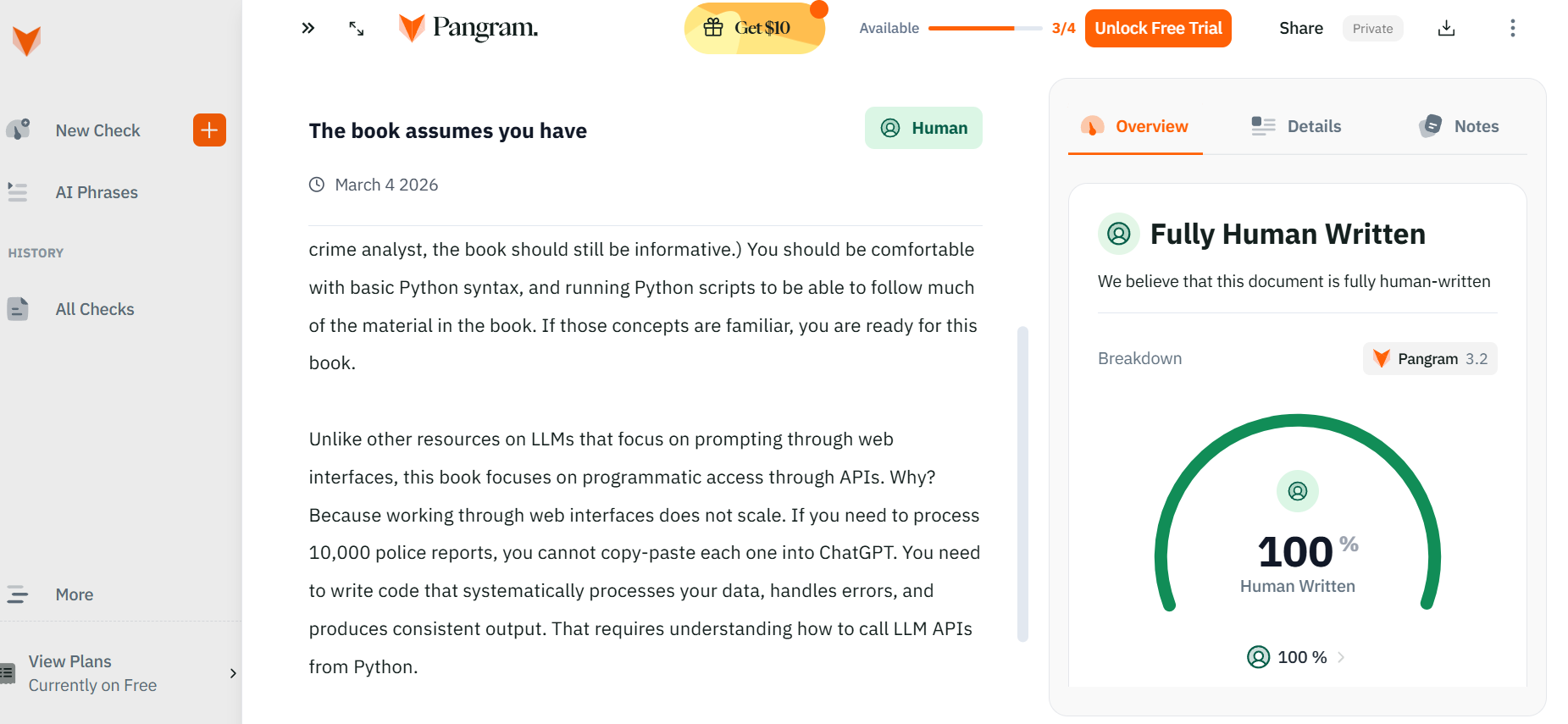
 Using Claude Code to help me write | Andrew Wheeler
https://andrewpwheeler.com/2026/03/20/using-claude-code-to-help-me-write/
There are two big issues currently with LLM writing:
it is potentially wrong
current LLM writing has a particular style that is itself becoming noticeable
The first bullet, you need to review what it writes. It is much easier to have it write on content you are an expert in, so it is easier to review and spot errors. (It is the same current problem with using the tools to help you write computer code – they are boons for seniors but can write a ton of slop that more neophyte coders have a hard time spotting issues.)
The second bullet, having the style mimic your own, is what I am going to discuss here. It is worth understanding at a high level how generative AI LLMs work – if you ask “answer question X” vs “here is a book, …., answer question X” the LLM will generate a different response. The first part in the former prompt, “here is a book, …” is what is referred to the context. Current models have context windows (how large of a potential input) at around 500,000 words (technically they are around 1 million tokens, one word is often multiple tokens though).
 Why craft-lovers are losing their craft — Hong Minhee on Things
https://writings.hongminhee.org/2026/03/craft-alienation-llm/
One caveat matters here. The tension between craft and efficiency doesn't disappear if you remove capitalism from the picture. LLM coding assistants produce faster results whether anyone is being paid or not, and any community, however it's organized, will eventually have to reckon with what to do with that speed difference. Capitalism gives the harshest possible answer to that question: the slower worker loses their livelihood. But the question itself would survive capitalism. Other forms of social organization might answer it more gently, but they'd still have to answer it.

A thing we should acknowledge about AI
https://a.wholelottanothing.org/a-thing-we-should-acknowledge-about-ai/?ref=a-whole-lotta-nothing-newsletter
There are a shitload of downsides to using AI, but I have to admit that even if you think it's just a clumsy word salad robot, giving out helpful advice freely is a refreshing contrast to how most online communities treat their newest members and I have to acknowledge that it's a real upside in AI tools.
 OpenClaw and the Dream of Free Labour | entropytown
https://entropytown.com/articles/2026-03-12-openclaw-sandbox/
It is tempting to describe OpenClaw as a breakthrough in autonomy. That gives it slightly too much credit. The fantasy it sold was not subtle. Give the machine a goal, leave it alone, and return to discover that it has not merely completed a task but conducted a small campaign on your behalf. In the most vulgar version, the goal is simply to make money. So the demo feed fills with the same intoxicating little story: the agent notices a pain point, writes the code, wires up payments, deploys the thing, posts the link and begins, as if by administrative sorcery, to earn while its owner sleeps.
 Pivot to AI – It can't be that stupid, you must be prompting it wrong
https://pivot-to-ai.com/
It can’t be that stupid, you must be prompting it wrong

 Silicon Valley Abuzz About Adding AI Compute to Engineer Compensation - Business Insider
https://www.businessinsider.com/ai-compute-compensation-software-engineers-greg-brockman-2026-3
With Levels.fyi pegging the 75th percentile software engineer salary at $375,000, Tunguz estimates that adding $100,000 in annual inference costs brings the fully loaded cost to $475,000 — meaning just over 20% of the compensation cost could come from AI usage in the future.
 Run prompts on a schedule - Claude Code Docs
https://code.claude.com/docs/en/scheduled-tasks?utm_source=www.therundown.ai&utm_medium=newsletter&utm_campaign=openai-s-robotics-lead-exits-over-pentagon-deal
Scheduled tasks let Claude re-run a prompt automatically on an interval. Use them to poll a deployment, babysit a PR, check back on a long-running build, or remind yourself to do something later in the session.
Continue local sessions from any device with Remote Control - Claude Code Docs
https://code.claude.com/docs/en/remote-control#new-session
Continue a local Claude Code session from your phone, tablet, or any browser using Remote Control. Works with claude.ai/code and the Claude mobile app.

 Where did you think the training data was coming from?
https://idiallo.com/blog/where-did-the-training-data-come-from-meta-ai-rayban-glasses
AI is not a magical technology that simply happens to know a great deal about us. It is trained on a pipeline of people's information: video, audio, text. That's how it works. If you buy the device, it will monitor you.
Why is GPT-5.4 obsessed with Goblins? | Hacker News
https://news.ycombinator.com/item?id=47319285
After the 5.4 update, ChatGPT uses "goblin" in almost every conversation. Sometimes It's "gremlin." A recent chat of mine used goblin 3 times in 4 messages:
AI should help us produce better code - Agentic Engineering Patterns - Simon Willison's Weblog
https://simonwillison.net/guides/agentic-engineering-patterns/better-code/#atom-everything
If adopting coding agents demonstrably reduces the quality of the code and features you are producing, you should address that problem directly: figure out which aspects of your process are hurting the quality of your output and fix them.
Continue local sessions from any device with Remote Control - Claude Code Docs
https://code.claude.com/docs/en/remote-control
Continue a local Claude Code session from your phone, tablet, or any browser using Remote Control. Works with claude.ai/code and the Claude mobile app.
 Sandboxes Won't Save You From OpenClaw | Tachyon Blog
https://tachyon.so/blog/sandboxes-wont-save-you
There isn't a sandbox in the world that prevents this. Sandboxes are useful for isolating between workloads, but agents primarily need to be isolated from you. The only thing the sandbox gives you here is filesystem protections, which keep the agent from rm -rf'ing your root, and network protections, which limit which websites the agent can access. This is definitely useful. But it's not at all sufficient for safety.