TERMinator - BBS Terminal
https://deadmodemsociety.com/terminator/
is a modern BBS Terminal emulator built for the retro computing community. Connect to Bulletin Board Systems around the world using Telnet, TelnetS (SSL), and SSH.
 Netrunner – Convolution BBS
https://convolutionbbs.org/netrunner-2/
Finally, an online ‘cyberpunk’ game that comes close to portraying computing as depicted in classic cyberpunk works like Neuromancer by William Gibson. In this game the player is a NetRunner, an arrogant and bold futuristic hacker. Armed with his cyberdeck and an arsenal of offensive, defensive and analysis software he’s ready to invade corporate systems in the grid and raid their credits, for fame and fortune! It’s no cakewalk though! Waiting for the unwary are Intrusion Counter-measures (IC). Machine controlled defenses that can inflict damage to hardware and software, steal the players own credits and even cause… death.
QWK Packets and the Muffled Spark : Jason Scott : Free Download, Borrow, and Streaming : Internet Archive
https://archive.org/details/muffled-spark/page/n13/mode/2up
A deep dive into the QWK packet - a revolutionary addition to the Bulletin Board Experience of the 1980s - and the ramifications of what it represents in a very changed world.
u/Quick_Butterfly_4571 passionately explains why geeky 80’s kids are confused with ChatGPT : r/bestof
https://www.reddit.com/r/bestof/comments/1ovxrk6/uquick_butterfly_4571_passionately_explains_why/
So, it is the vernacular of the first globally connected generation of kids, who — working in tandem and free from constraints, oversight, or rules — developed an epistolary style designed to facilitate belonging by wire to communities that were virtual and spread across the globe. To connect with other lonely oddballs who were thrilled to discuss geeky things.
It is the first ever, democratically developed, global, epistolary style and the first consistent style developed in the age of the internet for the internet.
We also drew boobs and said vulger things and developed new ways of slinging insults and enraging each other. Like, it wasn't a utopia.
Some context on why some 80's kids keep getting mistaken for GPT
https://www.reddit.com/r/diypedals/comments/1ovmx4l/comment/nokigif/
So, when you got online, you pulled or copied or saved all your messages, drafted up what was...essentially an essay of a response — trying to anticipate follow up questions or points of confusion. You planned it ahead of time. You studied your ass off to equip yourself with knowledge in the hopes of getting some replies off the same day you read them (it sounds stupid now, but that was fucking incredible — send and receive a letter same day!? Eesh. I am getting old).
Also, because communication was fast, but our time was limited, it was more like faster letters at first than it was like texts. It was a horror to waste round trips on misunderstandings — the person you were collaborating with might only get online Wednesday afternoons. If you were ambiguous, you might waste a whole week of progress just by not being clear! So, we were explicit.
 Doors - SynchroFans
https://synchronetbbs.org/index.php/downloads/category/3-doors
Released on June 10, 2004 by Rob Jacob. This allows you to register NetRunner with any name and serial number you like. Check out the web version of NetRunner now called MatrixRunner under
 Making WiFi Sound Like Dial-Up Internet | Hackaday
https://hackaday.com/2025/10/24/making-wifi-sound-like-dial-up-internet/
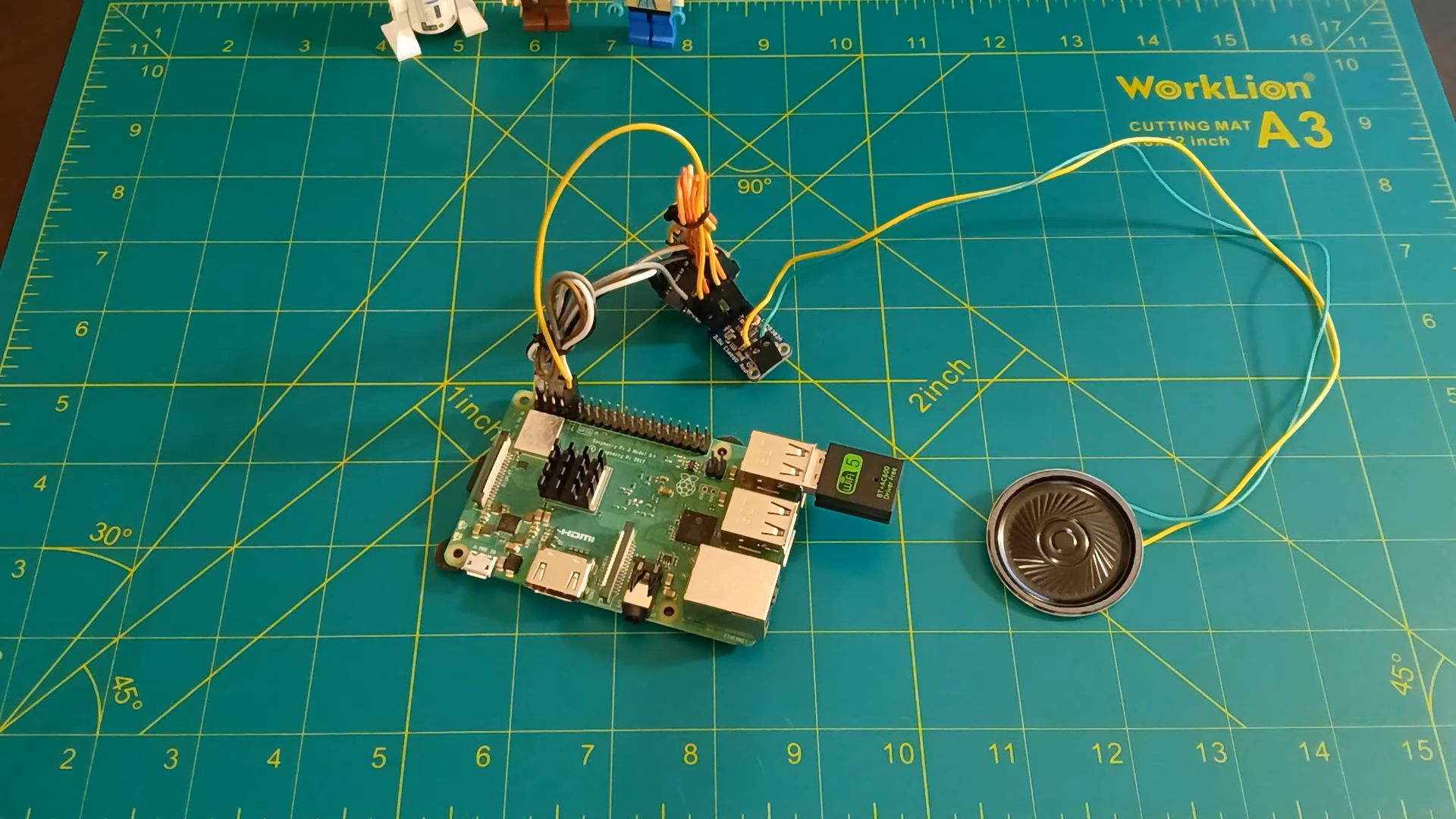
Dial-up modems had a distinctive sound when connecting, with the glittering, screeching song becoming a familiar melody to those jumping online in the early days of the Internet. Modern digital connections don’t really have an analog to this, by virtue of being entirely digital. And yet, [Nick Bild] decided to make WiFi audible in a pleasing tribute to the modems of yore.

 GlyphDrawing.Club -blog
https://blog.glyphdrawing.club/amiga-ascii-art/
In my thesis, I study Amiga ASCII text art. Amiga ASCII is a form of text art where the composition of letter characters set in the Amiga computer's font forms a two-dimensional representation or image. The Amiga scene is a subculture of computer enthusiasts that was popular in the 1990s. At its core are the logos and other visual materials created for BBS systems and the competitive rivalry among artists who create text art over their image-making prowess.
 Who Wants One More Package Manager | MeaTLoTioN's Place
https://meatlotion.com/blog/who-wants-one-more-package-manager/
Creating a package manager for BBSes - BSR or BBS Sysop Repository is a tool that will enable you to install BBS doors in the same way you can install packages on your *nix operating system
Who Wants One More Package Manager | MeaTLoTioN's Place
https://meatlotion.com/blog/who-wants-one-more-package-manager/
Creating a package manager for BBSes - BSR or BBS Sysop Repository is a tool that will enable you to install BBS doors in the same way you can install packages on your *nix operating system
 BBS PETSCII, 1986-1993 (WIP) | text-mode.org
https://text-mode.org/?p=27470
Old Commodore 64 BBS graphics are not easy to find. A lot of it was probably never saved, and there’s not really any obvious place for it online either. So I was thrilled to get a whole bunch disk images from Sixx: more than 1,000 PETSCII graphics and animations! I’ve gone through it, removed duplicates, identified artists, etc, and captured it as images and videos. I’m not done yet, but I’m presenting it as is.
 ActivityPub Beta on Xibalba BBS
https://l33t.codes/2023/04/20/ActivityPub-Beta-on-Xibalba-BBS/
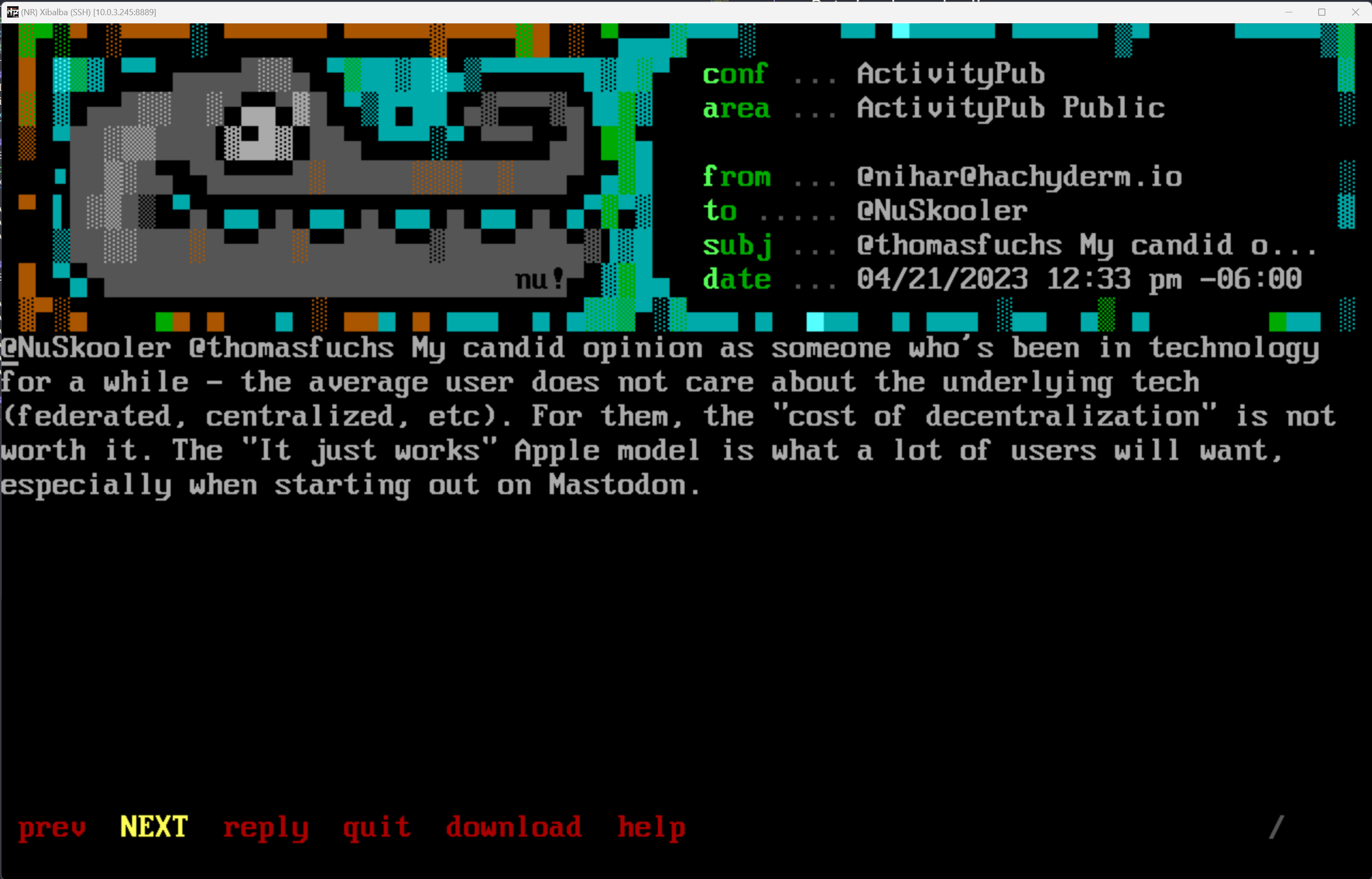
Simply hop on Xibalba BBS and let me (NuSkooler) know you’d like to join in. You’ll get an @YourName@Xibalba.l33t.codes Fediverse address with the ability to both post and read public and private messages.
ActivityPub Beta on Xibalba BBS
https://l33t.codes/2023/04/20/ActivityPub-Beta-on-Xibalba-BBS
Simply hop on Xibalba BBS and let me (NuSkooler) know you’d like to join in. You’ll get an @YourName@Xibalba.l33t.codes Fediverse address with the ability to both post and read public and private messages.
 Recreating ANSI Art from a screenshot | bertrand fan
https://bert.org/2023/02/27/recreating-ansi-art-from-a-screenshot/
It’s not the most beautiful ANSI art, but it is something that someone made for me and I’ve always been a little bummed that I can’t look at it in one of the many ANSI viewers (or DOS emulators) that exist today.
Let’s fix that!
Recreating ANSI Art from a screenshot | bertrand fan
https://bert.org/2023/02/27/recreating-ansi-art-from-a-screenshot
It’s not the most beautiful ANSI art, but it is something that someone made for me and I’ve always been a little bummed that I can’t look at it in one of the many ANSI viewers (or DOS emulators) that exist today.
Let’s fix that!
 xtrn/mrc · master · Main / Synchronet · GitLab
https://gitlab.synchro.net/main/sbbs/-/tree/master/xtrn/mrc
Multi Relay Chat (MRC) client for Synchronet BBS 3.17b+
 The Internet Origin Story You Know Is Wrong | WIRED
https://archive.ph/2022.05.19-021317/https://www.wired.com/story/internet-origin-story-bbs/#selection-471.0-471.132
The history of the internet is repeatedly reduced to the story of the singular Arpanet. But BBSs were just as important—if not more.
The Internet Origin Story You Know Is Wrong | WIRED
https://archive.ph/2022.05.19-021317/https://www.wired.com/story/internet-origin-story-bbs#selection-471.0-471.132
The history of the internet is repeatedly reduced to the story of the singular Arpanet. But BBSs were just as important—if not more.
ActivityPub is the new FidoNet
https://l33t.codes/2023/02/04/ActivityPub-is-the-new-FidoNet/
It occurred to me today that ActivityPub is the new, modern FidoNet(-style) networking. Sure you have W3C publishing official specifications, but what you mostly have is every day “hackers” putting the protocol to work building decentralized communications. Anyway, the specifications are quote vague at best, which in this case, I’m going to consider a feature. In other words, a lot like FidoNet.
ActivityPub is the new FidoNet
https://l33t.codes/2023/02/04/ActivityPub-is-the-new-FidoNet
It occurred to me today that ActivityPub is the new, modern FidoNet(-style) networking. Sure you have W3C publishing official specifications, but what you mostly have is every day “hackers” putting the protocol to work building decentralized communications. Anyway, the specifications are quote vague at best, which in this case, I’m going to consider a feature. In other words, a lot like FidoNet.
 How To Add DOS doors to Raspberry Pi Mystic
http://cyberiabbs.zapto.org/dispfile.php?textfile=gfiles/mystic/dosdoors-howto.txt&title=How+To+Add+DOS+doors+to+Raspberry+Pi+Mystic
This tutorial is intended for BBS sysops who wish to run DOS door games on their Raspberry Pi (or other ARM device)
 Parallax-scrolling effect … in ANSI | Break Into Chat
http://breakintochat.com/blog/2015/01/14/parallax-scrolling-effect-in-ansi/
I shared this video with different BBS enthusiasts. Since I now knew how to scroll the background continuously, and I knew how to mask frames to allow transparency, I began to wonder about parallax scrolling
Parallax-scrolling effect … in ANSI | Break Into Chat
http://breakintochat.com/blog/2015/01/14/parallax-scrolling-effect-in-ansi
I shared this video with different BBS enthusiasts. Since I now knew how to scroll the background continuously, and I knew how to mask frames to allow transparency, I began to wonder about parallax scrolling
 Hobbyist inter-networking and the popular Internet imaginary: forgotten histories of networked personal computing, 1978-1998 :: University of Southern California Dissertations and Theses
http://digitallibrary.usc.edu/cdm/compoundobject/collection/p15799coll3/id/444362/rec/2
Popular social computing began in the late‐1970s with the emergence of dial‐up bulletin‐board systems (BBS). For nearly two decades before the privatization of the state‐sponsored internet, tens of thousands of dial‐up computer networks were run out of the homes and offices of hobbyists, volunteers, and entrepreneurs throughout North America. It was on these bulletin‐board systems that personal computer owners first began to use their machines for popular communication. The history of BBSing portrays amateurs, hobbyists, and enthusiasts as key agents in the development and diffusion of social computing. Indeed, the users and administrators of early BBSes were the first to confront the fundamental challenges of living and working in online communities. Their experiences and experiments with anonymity, identity, privacy, sexuality, and trust established norms and values that were reproduced in the commercial services and social media systems to follow. Restoring the popular memory of the BBS movement confers legitimacy on amateur users to speak with authority about the present and future of internet technology and policy.
 Renegade BBS in Ubuntu Linux - Telnet|Multi-Node
http://www.instructables.com/id/Renegade-BBS-in-Ubuntu-Linux-Telnet-Multi-Node/
There are many open source BBS resources out there for Linux, but I came up short in finding anything even remotely mentioning renegade and Linux in the same sentence. This left me feeling nostalgically challenged so I set out to find a way to run a telnet multi-node Renegade BBS from my Ubuntu system. In this instructable, I will show you how I achieved this and hopefully inspire some much needed creative improvements as well.
Renegade BBS in Ubuntu Linux - Telnet|Multi-Node
http://www.instructables.com/id/Renegade-BBS-in-Ubuntu-Linux-Telnet-Multi-Node
There are many open source BBS resources out there for Linux, but I came up short in finding anything even remotely mentioning renegade and Linux in the same sentence. This left me feeling nostalgically challenged so I set out to find a way to run a telnet multi-node Renegade BBS from my Ubuntu system. In this instructable, I will show you how I achieved this and hopefully inspire some much needed creative improvements as well.
 VC&G | Revisiting Hotline, the 1990s Internet BBS Platform
http://www.vintagecomputing.com/index.php/archives/972
Hotline was neat. It was basically like DIY AOL for Mac, and most installations were completely infested by pirates and warez.
VC&G | Wikipedia is Deleting BBS Game History
http://www.vintagecomputing.com/index.php/archives/922
As we speak, certain vigilante Wikipedia users are hard at work erasing whatever scraps of little-known BBS door game history that resides in Wikipedia's databases. The first casualty in this war was the entry for Space Empire Elite, which was deleted early this morning.
 12 Forgotten Online Games - BBS Door Games - Slideshow from PCMag.com
http://www.pcmag.com/slideshow_viewer/0,1205,l%3D255130%26a%3D255131%26po%3D10,00.asp?p=n
"There was a time when "online game" usually meant a text-based game played over the modem on an amateur-run bulletin board system (BBS). Most of these BBSes supported only one phone line, so players took turns dialing in and playing, but they still competed against each other."
 Solar Realms Elite 0.995: Documentation
http://www-cs-students.stanford.edu/~amitp/Articles/SRE-Documentation.html
"n Solar Realms Elite (SRE), you rule a solar empire. The goal is to become and remain the most powerful empire. You can gain strength by buying forces, and you can gain size by colonizing planets. You start with 6 planets, and a little bit of money. You are required to feed your people and army, and to pay to maintain your planets and army. If you fail to do these things, disastrous results may occur. You are given 20 years (“turns”) of protection, during which you can not attack or be attacked. You can not perform covert operations (except Spy). This provides a way for smaller empires to build up their defenses and planets before they enter the “real world”. "
 ASCII by Jason Scott / What Is BBS?
http://ascii.textfiles.com/archives/1789
"In its most fundamental form, the BBS was simply a computer connected via a modem to a phone line. On the computer was software that, when it detected that someone was calling the modem, would pick up, connect, and then provide the calling person with a menu. From this menu you could post and read messages from other users, send or receive files, or play games. What happened to BBSes, especially as it looked like they’d be around in some form forever, was multi-threaded connection to the Internet, especially Trumpet Winsock, a program that allowed PPP (Point to Point Protocol) on Windows systems."
ASCII by Jason Scott / Rob Swindell and the Synchronet Museum
http://ascii.textfiles.com/archives/1697
"One thing that’s important to demarcate for Rob over a lot of my other interviewees was that he was one of the few BBS software authors still actively writing and maintaining his software. In fact, he still maintains it to the present day. Add on top of this that he was originally a commercial developer of the software, closed the business, and then turned his product into a totally free one, and you start to see why his perspective was so cool."
ASCII by Jason Scott: When the BBS Broke Free
http://ascii.textfiles.com/archives/000744.html
"Consider for a moment, if you will, how much computer you're seeing in this shot. Each of those machines is a fully set up PC compatible, with the attendant costs of memory, hard drive, and internal cards. They are all connected to modems (some of which you can see stacked on top) and all of this collection of hardware are plugged into the masses of power strips along the back. The room was obviously never designed for these computers - it has a regular carpet and those power strips are ad hoc. Consider how much effort was expended to make this system even work, to keep it all running, to make it function, to administer the software. This was a hell of a way to make a buck."
 Legend of the Red Dragon - Wikipedia, the free encyclopedia
http://en.wikipedia.org/wiki/Legend_of_the_Green_Dragon
"Legend of the Red Dragon (LORD) is a text-based role-playing game written in Pascal and run on Bulletin board systems as a third party door game. It was created by Seth Robinson of Robinson Technologies and is currently maintained by Michael Preslar. The player's goal is to improve his or her skills in order to defeat the Red Dragon which has been attacking the village"
ASCII by Jason Scott: Ding Dong, ANSI Calling
http://ascii.textfiles.com/archives/000623.html
"I had the pleasure of attending the ANSI Gallery showing this past January, and I also had the chance to purchase one of the items being shown; one of the small handful of ANSI display boxes against the wall"
 BBS Corner - Setting Up A Telnet BBS
http://www.dmine.com/bbscorner/telnet.htm
"Are you looking to set up a Telnet BBS but don't know anything about Telnet or where to begin?"
 Old School BBS: The Chinese Social Networking Phenomenon
http://www.readwriteweb.com/archives/bbs_china_social_networking.php
One man's "old school BBS" is another man's new-school fancy web thing. Mine made screaming noises on the telephone.
ASCII by Jason Scott: Goatse II: The Widening
http://ascii.textfiles.com/archives/000397.html
"this networking facility allows people to go from 0-60,000 displays of a stretched rectum in just a couple days, where that same period of time can lead to hundreds of people "discussing" what is essentially a prank, and the bell-curve of likelihood of "
ASCII by Jason Scott: Review: Commodork
http://ascii.textfiles.com/archives/000260.html
"his book does what my film couldn't; go front to end on one boy's story to turning into a man online. And for that, I thank him, and I think a lot of others will too."
VintageComputing.com | The Dial-Up BBS Revisited
http://www.vintagecomputing.com/index.php/archives/161
"These few remaining dial-up BBSes understandably receive very few calls these days, so they tend to feel a little eerie and lonely, like digital ghost towns."
 BBS Ads Collection v1.0
http://mbox.bz/slurp/ascii/bbsads
"This is the unofficial online version of bac-v10.zip that was published with PAiN issue 10/03 (54) in Oct'2003."
ASCII by Jason Scott: A Silent Key
http://ascii.textfiles.com/archives/000139.html
"We stand on crumbling sand."
ASCII by Jason Scott: TeeVee
http://ascii.textfiles.com/archives/000136.html
"Why would I work hard to jump off that mountain into a garbage pit?"
ASCII by Jason Scott: I'm Shocked! Truly SHOCKED!
http://ascii.textfiles.com/archives/000130.html
'Well, finally someone turned the Documentary into a "ware".'
 played.todeath.com - Legend of the Red Dragon
http://played.todeath.com/05/june/html/page_26.html
"L.O.R.D. is a text-based game played on a BBS (bulletin board system)."
ASCII by Jason Scott: Why the BBS Documentary is Creative Commons
http://ascii.textfiles.com/archives/000123.html
"I've tried to make a decent, good, solid loaf of bread here, which tastes good, is what it says it is, and doesn't cheat you." Definitely happy I bought this.
ASCII by Jason Scott: Out There
http://ascii.textfiles.com/archives/000119.html
"Because treating my customers/audience like moronic criminals is not what intelligent beings do." Hooray - almost makes me want to order the documentary again. Maybe I will, for a birthday gift or something
 BBS: A Documentary: News
http://bbsdocumentary.com/news.html
"The vast majority of the DVDs have shipped!" Hooray!
ASCII by Jason Scott: Packing Boxes Arrive, DVDs in about a Week
http://ascii.textfiles.com/archives/000101.html
"This is what $800 worth of packing boxes looks like"
 Boing Boing: FidoNET Web-interface
http://www.boingboing.net/2005/02/10/fidonet_webinterface.html
...and spam from the web finally reached FidoNET. :)
ASCII by Jason Scott: The BBS Documentary DVD and Premiere
http://ascii.textfiles.com/archives/000055.html
"First of all, I have basically committed to finish the BBS documentary this year." Hooray!

 Trade Wars 2002 Version 3
http://www.eisonline.com/TradeWars