 Soup Raiders Goes Native: What You Gain by Building Your Own Game Engine | Elias Farhan
https://eliasfarhan.ch/gamedev/cpp/2026/08/14/srnative-01-why-a-custom-engine.html
This post grew far beyond my original idea, but I wanted to set out my thoughts on building a custom engine before delving into the technology itself. Building an engine takes time, but it gives us control over how the game loads and updates, removes engine-licence fees, and teaches us about asset compilation, rendering, and optimisation. We can even expose parts of the engine to players, allowing them to improve the game or create mods (and potentially entirely new games) with our technology. After Unity’s runtime-fee announcement, technological independence became an even more important concern for game developers.
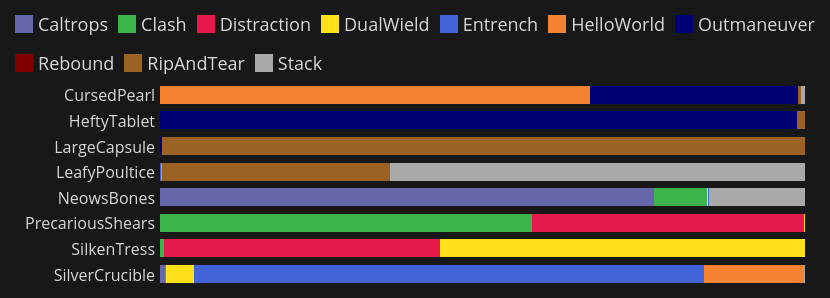
 Correlated randomness in Slay the Spire 2 - Andy Tockman
https://tck.mn/blog/correlated-randomness-sts2/
Briefly, in Spire 1, the game used several distinct pseudorandom number generators, to prevent e.g. randomness within a combat from influencing future card rewards. However, they were all initialized to the same starting state, which meant they produced the same sequence of numbers. A crafty player could therefore pay attention to the results of past random events and gain information about future random events.
 Rivalis — Open-source real-time framework for Node.js
https://rivalis.dev/?utm_source=gamedevjsweekly&utm_medium=email
Build real-time multiplayer for Phaser, PixiJS, Three.js, or any browser game. Open-source Node.js framework — rooms, actors, typed binary protocol. Free for commercial use, forever.
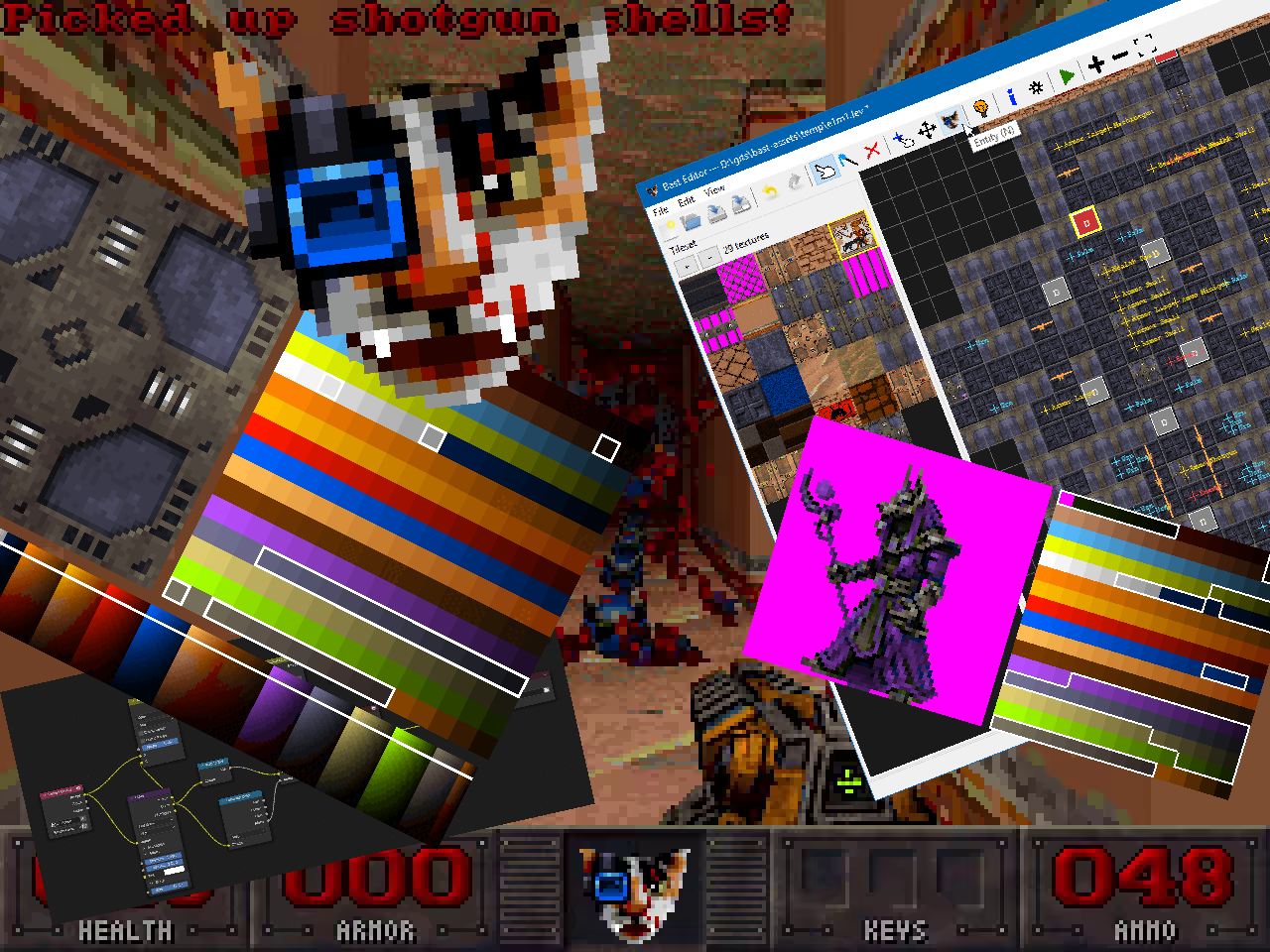
 staniks.github.io - Catlantean 3D - Making Graphics Like It's 1993
https://staniks.github.io/articles/catlantean-3d-blog-1/?utm_source=gamedevjsweekly&utm_medium=email
My goal was to build a complete, shippable first-person shooter using techniques that were common in the early 90s, while allowing myself the luxury of using a modern compiler and a platform abstraction layer.
 Picotron User Manual
https://www.lexaloffle.com/dl/docs/picotron_manual.html#Podnet
Podnet is a public file storage service that can be used to share pods (and other files) with other Picotron users. Any address on podnet can be read by any other user even when not logged in:
Lexaloffle Online (LXO)
https://www.lexaloffle.com/lxo.php
A Lexaloffle Online Pass ("LXO") is included with every Lexaloffle Fantasy Console, and provides access to highscore tables and Picotron Podnet file publishing, either inside the binary versions of consoles or via web.
 Caves of Qud/Videos - Official Caves of Qud Wiki
https://wiki.cavesofqud.com/wiki/Caves_of_Qud/Videos
A collection of Freehold Games's developers' talks relating to Caves of Qud at various venues.
 I hotreload Rust and so can you | Kampffrosch's blog
https://kampffrosch94.github.io/posts/hotreloading_rust/
What I really want is to use Rust as a scripting language that I can hotreload. Even if its just for development. This way the API would stay simple, types could be shared directly and marshalling costs either don’t exist or are minimal.
And this is exactly what I am going to show how to set up now.
 KAPLAY.js, HTML5 Game library for JavaScript and TypeScript. Free & Open Source.
https://kaplayjs.com/
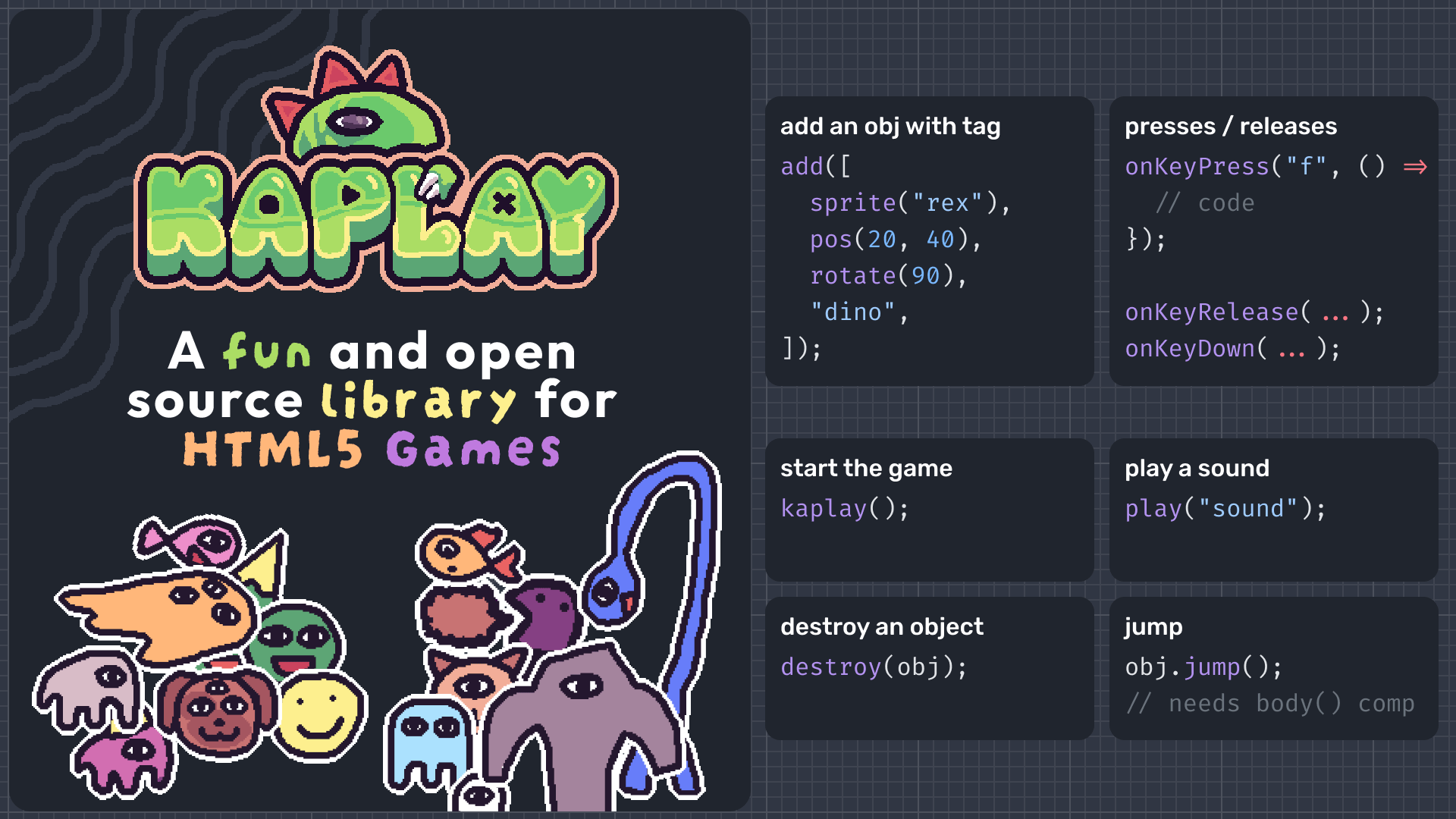
KAPLAY (/ˈkæpleɪ/) is a JavaScript and TypeScript game library that makes it easy to create games for the web. It's free, open-source and fun.
 Porting Terraria and Celeste to WebAssembly
https://velzie.rip/blog/celeste-wasm
As much as I can justify it, this project is probably going to be useless to most people. Not many people are seriously going to play all of celeste or terraria in the browser, and the novel things we did discover along the way are probably too niche to be of any help to anyone else.
 Making Video Games in 2025 (without an engine) - Noel Berry
https://noelberry.ca/posts/making_games_in_2025/
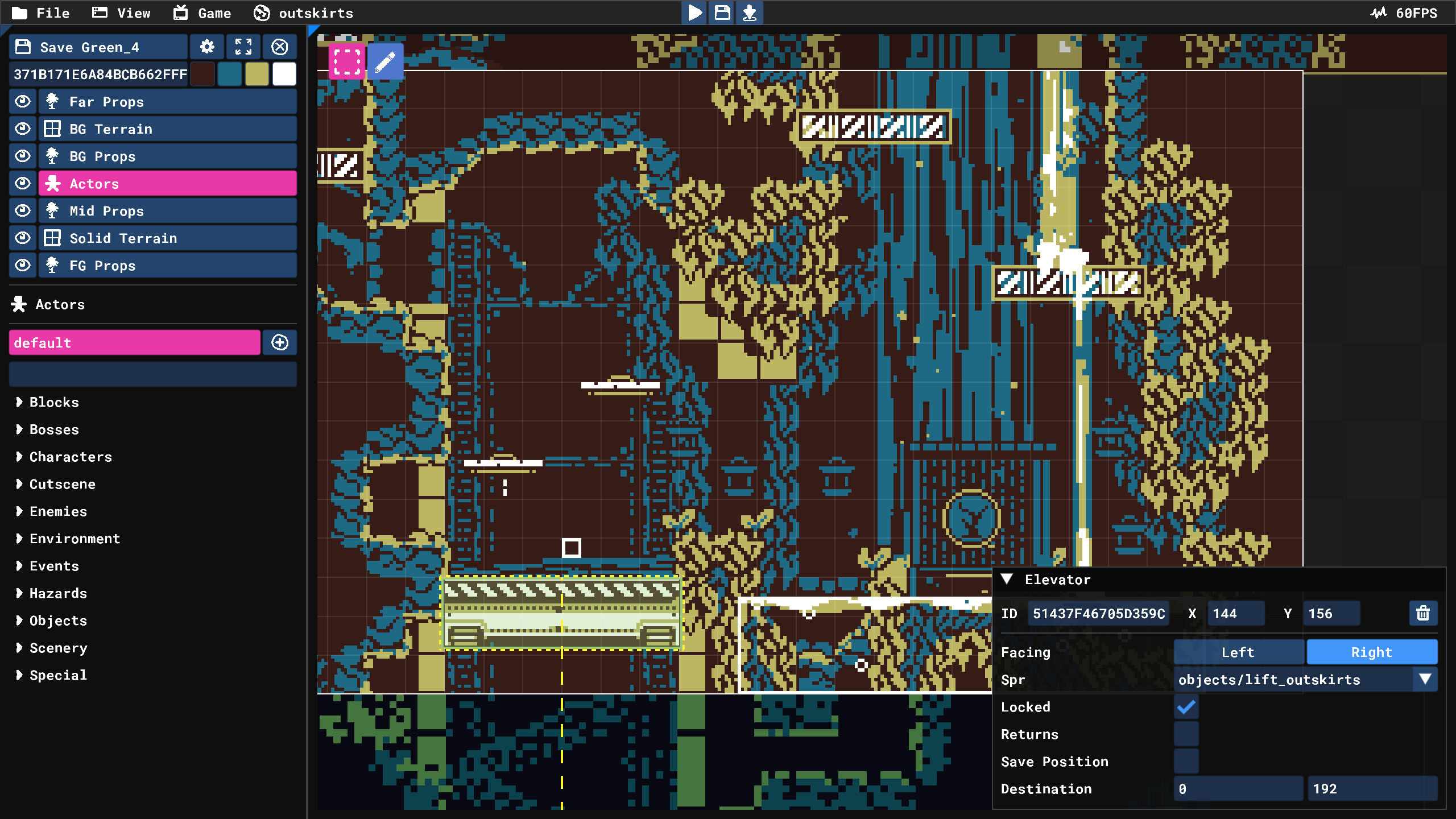
When I share stuff I'm working on, people frequently ask how I make games and are often surprised (and sometimes concerned?) when I tell them I don't use commercial game engines. There's an assumption around making games without a big tool like Unity or Unreal that you're out there hand writing your own assembly instruction by instruction.
 Whimsy by Ct.js
https://ctjs.itch.io/whimsy?utm_source=FuckOff&utm_medium=FuckOff
Whimsy is a small game engine and a fantasy console for making interactive stories where you can navigate the worlds you create and talk with stuff! Whilst simple in nature, the toolset allows making narrative-driven exploratory games with no prior experience in game development.

 Supercharging Game Development with GitHub Copilot
https://timmykokke.com/blog/2025/2025-03-31-gamedev-with-copilot/?utm_source=FuckOff&utm_medium=FuckOff
Over the past year, AI-powered development tools have completely transformed how I build games. GitHub Copilot has become an essential part of my workflow when developing WebXR games with Wonderland Engine. Today, I want to share how I leverage Copilot to streamline my game development process and some practical tips to make it work better for your specific needs.
 Oasis
https://oasis-model.github.io/
Oasis takes in user keyboard input and generates real-time gameplay, including physics, game rules, and graphics. You can move around, jump, pick up items, break blocks, and more. There is no game engine; just a foundation model.
 JohnEarnest/Decker: A multimedia sketchpad
https://github.com/JohnEarnest/Decker
A multimedia sketchpad
 2D Rigid Body Collision Response
https://fotino.me/2d-rigid-body-collision-response/
This is a followup to my previous article regarding collision detection between arbitrary polygons.
2D Rigid Body Collision Response
https://fotino.me/2d-rigid-body-collision-response
This is a followup to my previous article regarding collision detection between arbitrary polygons.
 Tarot-Based Situation Generator ~ Clarity Flowers
https://clarity.flowers/wiki/tarot_sitch_generator.html
A tool for generating some characters and a situation using tarot cards.
 Creating a 2D physics engine from scratch in Javascript – AILEF
https://ailef.tech/2022/11/12/creating-a-2d-physics-engine-from-scratch-in-javascript/
In this article, we will implement a toy 2d physics engine that supports basic forces, collisions and constraints (joints) for circle-shaped objects.
Creating a 2D physics engine from scratch in Javascript – AILEF
https://ailef.tech/2022/11/12/creating-a-2d-physics-engine-from-scratch-in-javascript
In this article, we will implement a toy 2d physics engine that supports basic forces, collisions and constraints (joints) for circle-shaped objects.
 SAM: Software Automatic Mouth
https://www.simulationcorner.net/index.php?page=sam
Sam is a very small Text-To-Speech (TTS) program written in C, that runs on most popular platforms. It is an adaption to C of the speech software SAM (Software Automatic Mouth) for the Commodore C64 published in the year 1982 by Don't Ask Software (now SoftVoice, Inc.). It includes a Text-To-Phoneme converter called reciter and a Phoneme-To-Speech routine for the final output. It is so small that it will work also on embedded computers. On my computer it takes less than 39KB (much smaller on embedded devices as the executable-overhead is not necessary) of disk space and is a fully stand alone program.
 The Things We Did on the Atari ST - Guido Henkel: Guido Henkel
http://guidohenkel.com/2018/09/the-things-we-did-on-the-atari-st/
Using raster timing to switch palette per line, yow!
The Things We Did on the Atari ST - Guido Henkel: Guido Henkel
http://guidohenkel.com/2018/09/the-things-we-did-on-the-atari-st
Using raster timing to switch palette per line, yow!
 Creating an RSS Reader in Godot Engine (part 1) – Andrew Wooldridge – Medium
https://medium.com/@triptych/creating-an-rss-reader-in-godot-engine-part-1-3abe0068b6b1
This article will discuss my own efforts to create a simple application using Godot Engine — specifically an RSS reader. It’s probably one of the more common simple applications one might create for a given framework — which tests out things like networking, parsing, rendering, and saving preferences.
 shaktool / beepbox — Bitbucket
https://bitbucket.org/shaktool/beepbox
This is the source code for BeepBox, an online tool for sketching and sharing chiptune melodies. All of the source code here is available under the MIT license.
 The Programming Behind Cel Shading – Partly Shaderly
http://partlyshaderly.com/2019/02/08/the-programming-behind-cel-shading/
This layman explanation is exactly, how I would describe it. Indeed, cel shading is rendering of the diffuse light channel. Texturing, and rendering. I know that light is a component of the material, and not something to be rendered, but using LUTs, we can achieve exactly this.
The Programming Behind Cel Shading – Partly Shaderly
http://partlyshaderly.com/2019/02/08/the-programming-behind-cel-shading
This layman explanation is exactly, how I would describe it. Indeed, cel shading is rendering of the diffuse light channel. Texturing, and rendering. I know that light is a component of the material, and not something to be rendered, but using LUTs, we can achieve exactly this.
 Rocket - A Rust game running on WASM
https://aochagavia.github.io/blog/rocket---a-rust-game-running-on-wasm/
After seeing the examples on hellorust.com, I thought it would be interesting to try to adapt my game Rocket to work on the browser through the wasm32-unknown-unknown target. The project was a great way to figure out how far you can go when porting a project that is a bit more complex than a hello world. I was pleasantly surprised by the fact that most of the code could be reused. Particularly, the game logic code was barely touched at all.
Rocket - A Rust game running on WASM
https://aochagavia.github.io/blog/rocket---a-rust-game-running-on-wasm
After seeing the examples on hellorust.com, I thought it would be interesting to try to adapt my game Rocket to work on the browser through the wasm32-unknown-unknown target. The project was a great way to figure out how far you can go when porting a project that is a bit more complex than a hello world. I was pleasantly surprised by the fact that most of the code could be reused. Particularly, the game logic code was barely touched at all.
 Panic Ranger theme experiment 1 by lmorchard | Les Orchard | Free Listening on SoundCloud
https://soundcloud.com/lmorchard/panic-ranger-theme-experiment-1
Messing around with websynths.com to make a simple spoopy theme song
 Make Games - Finishing a Game
http://makegames.tumblr.com/post/1136623767/finishing-a-game
So without further ado, here is a list of 15 tips for finishing a game:
 Game Design Idea Inspiration and Execution
http://www.completeunitydeveloper.com/blog/game-design-idea-inspiration-and-execution
Ideally, you should have a project where the following 3 things are well balanced:
Your desire to have the game made
Your desire to make the game
Your skill
If you choose a project with only 2 of these things, the game will ultimately fall flat.