
 Court Finds That Using Copyrighted Material as AI Training Data Is Not Fair Use
https://futurism.com/artificial-intelligence/court-finds-copyrighted-material-training-data-fair-use
Now, the legal system is starting to show signs that the defense could be on thin ice. Last week, a US appeals court upheld a ruling that AI legal research company Ross Intelligence had broken copyright law by training its legal search engine on materials taken from Thomson Reuters’ Westlaw legal research platform and database.
 Introducing System One Models & Jev - TypeSafe AI Blog
https://typesafe.ai/blog/introducing-system-one-models-and-jev
Our first public model is Jev, available today in early access. Jev achieves similar levels of intelligence on System One tasks compared to existing LLMs, while being two orders of magnitude faster and more efficient. While Jev gives up string generation, it’s optimized for structured outputs and can’t hallucinate.
Think of Jev as a frontier-intelligence function call: unstructured state in, typed probabilistic decisions out.
 Cheaper LLM labelling
https://entropicthoughts.com/cheaper-llm-labeling
I learned for this project that a logistic regression can be trained by streaming it one label at a time, and using gradient descent to nudge its weights toward a better fit. I haven’t fully worked through the derivation, but this is not that complicated as far as these things go. And the final result is just 3–10 lines of code depending on how you count. I wish I knew this years ago! It’s so elegant.
Nano Banana can be prompt engineered for extremely nuanced AI image generation | Max Woolf's Blog
https://minimaxir.com/2025/11/nano-banana-prompts/
For developers who want to build apps that programmatically generate images from Nano Banana, Google offers the gemini-2.5-flash-image endpoint on the Gemini API. Each image generated costs roughly $0.04/image for a 1 megapixel image (e.g. 1024x1024 if a 1:1 square): on par with most modern popular diffusion models despite being autoregressive, and much cheaper than gpt-image-1’s $0.17/image.
minimaxir/nano-banana-tests: Notebooks testing Nano Banana
https://github.com/minimaxir/nano-banana-tests?tab=readme-ov-file
Jupyter Notebooks for experiments prompt engineering Nano Bana/Gemini 2.5 Flash Image.
minimaxir/gemimg: Lightweight wrapper for generating and editing images from Gemini 2.5 Flash Image/Nano Banana
https://github.com/minimaxir/gemimg
Lightweight wrapper for generating and editing images from Gemini 2.5 Flash Image/Nano Banana
The Continual Learning Problem
https://jessylin.com/2025/10/20/continual-learning/?ref=sidebar
If we want to move towards a world where models are “always training” and continually learning from experience over time, we need to address a basic challenge: how do we keep updating the parameters of a model without breaking it? In this post, I’ll motivate memory layers as a natural architecture for this paradigm: high-capacity, but sparse (few active parameters) on each forward pass. In our recent paper, we found that finetuning memory layers enables learning without forgetting much more effectively than LoRA. When learning TriviaQA facts, NaturalQuestions performance drops by 89% with full finetuning and 71% with LoRA, but only 11% with memory layers. Along the way, I’ll also discuss the challenges of the continual learning problem broadly.
 The Programmer Identity Crisis ❈ Simon Højberg ❈ Principal Frontend Engineer
https://hojberg.xyz/the-programmer-identity-crisis/
Inside companies, power dynamics are shifting as this new identity is pushed. In a mad dash to increase productivity in the wrong place7, developers are forced to use LLMs in increasingly specific ways. Conform or be cast out. Use the products that herald our obsolescence, or resign. Scarcely has management mandated such specifics of our tools before. Tools, like those of a chef or carpenter, that we’ve taken great pride in curating and honing ourselves: careful configuration of our editor, tinkering with dot files, and dev environments. As part of the craft, we’ve been dedicated and devoted to personalizing our toolsets to match our thinking. It feels like a violation to have this be decreed by management, who have little to no connection to the day-to-day, and who should instead be concerned with outcomes, process, and facilitating creativity. For decades, programmers have been pampered within companies. These narratives offer a new way for management to tip the balance back in their favor.
 obra/smallest-agent: A tiny agent.
https://github.com/obra/smallest-agent/tree/main
Some folks were talking about how minimal they could make a functional coding agent.
I decided to play the game.
obra/private-journal-mcp: A lightweight MCP server that provides Claude with a private journaling capability to process feelings and thoughts
https://github.com/obra/private-journal-mcp
A lightweight MCP server that provides Claude with a private journaling capability to process feelings and thoughts
 My agentic coding methodology of June 2025
https://blog.fsck.com/2025/06/24/my-agentic-coding-methodology-of-june-2025/
I was chatting with some friends about how I'm using "AI" tools to write code. Like everyone else, my process has been evolving over the past few months. It seemed worthwhile to do a quick writeup of how I'm doing stuff today.
 90% | Armin Ronacher's Thoughts and Writings
https://lucumr.pocoo.org/2025/9/29/90-percent/
For me, this has reached the point where I can’t imagine working any other way. Yes, I could probably have done it without AI. But I would have built a different system in parts because I would have made different trade-offs. This way of working unlocks paths I’d normally skip or defer.

 Reader-LM: Small Language Models for Cleaning and Converting HTML to Markdown
https://jina.ai/news/reader-lm-small-language-models-for-cleaning-and-converting-html-to-markdown/

 LLM Daydreaming · Gwern.net
https://gwern.net/ai-daydreaming
Despite impressive capabilities, large language models have yet to produce a genuine breakthrough. The puzzle is why.
A reason may be that they lack some fundamental aspects of human thought: they are frozen, unable to learn from experience, and they have no “default mode” for background processing, a source of spontaneous human insight.
 How I keep up with AI progress (and why you must too) - nilenso blog
https://blog.nilenso.com/blog/2025/06/23/how-i-keep-up-with-ai-progress/
I’ve curated a list of sources that make up an information pipeline that I consider balanced and healthy. If you’re late to the game, consider this a good starting point.
 ADD / XOR / ROL: A non-anthropomorphized view of LLMs
https://addxorrol.blogspot.com/2025/07/a-non-anthropomorphized-view-of-llms.html
The moment that people ascribe properties such as "consciousness" or "ethics" or "values" or "morals" to these learnt mappings is where I tend to get lost. We are speaking about a big recurrence equation that produces a new word, and that stops producing words if we don't crank the shaft.
 Strange loop - Wikipedia
https://en.wikipedia.org/wiki/Strange_loop
A strange loop is a cyclic structure that goes through several levels in a hierarchical system. It arises when, by moving only upwards or downwards through the system, one finds oneself back where one started. Strange loops may involve self-reference and paradox. The concept of a strange loop was proposed and extensively discussed by Douglas Hofstadter in Gödel, Escher, Bach, and is further elaborated in Hofstadter's book I Am a Strange Loop, published in 2007.
A tangled hierarchy is a hierarchical consciousness system in which a strange loop appears.

 On Consciousness
https://v1tali.com/ai-consciousness
The question isn’t whether these systems are conscious now - they’re not. The question is whether we’ll recognise consciousness when it arrives in forms we never expected. Our response will define not just the future of AI, but the future of humanity itself.

 Stop Vibe Coding Every Damn Time! - by Aditya Oberai
https://newsletter.oberai.dev/p/stop-vibe-coding-every-damn-time
Vibe coding is what happens when you build software without understanding how anything works, relying entirely on tools to fill in the gaps. You feed ChatGPT a vague prompt, drag in some randomly generated code blocks, wire up a few buttons, and hope it works. You ship without testing. You copy code you don’t understand. You build with vibes, not logic.
AI-assisted coding, on the other hand, is intentional. You still plan your features. You still understand how your system fits together. You just move faster because you’ve got an AI pair programmer who helps with boilerplate, explains confusing concepts, and suggests things you were going to write anyway.
 My LLM codegen workflow atm | Harper Reed's Blog
https://harper.blog/2025/02/16/my-llm-codegen-workflow-atm/
tl:dr; Brainstorm spec, then plan a plan, then execute using LLM codegen. Discrete loops. Then magic. ✩₊˚.⋆☾⋆⁺₊✧
 Putting an untrusted layer of chatbot AI between you and the internet is an obvious disaster waiting to happen - macwright.com
https://macwright.com/2025/05/29/putting-an-untrusted-chat-layer-is-a-disaster
I feel like this is obvious but I’m not hearing it shouted from the rooftops so here it is: adding an untrusted middleman to your information diet and all of your personal communications will eventually become a disaster that will be obvious in hindsight.

 Peer Programming with LLMs, For Senior+ Engineers
https://pmbanugo.me/blog/peer-programming-with-llms
This article is a collection of blog posts written by other senior or staff+ engineers exploring the use of LLM in their work, without the usual hype or buzzwords from the usual suspects. I hope you find them useful and inspiring.

 The Perverse Incentives of Vibe Coding | by fred benenson | May, 2025 | Medium
https://fredbenenson.medium.com/the-perverse-incentives-of-vibe-coding-23efbaf75aee
But lets talk about the expense too, because I think there’s something bad there as well: coding agents, and especially Claude 3.7 (the backend of Claude Code), tend to write too much code, a phenomenon that ends up costing users more than it should.
 Embeddings are underrated
https://technicalwriting.dev/ml/embeddings/overview.html
Embeddings aren't exactly new, but they have become much more widely accessible in the last couple years. What embeddings offer to technical writers is the ability to discover connections between texts at previously impossible scales.

 In 2025, venture capital can’t pretend everything is fine any more – Pivot to AI
https://pivot-to-ai.com/2025/05/03/in-2025-venture-capital-cant-pretend-everything-is-fine-any-more/
Venture capital is screwed. A bubble in AI is their last hope, and they’re betting everything on Sam Altman. It’s heartwarming.
 VectorVFS: Your Filesystem as a Vector Database
https://vectorvfs.readthedocs.io/en/latest/
VectorVFS is a lightweight Python package that transforms your Linux filesystem into a vector database by leveraging the native VFS (Virtual File System) extended attributes. Rather than maintaining a separate index or external database, VectorVFS stores vector embeddings directly alongside each file—turning your existing directory structure into an efficient and semantically searchable embedding store.
 Diane, I wrote a lecture by talking about it (Interconnected)
https://interconnected.org/home/2025/03/20/diane
Diane, it’s Thursday and I’ve been figuring out how transcription fits into my everyday work. I had to make up a character to make it make sense, as I’ll say.
 Teaching LLMs how to solid model
https://willpatrick.xyz/technology/2025/04/23/teaching-llms-how-to-solid-model.html
It turns out that LLMs can make CAD models for simple 3D mechanical parts. And, I think they’ll be extremely good at it soon.

 The Hidden Cost of AI Coding – Terrible Software
https://terriblesoftware.org/2025/04/23/the-hidden-cost-of-ai-coding/
Perhaps what we need is a new understanding of where happiness can exist in this AI-augmented world. Maybe the joy doesn’t have to disappear completely — it just shifts. Instead of finding delight in writing the perfect algorithm, perhaps we’ll discover satisfaction in the higher-level thinking about system design, in the creative process of describing exactly what we want to build, or in the human aspects of software development that AI can’t touch.

 Vibe Coding is not an excuse for low-quality work
https://addyo.substack.com/p/vibe-coding-is-not-an-excuse-for
A field guide to responsible AI-assisted development
 How Big Tech’s AI labor supply chain relies on hidden African workers - Rest of World
https://restofworld.org/2025/big-tech-ai-labor-supply-chain-african-workers/
New data reveals the hidden network of African workers powering AI, as they push for transparency from the global companies that employ them indirectly.
HandsOnLLM/Hands-On-Large-Language-Models: Official code repo for the O'Reilly Book - "Hands-On Large Language Models"
https://github.com/HandsOnLLM/Hands-On-Large-Language-Models
Official code repo for the O'Reilly Book - "Hands-On Large Language Models"
An LLM Codegen Hero's Journey | Harper Reed's Blog
https://harper.blog/2025/04/17/an-llm-codegen-heros-journey/
This is my journey. It is largely the path I took. I think you could speed run it if you were compelled. I don’t think you need to follow every step, but I do think every step is additive.

 SeedLM: Compressing LLM Weights into Seeds of Pseudo-Random Generators - Apple Machine Learning Research
https://machinelearning.apple.com/research/seedlm-compressing
Large Language Models (LLMs) have transformed natural language processing, but face significant challenges in widespread deployment due to their high runtime cost. In this paper, we introduce SeedLM, a novel post-training compression method that uses seeds of a pseudo-random generator to encode and compress model weights.
 AI Blindspots | AI Blindspots
https://ezyang.github.io/ai-blindspots/
Blindspots in LLMs I’ve noticed while AI coding. Sonnet family emphasis. Maybe I will eventually suggest Cursor rules for these problems.
 The Slow Collapse of Critical Thinking in OSINT due to AI
https://www.dutchosintguy.com/post/the-slow-collapse-of-critical-thinking-in-osint-due-to-ai
OSINT used to be a thinking game. Now it’s becoming a trusting game and that should terrify you.
 Chatbots are AI anti-patterns! | Jakob Pörschmann
https://hello-jp.net/building-beyond-the-buzz/chatbots-are-ai-antipatterns
Why did we fall in love with chat interfaces for human-ai interaction? Let us leave them behind once and for all.
 Horseless intelligence | Ned Batchelder
https://nedbatchelder.com/blog/202503/horseless_intelligence.html
OK, so AI doesn’t think the same way that people do. I’m fine with that. What’s important to me is that it can do some work for me, work that could also be done by people thinking. Cars (“horseless carriages”) do work that used to be done by horses running. No one now complains that cars work differently than horses.
 Literate Development: AI-Enhanced Software Engineering
https://substack.com/home/post/p-160183664
By emphasizing documentation as the primary source of truth, establishing explicit linkages between development artifacts, and employing iterative, human-guided prompting, the whole team can harness the power of LLMs while mitigating their current limitations.
tuananh/hyper-mcp: Model Context Protocol on steroids ;)
https://github.com/tuananh/hyper-mcp/tree/main
Model Context Protocol on steroids ;)
 Notes on MCP - Tao of Mac
https://taoofmac.com/space/notes/2025/03/22/1900
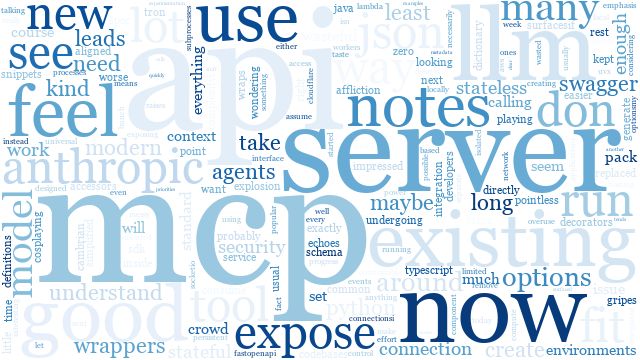
Right now, I’m not overly excited by MCP over “standard” tool calling. I much prefer agents.json and the concepts around endpoint discovery, which feel much more natural if you are working with APIs.
 "Vibe Coding" vs Reality
https://cendyne.dev/posts/2025-03-19-vibe-coding-vs-reality.html
"Vibe Coding" might get you 80% the way to a functioning concept. But to produce something reliable, secure, and worth spending money on, you’ll need experienced humans to do the hard work not possible with today’s models.

 Revenge of the junior developer | Sourcegraph Blog
https://sourcegraph.com/blog/revenge-of-the-junior-developer
One consistent pattern I’ve observed in the past year, since I published "The death of the junior developer", is that junior developers have actually been far more eager to adopt AI than senior devs. It’s not always true; a few folks have told us that their juniors are scared to use it because they think, somewhat irrationally, that it will take their jobs. (See: Behavioral regret theory. Thanks for the pointer Dr. Daniel Rock!)
 Verifiability is the Limit
https://alperenkeles.com/posts/verifiability-is-the-limit/
I now, although tentatively, believe that LLMs can indeed succeed in all domains with perfect oracles.
 Here’s how I use LLMs to help me write code
https://simonwillison.net/2025/Mar/11/using-llms-for-code/
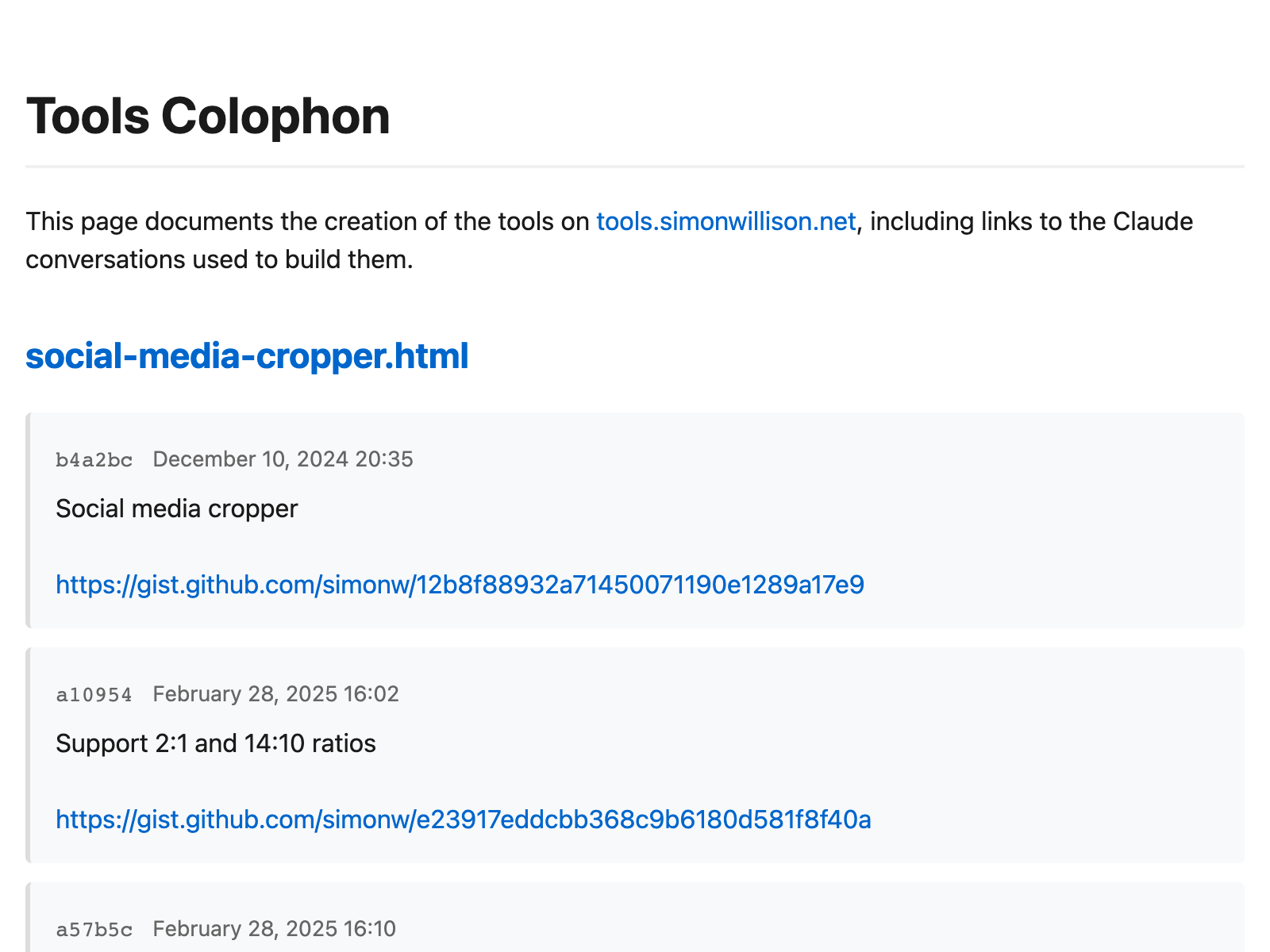
Using LLMs to write code is difficult and unintuitive. It takes significant effort to figure out the sharp and soft edges of using them in this way, and there’s precious little guidance to help people figure out how best to apply them.
If someone tells you that coding with LLMs is easy they are (probably unintentionally) misleading you. They may well have stumbled on to patterns that work, but those patterns do not come naturally to everyone.
I’ve been getting great results out of LLMs for code for over two years now. Here’s my attempt at transferring some of that experience and intution to you.

johnbean393/Sidekick: A native macOS app that allows users to chat with a local LLM that can respond with information from files, folders and websites on your Mac without installing any other software. Powered by llama.cpp.
https://github.com/johnbean393/Sidekick
A native macOS app that allows users to chat with a local LLM that can respond with information from files, folders and websites on your Mac without installing any other software. Powered by llama.cpp.

 What if AGI is Free? | Drew Breunig
https://www.dbreunig.com/2025/02/11/what-if-agi-is-free.html
What if super-intelligent AI1 arrives but it can be run by anyone, basically for free?
 Chat is a bad UI pattern for development tools—Daniel De Laney
https://danieldelaney.net/chat/?ref=sidebar
The first company to get this will own the next phase of AI development tools. They’ll build tools for real software instead of toys. They’ll make everything available today look like primitive experiments.
 Boomer Prompts - Outdated LLM Techniques
https://boomerprompts.com/
Welcome to Boomer Prompts—an affectionate trip down memory lane of the elaborate, quirky, and sometimes overkill techniques used to guide earlier Large Language Models.
These “relics” showcase just how much LLMs have evolved—where once you needed to triple your instructions and role-play as a wise oracle, now simpler, more direct prompts suffice. Read on for a chuckle, and discover how far we’ve come!
 Playing with AI inference in Firefox Web extensions
https://blog.tomayac.com/2025/02/07/playing-with-ai-inference-in-firefox-web-extensions/
Concluding, I think this is a very interesting way of working with AI inference in the browser. The obvious downside is that you need to convince your users to download an extension, but the obvious upside is that you possibly can save them from having to download a model they may already have downloaded and stored on their disk.

 Depth is all you need: how Antithesis crushes Gradius
https://antithesis.com/blog/2025/gradius/
Antithesis’ ability to play like a computer, not a human being, is central both to finding bugs and beating side-scrolling shooters.
aittalam/byota: Build Your Own Timeline Algorithm
https://github.com/aittalam/byota
Build Your Own Timeline Algorithm
 FOSDEM 2025 - Build your own timeline algorithm
https://fosdem.org/2025/schedule/event/fosdem-2025-5601-build-your-own-timeline-algorithm/
Timeline algorithms should be useful for people, not for companies. Their quality should not be evaluated in terms of how much more time people spend on a platform, but rather in terms of how well they serve their users’ purposes
 Evaluating Retrieval Augmented Generation for large-scale codebases
https://www.qodo.ai/blog/evaluating-rag-for-large-scale-codebases/
By focusing on the answer correctness as a key success metric, and designing our datasets and metrics carefully, we’ve managed to build a reliable evaluation process which has helped us increase confidence in our system’s quality.
 Getting Started | Transformer Lab
https://transformerlab.ai/docs/intro/
Transformer Lab is a free, open-source LLM workspace that you can run on your own computer. It is designed to go beyond what most modern open LLM applications allow. Using Transformer Lab you can easily finetune, evaluate, export and test LLMs across different inference engines and platforms.
GitHub - exo-explore/exo: Run your own AI cluster at home with everyday devices 📱💻 🖥️⌚
https://github.com/exo-explore/exo
Run your own AI cluster at home with everyday devices
DIVISIO-AI/stag: An AI based automatic image tagger
https://github.com/DIVISIO-AI/stag
An AI based automatic image tagger
AnswerDotAI/llms-txt: The /llms.txt file, helping language models use your website
https://github.com/answerdotai/llms-txt
The /llms.txt file, helping language models use your website
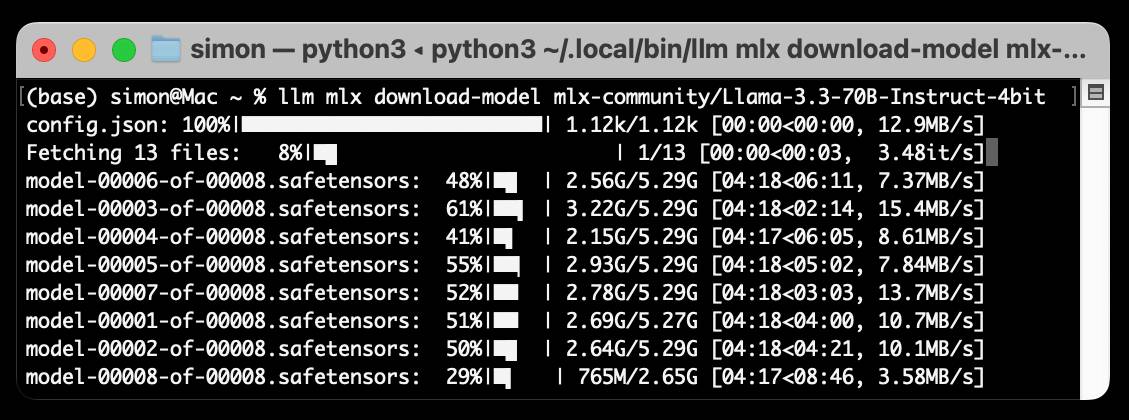
Run LLMs on macOS using llm-mlx and Apple’s MLX framework
https://simonwillison.net/2025/Feb/15/llm-mlx/
llm-mlx is a brand new plugin for my LLM Python Library and CLI utility which builds on top of Apple’s excellent MLX array framework library and mlx-lm package. If you’re a terminal user or Python developer with a Mac this may be the new easiest way to start exploring local Large Language Models.
 How I code with LLMs these days
https://www.phillipcarter.dev/posts/coding-with-llms
To me, all signs point towards software engineering changing radically as a profession to be much more oriented around the what and why of software, and much less around the how. This will cause disruption at a massive scale in the long run. But in the short run, it's just a lot of fun to play with these tools and see what they can do.

 How to Increase the VRAM of Your Mac with Apple Silicone for LLMs? | Hardware Corner
https://www.hardware-corner.net/increase-mac-vram/
It is surprisingly straightforward to increase the VRAM of your Mac (Apple Silicone M1/M2/M3 chips) computer and use it to load large language models. Here’s the rundown of my experiments. ... I found a way to bypass this limitation. To allocate more of your Mac’s system RAM to VRAM – in this case, up to 28 GB – the following command can be used in the terminal window:
sudo sysctl iogpu.wired_limit_mb=27536
 ewintr.nl - building a personal, private ai computer on a budget
https://ewintr.nl/posts/2025/building-a-personal-private-ai-computer-on-a-budget/?ref=sidebar
my attempt to build such a capable AI computer without spending too much. I ended up with a workstation with 48GB of VRAM that cost me around 1700 euros

 Gwern Branwen - How an Anonymous Researcher Predicted AI's Trajectory
https://www.dwarkeshpatel.com/p/gwern-branwen
You wrote an interesting comment about getting your work into the LLM training corpus: "there has never been a more vital hinge-y time to write."
Do you mean that in the sense that you will be this drop in the bucket that’s steering the Shoggoth one way or the other? Or do you mean it in the sense of making sure your values and persona persist somewhere in latent space?
 How I use LLMs as a staff engineer | sean goedecke
https://www.seangoedecke.com/how-i-use-llms/
Personally, I feel like I get a lot of value from AI. I think many of the people who don’t feel this way are “holding it wrong”: i.e. they’re not using language models in the most helpful ways. In this post, I’m going to list a bunch of ways I regularly use AI in my day-to-day as a staff engineer.

 AI Slop, Suspicion, and Writing Back | Ben Congdon
https://benjamincongdon.me/blog/2025/01/25/AI-Slop-Suspicion-and-Writing-Back/?ref=sidebar
Undoubtedly, the sloppification of the internet will likely get worse over the next few years. And as such, the returns to curating quality sources of content will only increase. My advice? Use an RSS feed reader, read Twitter lists instead of feeds, and find spaces where real discussion still happens (e.g. LessWrong and Lobsters still both seem slop-free).

 DeepSeek FAQ – Stratechery by Ben Thompson
https://stratechery.com/2025/deepseek-faq/
At the same time, there should be some humility about the fact that earlier iterations of the chip ban seem to have directly led to DeepSeek’s innovations. Those innovations, moreover, would extend to not just smuggled Nvidia chips or nerfed ones like the H800, but to Huawei’s Ascend chips as well. Indeed, you can very much make the case that the primary outcome of the chip ban is today’s crash in Nvidia’s stock price.

 Knowing less about AI makes people more open to having it in their lives – new research
https://theconversation.com/knowing-less-about-ai-makes-people-more-open-to-having-it-in-their-lives-new-research-247372
People with less knowledge about AI are actually more open to using the technology. We call this difference in adoption propensity the “lower literacy-higher receptivity” link.

 Ignore the Grifters - AI Isn't Going to Kill the Software Industry — Dustin Ewers
https://dustinewers.com/ignore-the-grifters/
I feel like half of my social media feed is composed of AI grifters saying software developers are not going to make it. Combine that sentiment with some economic headwinds and it's easy to feel like we're all screwed. I think that's bullshit. The best days of our industry lie ahead.
 Don't use cosine similarity carelessly
https://p.migdal.pl/blog/2025/01/dont-use-cosine-similarity
Just as Midas discovered that turning everything to gold wasn't always helpful, we'll see that blindly applying cosine similarity to vectors can lead us astray. While embeddings do capture similarities, they often reflect the wrong kind - matching questions to questions rather than questions to answers, or getting distracted by superficial patterns like writing style and typos rather than meaning. This post shows you how to be more intentional about similarity and get better results.
 crawshaw - 2025-01-06
https://crawshaw.io/blog/programming-with-llms
This document is a summary of my personal experiences using generative models while programming over the past year. It has not been a passive process. I have intentionally sought ways to use LLMs while programming to learn about them. The result has been that I now regularly use LLMs while working and I consider their benefits net-positive on my productivity. (My attempts to go back to programming without them are unpleasant.)
All-Hands-AI/OpenHands: 🙌 OpenHands: Code Less, Make More
https://github.com/All-Hands-AI/OpenHands?tab=readme-ov-file
Welcome to OpenHands (formerly OpenDevin), a platform for software development agents powered by AI.
OpenHands agents can do anything a human developer can: modify code, run commands, browse the web, call APIs, and yes—even copy code snippets from StackOverflow.
 Home - PaddleOCR Documentation
https://paddlepaddle.github.io/PaddleOCR/main/en/index.html
PaddleOCR aims to create multilingual, awesome, leading, and practical OCR tools that help users train better models and apply them into practice.
mittagessen/kraken: OCR engine for all the languages
https://github.com/mittagessen/kraken
kraken is a turn-key OCR system optimized for historical and non-Latin script material.

 Automatic Text Recognition / PyLaia · GitLab
https://gitlab.teklia.com/atr/pylaia
PyLaia is a device agnostic, PyTorch based, deep learning toolkit for handwritten document analysis.
 Implementing Filtered Semantic Search Using Pgvector and JavaScript
https://www.timescale.com/blog/implementing-filtered-semantic-search-using-pgvector-and-javascript-2/
Conventional search methods rely on keyword matching, where the system locates exact words or phrases from the query within documents. This technique can be enhanced to better capture the context and intent behind the user's query, leading to more relevant and precise search results. Semantic search focuses on understanding the meaning and intent behind the query. Combining semantic search with filters—or additional parameters to narrow the results based on specific attributes—further improves accuracy.
In this article, we explore semantic search with filters and demonstrate how you can implement it using pgvector and JavaScript.
The 70% problem: Hard truths about AI-assisted coding
https://addyo.substack.com/p/the-70-problem-hard-truths-about
AI isn't making our software dramatically better because software quality was (perhaps) never primarily limited by coding speed. The hard parts of software development – understanding requirements, designing maintainable systems, handling edge cases, ensuring security and performance – still require human judgment.
What AI does do is let us iterate and experiment faster, potentially leading to better solutions through more rapid exploration. But only if we maintain our engineering discipline and use AI as a tool, not a replacement for good software practices. Remember: The goal isn't to write more code faster. It's to build better software. Used wisely, AI can help us do that. But it's still up to us to know what "better" means and how to achieve it.
heaversm/llamafile-code-completion: Use llamafile to generate inline code completions in react / next.js apps.
https://github.com/heaversm/llamafile-code-completion
Use llamafile to generate inline code completions in react / next.js apps.
 Godot Isn't Making it
https://www.wheresyoured.at/godot-isnt-making-it/
New, more powerful chips require entirely new methods to rack-mount, operate and cool them, and all of these parts must operate in sync, as overheating GPUs will die. While these units are big, some of their internal components are microscopic in size, and unless properly cooled, their circuits will start to crumble when roasted by a guy typing "Garfield with Gun" into ChatGPT.
 The Illustrated Word2vec – Jay Alammar – Visualizing machine learning one concept at a time.
https://jalammar.github.io/illustrated-word2vec/
I hope that you now have a sense for word embeddings and the word2vec algorithm. I also hope that now when you read a paper mentioning “skip gram with negative sampling” (SGNS) (like the recommendation system papers at the top), that you have a better sense for these concepts.
 Bluesky, AI, and the battle for consent on the open web
https://werd.io/2024/bluesky-ai-and-the-battle-for-consent-on-the-open
So the problem Bluesky is dealing with is not so much a problem with Bluesky itself or its architecture, but one that’s inherent to the web itself and the nature of building these training datasets based on publicly-available data. Van Strien’s original act clearly showed the difference in culture between AI and open social web communities: on the former it’s commonplace to grab data if it can be read publicly (or even sometimes if it’s not), regardless of licensing or author consent, while on open social networks consent and authors’ rights are central community norms.
 Between the Booms: AI in Winter – Communications of the ACM
https://cacm.acm.org/opinion/between-the-booms-ai-in-winter/
After people stopped caring, artificial intelligence got more interesting.
On not using copilot - macwright.com
https://macwright.com/2024/11/20/not-using-copilot.html
So, in summary: maybe people shy away from copilots because they’re tired of complexity, they’re tired of accelerating productivity without improving hours, they’re afraid of forgetting rote skills and basic knowledge, and they want to feel like writers, not managers.
Maybe some or none of these things are true - they’re emotional responses and gut feelings based on predictions - but they matter nonetheless.
 Adjacent Possible | Steven Johnson | Substack
https://adjacentpossible.substack.com/
A newsletter from author Steven Johnson exploring where good ideas come from—and how to keep them from turning against us. Click to read Adjacent Possible, by Steven Johnson, a Substack publication with tens of thousands of subscribers.
 You Exist In The Long Context
https://thelongcontext.com/
The current state-of-the-art Gemini model can fit roughly 1.5 million words in its context. That’s enough for me to upload the full text of all fourteen of my books, plus every article, blog post, or interview I’ve ever published—and the entirety of my collection of research notes that I’ve compiled over the years. The Gemini team has announced plans for a model that could hold more than 7 million words in its short-term memory. That’s enough to fit everything I’ve ever written, plus the hundred books and articles that most profoundly shaped my thinking over the years. An advanced model capable of holding in focus all that information would have a profound familiarity with all the words and ideas that have shaped my personal mindset. Certainly its ability to provide accurate and properly-cited answers to questions about my worldview (or my intellectual worldview, at least) would exceed that of any other human. In some ways it would exceed my own knowledge, thanks to its ability to instantly recall facts from books I read twenty years ago, or make new associations between ideas that I have long since forgotten. It would lack any information about my personal or emotional history—though I suppose if I had maintained a private journal over the past decades it would be able to approximate that part of my mindset as well. But as reconstruction of my intellectual grounding, it would be unrivaled. If that is not considered material progress in AI, there is something wrong with our metrics.
 An introduction to fine-tuning LLMs at home with Axolotl • The Register
https://www.theregister.com/2024/11/10/llm_finetuning_guide/?td=rt-9c
In this guide we'll discuss:
Where and when fine-tuning can be useful.
Alternative approaches to extending the capabilities and behavior of pre-trained models.
The importance of data preparation.
How to fine-tune Mistral 7B using your own custom dataset with Axolotl.
The many hyperparameters and their effect on training.
Additional resources to help you fine-tune your models faster and more efficiently.
 Sponsoring the Web Applets project, an open approach to AI-empowered web apps - Mozilla Innovations
https://future.mozilla.org/builders/news_insights/sponsoring-the-web-applets-project/
Web Applets are small, secure pieces of web code (bundles of HTML, JavaScript, and CSS) that can run anywhere, allowing a model to take actions within software much like a human would and then generate interfaces appropriate for the user’s intent. For example, a developer could write an applet that enables a model to respond to a query about local coffee shops by conducting internet searches and then displaying the results on an in-line map. And because the model can read the internal state of each applet, it can then conduct follow-up actions to complete a user’s request (for example, updating the map to display only coffee shops that will be open tomorrow afternoon). Anyone can build Web Applets and host them on the Web, and any client can potentially support them.
 Dead Labor, Dead Speech - by Nicholas Carr
https://www.newcartographies.com/p/dead-labor-dead-speech
If, as Marx argued, capital is dead labor, then the products of large language models might best be understood as dead speech. Just as factory workers produce, with their “living labor,” machines and other forms of physical capital that are then used, as “dead labor,” to produce more physical commodities, so human expressions of thought and creativity—“living speech” in the forms of writing, art, photography, and music—become raw materials used to produce “dead speech” in those same forms. LLMs, to continue with Marx’s horror-story metaphor, feed “vampire-like” on human culture. Without our words and pictures and songs, they would cease to function. They would become as silent as a corpse in a casket.
 Everything I've learned so far about running local LLMs
https://nullprogram.com/blog/2024/11/10/
Over the past month I’ve been exploring the rapidly evolving world of Large Language Models (LLM). It’s now accessible enough to run a LLM on a Raspberry Pi smarter than the original ChatGPT (November 2022). A modest desktop or laptop supports even smarter AI. It’s also private, offline, unlimited, and registration-free. The technology is improving at breakneck speed, and information is outdated in a matter of months. This article snapshots my practical, hands-on knowledge and experiences — information I wish I had when starting. Keep in mind that I’m a LLM layman, I have no novel insights to share, and it’s likely I’ve misunderstood certain aspects. In a year this article will mostly be a historical footnote, which is simultaneously exciting and scary.
 Perceptually lossless (talking head) video compression at 22kbit/s | Martin Lumiste
https://mlumiste.com/technical/liveportrait-compression/
I’ve been having quite a bit of fun with the fairly recent LivePortrait model, generating deepfakes of my friends for some cheap laughs.
 [2410.16454] Does your LLM truly unlearn? An embarrassingly simple approach to recover unlearned knowledge
https://arxiv.org/abs/2410.16454
Large language models (LLMs) have shown remarkable proficiency in generating text, benefiting from extensive training on vast textual corpora. However, LLMs may also acquire unwanted behaviors from the diverse and sensitive nature of their training data, which can include copyrighted and private content. Machine unlearning has been introduced as a viable solution to remove the influence of such problematic content without the need for costly and time-consuming retraining. This process aims to erase specific knowledge from LLMs while preserving as much model utility as possible. Despite the effectiveness of current unlearning methods, little attention has been given to whether existing unlearning methods for LLMs truly achieve forgetting or merely hide the knowledge, which current unlearning benchmarks fail to detect. This paper reveals that applying quantization to models that have undergone unlearning can restore the "forgotten" information. To thoroughly evaluate this phenomenon, we conduct comprehensive experiments using various quantization techniques across multiple precision levels. We find that for unlearning methods with utility constraints, the unlearned model retains an average of 21\% of the intended forgotten knowledge in full precision, which significantly increases to 83\% after 4-bit quantization. Based on our empirical findings, we provide a theoretical explanation for the observed phenomenon and propose a quantization-robust unlearning strategy to mitigate this intricate issue...
 Whatever AI Looks Like, It's Not | Defector
https://defector.com/whatever-ai-looks-like-its-not
It is nightmarish to me to read reports of how reliant on ChatGPT students have become, even outsourcing to the machines the ideally very personal assignment "briefly introduce yourself and say what you're hoping to get out of this class." It is depressing to me to read defenses of those students, particularly this one that compares an AI-written essay to using a washing machine in that it reduces the time required for the labor. This makes sense only if the purpose of a student writing an essay is "to have written an essay," which it is not. The teacher did not assign it as busywork. The purpose of an essay is to learn and practice communication skills, critical thinking, organization of one's own thoughts. These are useful skills to develop, even (especially!) if you do not go into a writing career.
 Oasis
https://oasis-model.github.io/
Oasis takes in user keyboard input and generates real-time gameplay, including physics, game rules, and graphics. You can move around, jump, pick up items, break blocks, and more. There is no game engine; just a foundation model.
Vector Databases Are the Wrong Abstraction
https://www.timescale.com/blog/vector-databases-are-the-wrong-abstraction/
A more effective abstraction is conceptualizing vector embeddings not as independent tables or data types but as a specialized index on the embedded data. This is not to say that vector embeddings are literally indexes in the traditional sense, like those in PostgreSQL or MySQL, which retrieve entire data rows from indexed tables. Instead, vector embeddings function as an indexing mechanism that retrieves the most relevant parts of the data based on its embeddings.
You can now run prompts against images, audio and video in your terminal using LLM
https://simonwillison.net/2024/Oct/29/llm-multi-modal/
I released LLM 0.17 last night, the latest version of my combined CLI tool and Python library for interacting with hundreds of different Large Language Models such as GPT-4o, Llama, Claude and Gemini.
 The A.I. Bubble is Bursting with Ed Zitron - YouTube
https://www.youtube.com/watch?v=T8ByoAt5gCA
Big tech is betting tens of billions of dollars on AI being the next big thing, but what if it isn't?
Embeddings are underrated
https://technicalwriting.dev/data/embeddings.html
Embeddings aren't exactly new, but they have become much more widely accessible in the last couple years. What embeddings offer to technical writers is the ability to discover connections between texts at previously impossible scales.
 Xan 9 from Outer Space: "Generative AI is like if capitalism reinvented the fae. It’ll trick you into accepting its agreement and then it’ll steal your face and start speaking with your voice." — Bluesky
https://bsky.app/profile/xanindigo.bsky.social/post/3l6nwbdwdoh2p
Generative AI is like if capitalism reinvented the fae. It’ll trick you into accepting its agreement and then it’ll steal your face and start speaking with your voice.
 Aman's AI Journal • Primers • Ilya Sutskever's Top 30
https://aman.ai/primers/ai/top-30-papers/
Ilya Sutskever shared a list of 30 papers with John Carmack and said, “If you really learn all of these, you’ll know 90% of what matters today”
 AI Winter Is Coming
https://leehanchung.github.io/blogs/2024/09/20/ai-winter/
This is how we’re headed for another AI winter, just as we saw with the fall of data science, crypto, and the modern data stack. And that’s actually a good thing. The promoters will hop onto the next trendy buzzword, while the real producers will keep moving forward, building a more capable future for AI.
 Introducing sqlite-lembed: A SQLite extension for generating text embeddings locally | Alex Garcia's Blog
https://alexgarcia.xyz/blog/2024/sqlite-lembed-init/index.html
sqlite-lembed is a SQLite extension for generating text embeddings, meant to work alongside sqlite-vec. With a single embeddings model file provided in the .gguf format, you can generate embeddings using regular SQL functions, and store them directly inside your SQLite database. No extra server, process, or configuration needed!
KNN queries | sqlite-vec
https://alexgarcia.xyz/sqlite-vec/features/knn.html
The most common use-case for vectors in databases is for K-nearest-neighbors (KNN) queries. You'll have a table of vectors, and you'll want to find the K closest
Hybrid full-text search and vector search with SQLite | Alex Garcia's Blog
https://alexgarcia.xyz/blog/2024/sqlite-vec-hybrid-search/index.html
You can use SQLite's builtin full-text search (FTS5) extension and semantic search with sqlite-vec to create "hybrid search" in your applications. You can combine results using different methods like keyword-first, re-ranking by "semantics", and reciprocal rank fusion. Best of all, since it's all in SQLite, experiments and prototypes are cheap and easy, no 3rd party services required!

Using Llamafiles for Embeddings in Local RAG Applications
https://future.mozilla.org/builders/news_insights/llamafiles-for-embeddings-in-local-rag-applications/
 BART Model for Text Summarization
https://blog.paperspace.com/bart-model-for-text-summarization-part1/
This tutorial covers the origins and uses of the BART model for text summarization tasks, and concludes with a brief demo for using BART with Paperspace Notebooks.
 Overview — Ray 2.34.0
https://docs.ray.io/en/latest/ray-overview/index.html
 Open-Source LLMs - Schneier on Security
https://www.schneier.com/blog/archives/2023/06/open-source-llms.html
We have entered an era of LLM democratization. By showing that smaller models can be highly effective, enabling easy experimentation, diversifying control, and providing incentives that are not profit motivated, open-source initiatives are moving us into a more dynamic and inclusive AI landscape. This doesn’t mean that some of these models won’t be biased, or wrong, or used to generate disinformation or abuse. But it does mean that controlling this technology is going to take an entirely different approach than regulating the large players.
 ChatGPT is not ‘artificial intelligence.’ It’s theft. | America Magazine
https://www.americamagazine.org/faith/2023/05/15/chatgpt-artificial-intelligence-theft-245283
But in calling these programs “artificial intelligence” we grant them a claim to authorship that is simply untrue. Each of those tokens used by programs like ChatGPT—the “language” in their “large language model”—represents a tiny, tiny piece of material that someone else created. And those authors are not credited for it, paid for it or asked permission for its use. In a sense, these machine-learning bots are actually the most advanced form of a chop shop: They steal material from creators (that is, they use it without permission), cut that material into parts so small that no one can trace them and then repurpose them to form new products.
 ChatGPT Is a Blurry JPEG of the Web | The New Yorker
https://www.newyorker.com/tech/annals-of-technology/chatgpt-is-a-blurry-jpeg-of-the-web
It’s possible that, in the future, we will build an A.I. that is capable of writing good prose based on nothing but its own experience of the world. The day we achieve that will be momentous indeed—but that day lies far beyond our prediction horizon. In the meantime, it’s reasonable to ask, What use is there in having something that rephrases the Web?
Transcribing all our conversations 24/7 will be weird and also useful maybe (Interconnected)
https://interconnected.org/home/2022/12/14/transcription
Sooner or later, every single conversation I have will be recorded and transcribed and I’ll be able to look back at it later – details from a phone call with the bank, in the hardware store asking a question, someone mentions a book at the pub, an idea in a workshop. Ignoring the societal consequences for a sec lol ahem… how should the app to manage all that chatter work?