 Today I Rescued 7,234 Old GIFs – Dan Q
https://danq.me/2026/07/10/rescuing-7234-gifs/
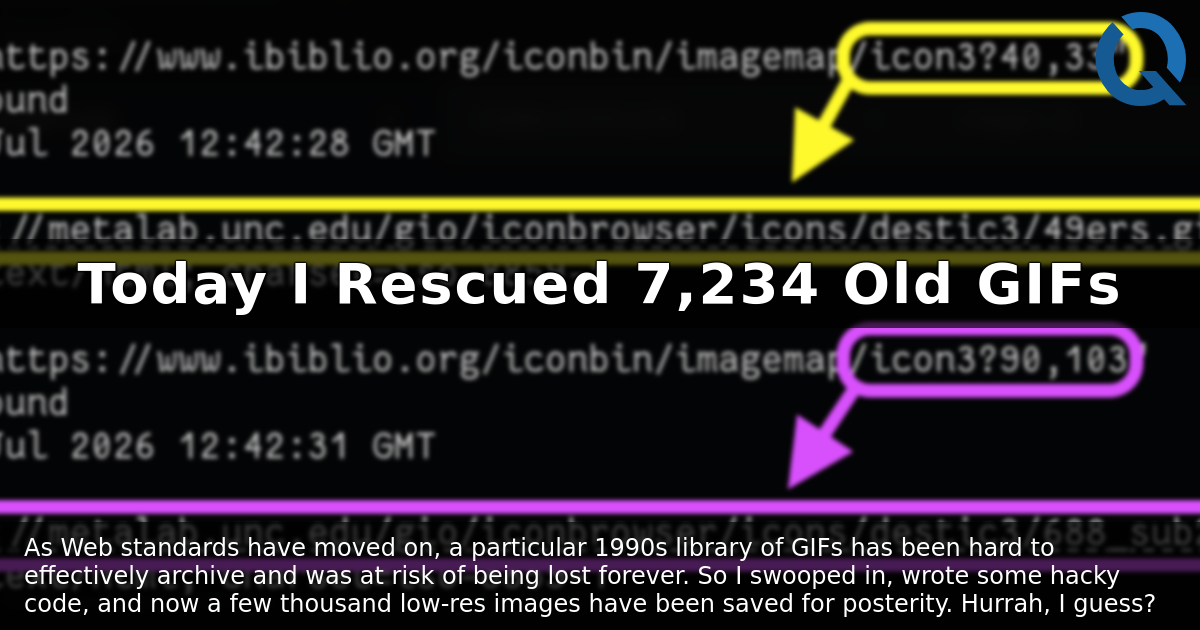
I’ve talked about imagemaps before, but the essence of them is that you define areas of an image that, when clicked, hyperlink to different places. The most-common way of doing these was always client-side imagemaps, where the HTML code itself contained all of the coordinates and, crucially, the resulting destinations. But that’s not what kind of imagemap this is.

 Backing up Spotify - Anna’s Blog
https://annas-archive.li/blog/backing-up-spotify.html
We backed up Spotify (metadata and music files). It’s distributed in bulk torrents (~300TB), grouped by popularity.
This release includes the largest publicly available music metadata database with 256 million tracks and 186 million unique ISRCs.
It’s the world’s first “preservation archive” for music which is fully open (meaning it can easily be mirrored by anyone with enough disk space), with 86 million music files, representing around 99.6% of listens.
 Taking regular screenshots of my website – alexwlchan
https://alexwlchan.net/2024/scheduled-screenshots/
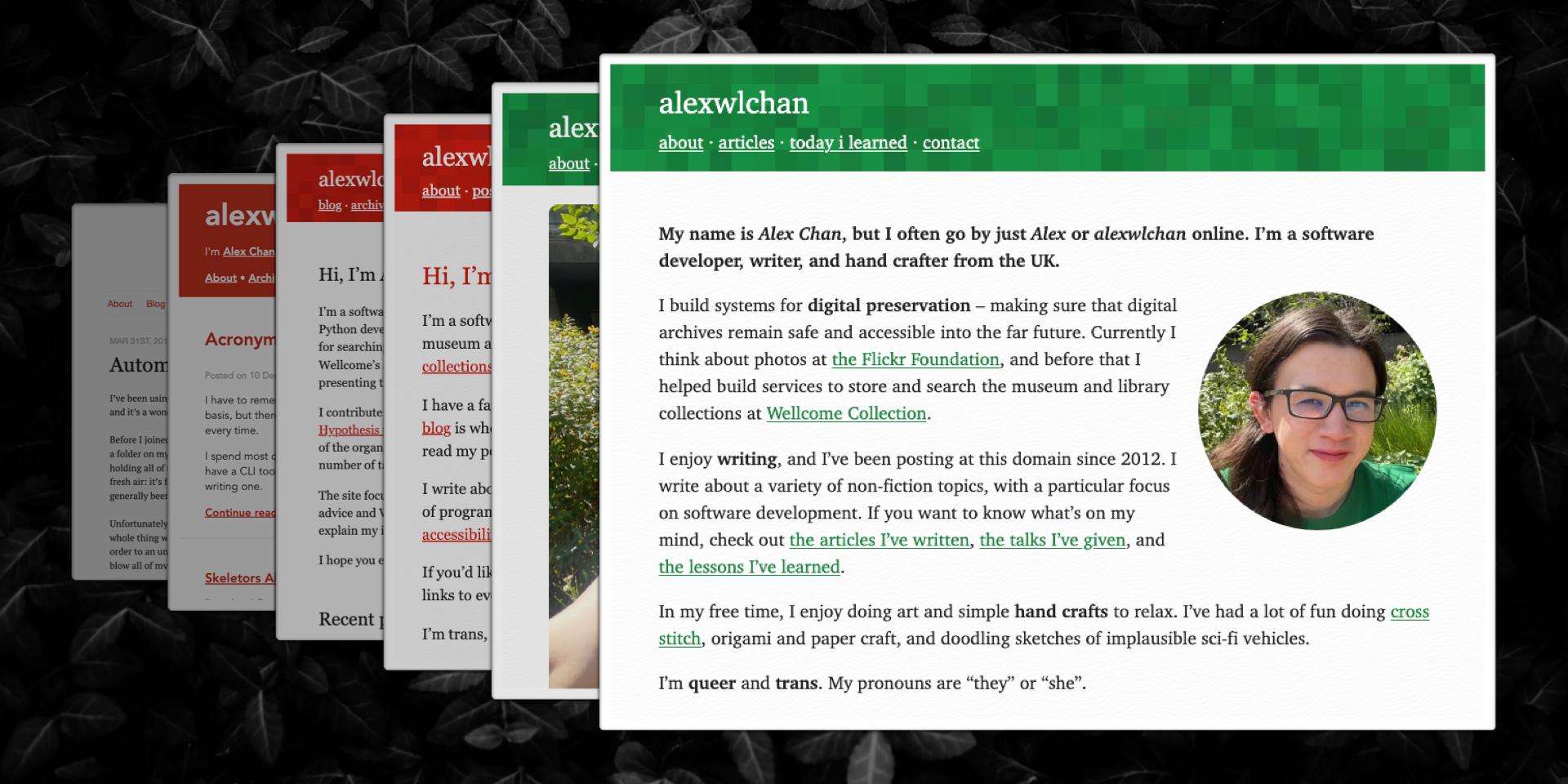
I was mulling over this for a while, and I had an idea. I like having a set of screenshots as a visual history of the stuff I’ve worked on (including this site), but I’m not very good at remembering to create them. I just finished a bunch of design tweaking on this site, and I completely forgot to take a screenshot of what it looked like before I started making changes.
Using static websites for tiny archives – alexwlchan
https://alexwlchan.net/2024/static-websites/
Because this system has no moving parts, and it’s just files on a disk, I hope it will last a long time. I’ve already migrated a lot of my files to this approach, and I’m pleased with how it’s going. I get all the simplicity and portability of a file full of folders, with just a bit of extra functionality sprinkled on top.
 International Center for the History of Electronic Games
http://www.icheg.org
The International Center for the History of Electronic Games® (ICHEG) at The Strong collects, studies, and interprets video games, other electronic games, and related materials and the ways in which electronic games are changing how people play, learn, and connect with each other, including across boundaries of culture and geography.
 MAME 0.151 ROMs : Free Download & Streaming : Internet Archive
https://archive.org/details/MAME_0.151_ROMs
MAME (an acronym of Multiple Arcade Machine Emulator) is an emulator application designed to recreate the hardware of arcade game systems in software on modern personal computers and other platforms. The intention is to preserve gaming history by preventing vintage games from being lost or forgotten. The aim of MAME is to be a reference to the inner workings of the emulated arcade machines; the ability to actually play the games is considered "a nice side effect".
 Yahoo Kills Upcoming, Archive Team Saves the Day | Webmonkey | Wired.com
http://www.webmonkey.com/2013/04/yahoo-shutters-upcoming-archive-team-saves-the-day/
Of course there’s a well known group of people that have made something of an art out of saving disappearing internet data — the Archive Team, headed by computer historian Jason Scott.
Yahoo Kills Upcoming, Archive Team Saves the Day | Webmonkey | Wired.com
http://www.webmonkey.com/2013/04/yahoo-shutters-upcoming-archive-team-saves-the-day
Of course there’s a well known group of people that have made something of an art out of saving disappearing internet data — the Archive Team, headed by computer historian Jason Scott.
 Change Computer History Forever: Well, Here We Are « ASCII by Jason Scott
http://ascii.textfiles.com/archives/3947
This is it, folks. This is the ideal world I’ve heard whispered about, referenced, and planned for a very long time. It’s here. I know you might have expected it to land with an earth-shattering boom but it was a slow and steady flowering on the Internet Archive’s servers. The Archive of Historical Computer Software is here, and it is very, very large.
Blow me away.
 Yahoo! Has Probably Destroyed the Most History, Ever – And Historians Need to Wake Up | Ian Milligan
http://ianmilligan.ca/2013/04/03/yahoo-sucks-historians-wake-up/
This stuff matters. If we want to be the profession that leads the way in understanding and interpreting the past, we should be part of this conversation, or at the very least learn and see how we can help out. I should note here, quickly, that I know there are historians who care. I follow them on Twitter and they’re awesome. But they’re a small minority of the profession, and that needs to change. This doesn’t just affect digital historians, it affects historians. Our very profession.
Yahoo! Has Probably Destroyed the Most History, Ever – And Historians Need to Wake Up | Ian Milligan
http://ianmilligan.ca/2013/04/03/yahoo-sucks-historians-wake-up
This stuff matters. If we want to be the profession that leads the way in understanding and interpreting the past, we should be part of this conversation, or at the very least learn and see how we can help out. I should note here, quickly, that I know there are historians who care. I follow them on Twitter and they’re awesome. But they’re a small minority of the profession, and that needs to change. This doesn’t just affect digital historians, it affects historians. Our very profession.
 Technical books online
http://www.tubebooks.org/technical_books_online.htm
I've found that most of the technical books published before about 1964 never had their copyrights renewed, so now are in the public domain. So I am endeavoring to digitize and post some selected books relating to the "vacuum tube age" of electronics here.
 Archivists' Toolkit | For archivists by archivists
http://www.archiviststoolkit.org/
The Archivists’ Toolkit™, or the AT, is the first open source archival data management system to provide broad, integrated support for the management of archives. It is intended for a wide range of archival repositories. The main goals of the AT are to support archival processing and production of access instruments, promote data standardization, promote efficiency, and lower training costs
Archivists' Toolkit | For archivists by archivists
http://www.archiviststoolkit.org
The Archivists’ Toolkit™, or the AT, is the first open source archival data management system to provide broad, integrated support for the management of archives. It is intended for a wide range of archival repositories. The main goals of the AT are to support archival processing and production of access instruments, promote data standardization, promote efficiency, and lower training costs
 Encoded Archival Description Tag Library - Version 2002 (EAD Official Site, Library of Congress)
http://www.loc.gov/ead/tglib/
Encoded Archival Description Tag Library - Version 2002 (EAD Official Site, Library of Congress)
http://www.loc.gov/ead/tglib
 Will Your Children Inherit Your E-Books? : NPR
http://www.npr.org/2012/06/21/155360197/will-your-children-inherit-your-e-books
What happens to our books when we die? Many books disappear before we do, of course; they fall apart, or we put them out on the stoop for scavengers. A book like this one, however — a text that is still read and reprinted, that has played a notable role in the 20th-century imagination, and then a copy of the text that played an especially interesting role — is likely to be passed down carefully as long as we can preserve and recognize it. Like the Bibles some families use to record their histories, it traces a chain of readers through time.
 Digital Preservation 2012 Meeting, Meetings & Events - Digital Preservation (Library of Congress)
http://www.digitalpreservation.gov/meetings/ndiipp12.html
Digital Preservation 2012 is the annual meeting of the National Digital Information Infrastructure and Preservation Program and the National Digital Stewardship Alliance. DP 2012 brings together the brightest minds exploring solutions to the challenges of stewarding digital content over the long-term. The theme of the meeting is access to digital content under stewardship.
 ArchiveTeam Warrior : Free Download & Streaming : Internet Archive
http://archive.org/details/archiveteam-warrior
The ArchiveTeam Warrior is a virtual archiving appliance. You can run it to help with the ArchiveTeam archiving efforts.
 Archiveteam
http://archiveteam.org/index.php?title=Main_Page
Archive Team is a loose collective of rogue archivists, programmers, writers and loudmouths dedicated to saving our digital heritage. Since 2009 this variant force of nature has caught wind of shutdowns, shutoffs, mergers, and plain old deletions - and done our best to save the history before it's lost forever. Along the way, we've gotten attention, resistance, press and discussion, but most importantly, we've gotten the message out: IT DOESN'T HAVE TO BE THIS WAY.
Wget with WARC output - Archiveteam
http://archiveteam.org/index.php?title=Wget_with_WARC_output
The development version of Wget can write its results to a WARC (Web ARChive file format) file, just like Heritrix and other archiving tools. With the WARC format, it's possible to save both the request and the response headers. It also provides a clean way to store redirects and 404 responses.
 git-annex
http://git-annex.branchable.com/
git-annex allows managing files with git, without checking the file contents into git. While that may seem paradoxical, it is useful when dealing with files larger than git can currently easily handle, whether due to limitations in memory, time, or disk space.
git-annex
http://git-annex.branchable.com
git-annex allows managing files with git, without checking the file contents into git. While that may seem paradoxical, it is useful when dealing with files larger than git can currently easily handle, whether due to limitations in memory, time, or disk space.
 Infovore » A Year of Links
http://infovore.org/archives/2012/02/26/a-year-of-links/
I thought it would be interesting to produce a kind of personal encylopedia: each volume cataloguing the links for a whole year. Given I first used Delicious in 2004, that makes for eight books to date.
Infovore » A Year of Links
http://infovore.org/archives/2012/02/26/a-year-of-links
I thought it would be interesting to produce a kind of personal encylopedia: each volume cataloguing the links for a whole year. Given I first used Delicious in 2004, that makes for eight books to date.
 Internet Archive Atari Donation - a set on Flickr
http://www.flickr.com/photos/textfiles/sets/72157629411540695/with/6913872479/
Internet Archive Atari Donation - a set on Flickr
http://www.flickr.com/photos/textfiles/sets/72157629411540695/with/6913872479
 Overview - Archivematica
http://archivematica.org/wiki/index.php?title=Overview
Archivematica provides an integrated suite of free and open-source tools that allows users to process digital objects from ingest to access in compliance with the ISO-OAIS functional model and other digital preservation standards and best practices. All of the Archivematica code and documentation is released under GPL and Creative Commons open-source licenses.
 BagIt - Wikipedia, the free encyclopedia
http://en.wikipedia.org/wiki/BagIt
BagIt is a hierarchical file packaging format designed to support disk-based storage and network transfer of arbitrary digital content. A "bag" consists of a "payload" (the arbitrary content) and "tags", which are metadata files intended to document the storage and transfer of the bag. A required tag file contains a manifest listing every file in the payload together with its corresponding checksum. The name, BagIt, is inspired by the "enclose and deposit" method [1], sometimes referred to as "bag it and tag it".
 Commodore - Magazines
http://www.bombjack.org/commodore/magazines.htm
"If you can provide any magazines that have not been scanned, please contact me."
 About Us (Open Library)
http://openlibrary.org/about
 kewlchops: A new leaf.
http://george08.blogspot.com/2009/04/new-leaf.html
"I'm very excited about my first day at work tomorrow in my new job at the Internet Archive, here in San Francisco, in the beautiful Presidio. I'll be heading up the Open Library project."
ASCII by Jason Scott / Rob Swindell and the Synchronet Museum
http://ascii.textfiles.com/archives/1697
"One thing that’s important to demarcate for Rob over a lot of my other interviewees was that he was one of the few BBS software authors still actively writing and maintaining his software. In fact, he still maintains it to the present day. Add on top of this that he was originally a commercial developer of the software, closed the business, and then turned his product into a totally free one, and you start to see why his perspective was so cool."
 welcome to the ficlets memorial « the ficlets memorial
http://ficlets.ficly.com
"ficlets is no more. AOL decided to kill the product, but thankfully, since all the content on the site was licensed under Creative Commons, I decided that there's no reason to let the content die. So, consider this the ficlets memorial. I will keep this site up as long as I'm able (it's extremely simple and not costing me anything)."
 Another *nix coder/sysadmin » Drop-down Archives Widget
http://tech.windsofstorm.net/wordpress/drop-archive-widget
"Some themes, such as Kurtina, use a drop-down archive listing. Since I didn’t find a widget to support this, I tossed together a quick replacement."
ASCII by Jason Scott: Flash
http://ascii.textfiles.com/archives/000514.html
"So yeah; if you were wondering if anyone was collecting 4chan (and other) flash animations, I'm your point man. 9,000 of them, totalling over 12gb."
 Posterity | Jeni's Musings
http://www.jenitennison.com/blog/node/59
"here I am using radically different software, in a completely different world, and these pieces from my past are lost, irretrievable because of the formats used to save them (as well as the hardware on which they’re saved: it’s getting harder to read
 The Unarchiver
http://wakaba.c3.cx/s/apps/unarchiver.html
"The Unarchiver is a much more capable replacement for "BOMArchiveHelper.app", the built-in archive unpacker program in Mac OS X."