BuildList.org
https://buildlist.org/#overview
A directory of on-demand manufacturers for your creative projects.
Each site listed has instant quotes / online ordering so you can upload your project files and immediately see how much it will cost and how long i
Gun piano should be illegal - YouTube
https://www.youtube.com/watch?v=yFIxf2gTg_k
Pain is very effective to get sound out of people, so now we just need to tune them
DEC Mini, a lovely 3D-printable retro computer
https://decmini.tin.cat/
A 3D-printable, fully working, customizable computer inspired by one of the loveliest retro computers of the 80s
The DEC Mini: MiSTer Edition - YouTube
https://www.youtube.com/watch?v=KLdEn2B49mk
The DEC Mini builds in a single board computer, to make it a fully functional PC. I’ve modified Lorenzo’s design to accommodate Retro Remake’s MiSTer Pi. In this video, I’ll take you through the end-to-end build of my remix on the DEC Mini.
 Coping strategies for the serial project hoarder
https://simonwillison.net/2022/Nov/26/productivity/#issue-thread
The key trick is to ensure that every project has comprehensive documentation and automated tests. This scales my productivity horizontally, by freeing me up from needing to remember all of the details of all of the different projects I’m working on at the same time.
 Educational LCD Oscilloscope Kit EDU08 Velleman | Jameco
https://www.jameco.com/z/WSEDU08-Velleman-Velleman-Educational-LCD-Oscilloscope-Kit-by-Whadda_2261959.html?trk_msg=4P14JF8AODRKB0OJBNA6UIJB1G&trk_contact=0BK3H3I8ID11QJT0HBNJJVJBV0&trk_sid=91VNO9GBV7OR98IEVRIR9Q0KV0&trk_link=S6SL6TGC5GU4PA79DEKMDI4A64&utm_source=FuckOff&utm_medium=FuckOff&utm_term=FuckOff&utm_campaign=FuckOff&utm_content=FuckOff
Build your own oscilloscope and learn how to visualize signals. See the signals you learn about in real life! Despite the low cost, this oscilloscope has many features only found on expensive units like signal markers, frequency, dB, true RMS readouts, etc. This powerful auto-setup function will get you going in a snap!
 Lowering Expectations, One Project at a Time – Netninja.com
https://netninja.com/2024/08/29/lowering-expectations-one-project-at-a-time/
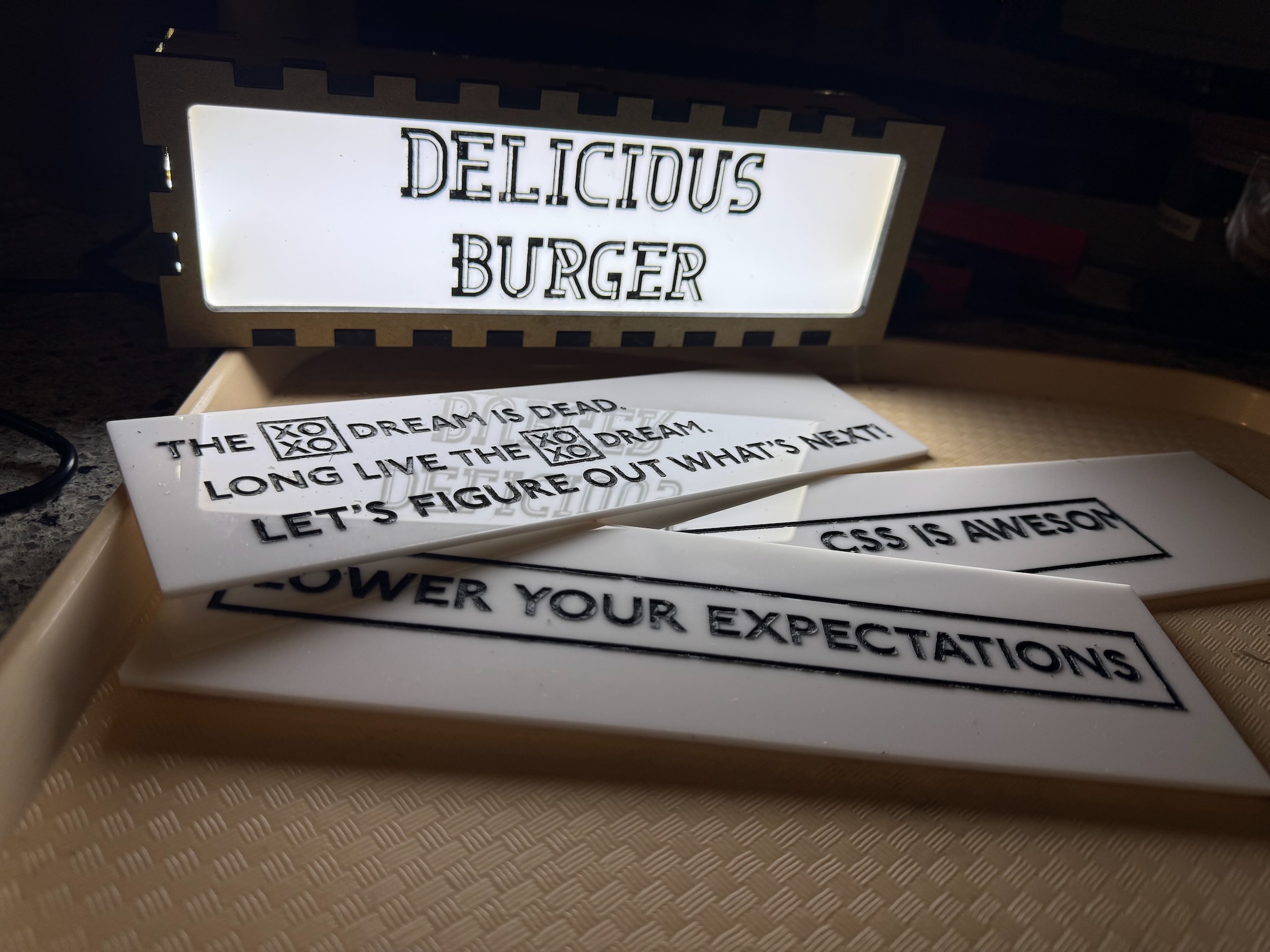
Highlight:At the entrance to the park was a sign that caught my eye. I’m fairly certain I have seen it in previous years, but this year it caught my attention enough to park itself in my brain.
Lower Your Expectations
I thought about that sign all weekend, joked on Slack about how to “win” it after the festival shuts down, and sketched some iterations of a desktop version while waiting for speakers to start. I wanted to be able to slide out the display board, so the toughest part was coming up with a retention mechanism. I did things like this in the past by sandwiching layers, but found tabbed guides to be a better way to achieve that in this form factor.
 Retro Gadgets: The 1974 Breadboard Project | Hackaday
https://hackaday.com/2023/08/29/retro-gadgets-the-1974-breadboard-project/
It is hard to imagine experimenting with electronics without the ubiquitous solderless breadboard. We are sure you have a few within arm’s reach. The little plastic wonders make it easy to throw together a circuit, try it, and then tear it down again. But, surprisingly, breadboards of that type haven’t always been around, and — for a while — they were also an expensive item. Maybe that’s what motivated [R. G. Cooper] to build Slip-n-Clip — his system for quickly building circuits that he published in a 1974 edition of the magazine Elementary Electronics.
Retro Gadgets: The 1974 Breadboard Project | Hackaday
https://hackaday.com/2023/08/29/retro-gadgets-the-1974-breadboard-project
It is hard to imagine experimenting with electronics without the ubiquitous solderless breadboard. We are sure you have a few within arm’s reach. The little plastic wonders make it easy to throw together a circuit, try it, and then tear it down again. But, surprisingly, breadboards of that type haven’t always been around, and — for a while — they were also an expensive item. Maybe that’s what motivated [R. G. Cooper] to build Slip-n-Clip — his system for quickly building circuits that he published in a 1974 edition of the magazine Elementary Electronics.
 Make your own S-Video for your 8-bit card easily and quickly - Atari 8-Bit Computers - AtariAge Forums
http://atariage.com/forums/topic/286982-make-your-own-s-video-for-your-8-bit-card-easily-and-quickly/
Heres how you can make your own top quality S-Video video board for almost any Atari 8 bit. It uses few parts and would take minutes to install.
Make your own S-Video for your 8-bit card easily and quickly - Atari 8-Bit Computers - AtariAge Forums
http://atariage.com/forums/topic/286982-make-your-own-s-video-for-your-8-bit-card-easily-and-quickly
Heres how you can make your own top quality S-Video video board for almost any Atari 8 bit. It uses few parts and would take minutes to install.
 ElectroHarmonograph - i3Detroit
https://www.i3detroit.org/wiki/ElectroHarmonograph
A Harmonograph is 19th-century mechanical device which draws geometric patterns based on the motion of pendulums. (For a real example, see Marie-therese's Maker Faire project - A 3-pendulum Harmonograph. Also, search youtube for videos like this one) By adjusting the physical parameters of the device, and initial conditions of the pendulums, you can vary the patterns it can make.
 BrownFox step by step • deskthority
https://deskthority.net/workshop-f7/brownfox-step-by-step-t6050.html
 » Re-using an LCD screen JeeLabs
http://jeelabs.org/2011/09/05/re-using-an-lcd-screen/
It turns out that there are several ways to get such a thing going again (thank you, Google). I ended up buying a DPMI/VGA interface board on eBay, complete with high-voltage supply and cables. It worked right out of the box:
» Re-using an LCD screen JeeLabs
http://jeelabs.org/2011/09/05/re-using-an-lcd-screen
It turns out that there are several ways to get such a thing going again (thank you, Google). I ended up buying a DPMI/VGA interface board on eBay, complete with high-voltage supply and cables. It worked right out of the box:
 Make Your Own Moleskine-Like-Notebook
http://michaelshannon.us/makeabook/index.html
"Your very own Moleskine-like-notebook/journal/sketchbook. The one we'll be making is 3.5 x 5.5 x .5 inches. I use this size because it fits nicely into my back or front pants pocket. Strangely enough it is also the same size as the Moleskine notebook."
 Carbonating at Home with Improvised Equipment and Soda Fountains
http://www.truetex.com/carbonation.htm
"Carbonating tap water to make seltzer is easy, fast, and absurdly inexpensive with my improvised apparatus. All that is required is to place CO2 (carbon dioxide) gas in agitated contact with chilled water for a few seconds. In this essay, I'll show you how it is done with easy-to-find parts and common PET (polyethylene terephthalate, sometimes called PETE) soda bottles. I'll also explain the kinetic chemistry of why it works so well. And in the second half of this essay, I'll explain how I progressed from this improvised apparatus to installing a complete soda fountain in my home.
"
 Per Vivere [To Live]: Holly Shelf Unit, Batman!
http://blog.simonshea.com/2005/09/holly-shelf-unit-batman.html
"I have always wanted to build a concealed room or have secret trapdoors or similar in a house, well this is my first (very amateur) attempt."
 The Spiral Data Tato -- A Curiously Complex Origami CD Case - The World's Biggest Show & Tell - art, craft, diy
http://www.instructables.com/id/The-Spiral-Data-Tato----A-Curiously-Complex-Origam
"The Spiral Data Tato is an origami CD or DVD case of the origata or tsutsumi ilk, that is, a complicated presentation model, intended as a gift for an honored recipient."
 Mike's Ambient Device
http://www.mcternan.co.uk/MAD
"I wished to use a Tuxgraphics kit to make an Internet connected LED Lamp."
 The Book Bar
http://www.vestaldesign.com/projects/bookbar
"We decided to rescue these books from that awful fate - and what better use for them than a bar from which to entertain our frequent guests?"