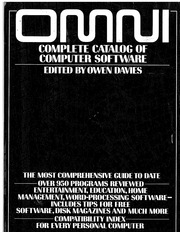
 Omni complete catalog of computer software : Davies, Owen : Free Download, Borrow, and Streaming : Internet Archive
https://archive.org/details/Omni_Complete_Catalog_of_Computer_Software_1984_Omni_Publications_International/
Omni Complete Catalog of Computer Software (1984)(Omni Publications International)
 RC2040 - Retro emulated Z80 CP/M computer kit - Extreme Kits
https://extkits.co.uk/product/rc2040/
The RC2040 is a PI PICO emulated RC2014 kit, with CP/M-80. It is capable of running the stock ROM images currently supported by the RC2014 (except RomWBW) which gives you a number of monitors and ROM based BASIC.
 START A COMPUTER CLUB
https://startacomputer.club/
a computer club is where a group of people hang out and do computer together
 Early Computer Art in the 50’s & 60’s — Amy Goodchild
https://www.amygoodchild.com/blog/computer-art-50s-and-60s
My original vision for this article was to cover the development of computer art from the 50’s to the 90’s, but it turns out there’s an abundance of things without even getting half way through that era. So in this article we’ll look at how Lovelace’s ideas for creativity with a computer first came to life in the 50’s and 60’s, and I’ll cover later decades in future articles.
 <Now Go Bang!> Raster CRT Typography (According to DEC)
https://www.masswerk.at/nowgobang/2019/dec-crt-typography
The time it takes for the phosphor to become fully activated is actually longer than the pulse representing the timing to draw a single pixel (40 nanoseconds). Meaning, if we were to attempt to display just a single pixel, the phosphor on this particular spot will never reach its full activation level resulting in a fuzzy image of varying brightnesses between dimmer, thin strokes and heavier, thick strokes. So the typography has to adjust for this, by streching the pulses to double width (80 ns), at least, in order to provide an even image and legible text and to work around the shallow flanks of the screen intensification.
 Fifty Years of BASIC, the Language That Made Computers Personal | Time
http://time.com/69316/basic/
BASIC wasn’t designed to change the world. “We were thinking only of Dartmouth,” says Kurtz, its surviving co-creator. (Kemeny died in 1992.) “We needed a language that could be ‘taught’ to virtually all students (and faculty) without their having to take a course.”
Fifty Years of BASIC, the Language That Made Computers Personal | Time
http://time.com/69316/basic
BASIC wasn’t designed to change the world. “We were thinking only of Dartmouth,” says Kurtz, its surviving co-creator. (Kemeny died in 1992.) “We needed a language that could be ‘taught’ to virtually all students (and faculty) without their having to take a course.”
 The Man Who Would Teach Machines to Think - James Somers - The Atlantic
http://www.theatlantic.com/magazine/archive/2013/11/the-man-who-would-teach-machines-to-think/309529/
Douglas Hofstadter, the Pulitzer Prize–winning author of Gödel, Escher, Bach, thinks we've lost sight of what artificial intelligence really means. His stubborn quest to replicate the human mind.
The Man Who Would Teach Machines to Think - James Somers - The Atlantic
http://www.theatlantic.com/magazine/archive/2013/11/the-man-who-would-teach-machines-to-think/309529
Douglas Hofstadter, the Pulitzer Prize–winning author of Gödel, Escher, Bach, thinks we've lost sight of what artificial intelligence really means. His stubborn quest to replicate the human mind.
 The Great Principles of Computing » American Scientist
http://www.americanscientist.org/issues/id.10402,y.2010,no.5,content.true,page.1,css.print/issue.aspx
"The great-principles framework reveals a rich set of rules on which all computation is based. These principles interact with the domains of the physical, life and social sciences, as well as with computing technology itself."
 Emoticons and Smileys on PLATO in the 1970s
http://platopeople.com/emoticons.html
"How were these things done? Well, on PLATO, you could press SHIFT-space to move your cursor back one space -- and then if you typed another character, it would appear on top of the existing character. And if you wanted to get real fancy, you could use the MICRO and SUB and SUPER keys on a PLATO keyboard to move up and down one pixel or more -- in effect providing a HUGE array of possible emoticon characters. So if you typed "W" then SHIFT-space then "O" then SHIFT-space then "B", "T", "A", "X", all with SHIFT-spaces in between, all those characters would plot on top of each other, and the result would be the smiley as shown above in the "WOBTAX" example. "
 A trip down memory lane and beyond at Vintage Computer Fest - Ars Technica
http://arstechnica.com/hardware/news/2009/09/a-trip-down-memory-lane-and-beyond-at-vintage-computer-fest.ars
"A photo essay featuring some hardware you may remember, some you may have only heard of, and a few things that you were probably never aware existed. One thing we learned: the older a computer is, the more likely it is to be blue."
 Why the Arduino Matters - Ideas For Dozens
http://www.urbanhonking.com/ideasfordozens/2009/05/why_the_arduino_matters.html